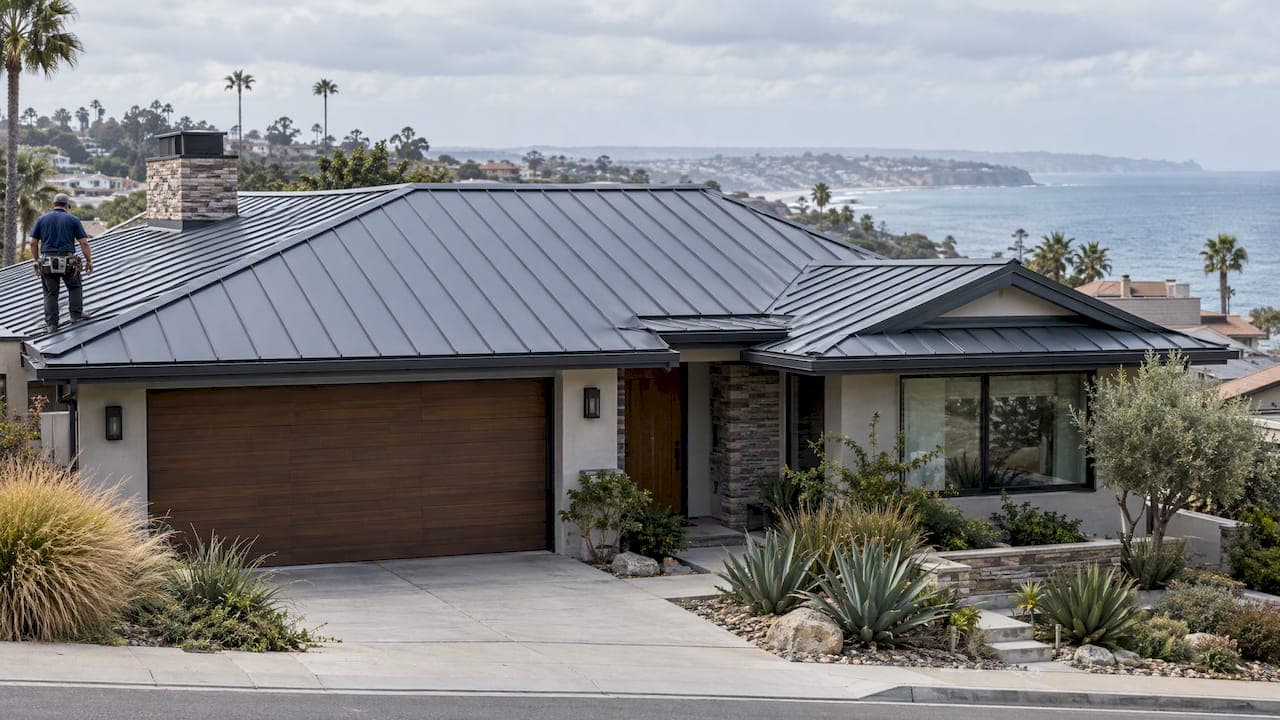
For coastal roofing, choose aluminum, Type 316 stainless, or a coastal-rated coated steel system such as COASTALUME with a PVDF or Tedlar finish, and pair it with stainless steel fasteners (Type 316 in harsh exposures) or heavy hot-dip galvanized G185+ hardware if stainless is not used. Rinse salt buildup regularly and confirm your finish and warranty terms cover coastal exposure before you sign anything.
TL;DR:
- Stainless steel fasteners, coated steel systems, or aluminum with coastal-rated finishes are essential for durability in salt-air environments, especially within a mile of the coast.
- PVDF, fluoropolymer, and Tedlar-backed coatings with increased film thickness provide the best protection against UV, salt spray, and chalking for coastal roofs.
- The fastest failure in coastal roofs typically occurs at hardware connections, making stainless steel or heavy galvanization critical for fasteners and connectors.
- Proper wind rating documentation, profile selection, and installation details like tighter edge clip spacing influence the roof’s ability to withstand coastal wind and salt exposure.
- Regular rinsing with fresh water and inspections after storms are vital to maintain warranty coverage and prolong roof lifespan in salty environments.
Table of Contents
- Which metal types hold up best near salt water
- What coatings actually protect against salt spray
- Why fasteners and connectors fail before the panels do
- What wind ratings and approvals mean for your roof
- Panel profiles and installation details that matter
- Keeping a coastal roof and its warranty intact
- How experienced coastal roofers apply these specs
- Designing for humidity, condensation, and ventilation
- What coastal metal roofing actually costs to own
- Sustainability of metal roofing in salt-air environments
- Examples of coastal metal roofing done right
- What I tell homeowners before they sign a contract
- Get a coastal-ready metal roof built to spec
- Standards and guidance worth reviewing
- Sources
- FAQ
Which metal types hold up best near salt water
Salt air does not treat every metal the same way, and the right choice depends on how close your roof sits to open water. Aluminum resists corrosion naturally because it forms a stable oxide layer, and it does not rust the way steel does, which makes it a common pick for homes within a mile or two of the coast. It costs less than stainless or copper, though painted aluminum finishes still need the right coating to avoid chalking in constant UV and salt exposure.
Stainless steel goes a step further for homes closer to breaking surf. Type 304 and Type 316 stainless both resist corrosion well, but Type 316 contains molybdenum, which gives it better resistance to chloride pitting. That makes 316 the preferred grade when a property sits close enough to catch direct salt spray.
Coated steel systems, including GALVALUME and galvanized steel with coastal-grade finishes, offer a middle path: strong performance at a lower cost than stainless, provided the coating is rated for marine exposure. COASTALUME from U. S. Steel pairs a GALVALUME substrate with a Tedlar-backed finish built specifically for salt spray resistance, an option worth asking about by name when you request bids.
Copper and zinc sit at the premium end. Both develop a protective patina over decades of exposure and can outlast most other roofing metals, but the material cost and labor for custom fabrication run higher than steel or aluminum systems.
- Aluminum: strong natural corrosion resistance, lower cost, good for moderate coastal distances.
- Stainless steel (316 preferred near surf): the toughest standard option against chloride pitting.
- Coated steel (GALVALUME or galvanized with coastal finish): budget-friendly with strong performance when properly coated.
- Copper and zinc: decades-long lifespan and a changing patina, at a higher upfront price.
As a rule of thumb, the closer your roof sits to breaking surf, the more the material choice should lean toward stainless steel or a coastal-specific coated system rather than standard steel.
What coatings actually protect against salt spray
The base metal matters, but the finish on top of it often determines how long a coastal roof actually looks good and keeps its warranty intact. PVDF and fluoropolymer coatings are formulated to resist ultraviolet breakdown, chalking, and the chemical effects of salt spray, which is why they show up repeatedly in manufacturer literature for coastal-grade products. Ordinary polyester finishes fade and chalk faster in the same conditions.
Tedlar film, used as a backing layer in some coastal coil coating systems, adds another layer of chemical and color-retention performance. COASTALUME’s Tedlar-backed finish is one example of how manufacturers combine a corrosion-resistant substrate with a film designed to hold its color and resist salt exposure over time.
Finish thickness matters too. Manufacturers often specify a two-coat coastal system with a higher dry film thickness than standard inland products, because a thin coat wears through faster in constant salt air. Industry guidance on coastal metal roofing notes that within close range of the coastline, special paint formulations and increased film thickness are often required, and skipping that requirement can void the finish warranty entirely.
- PVDF and fluoropolymer coatings resist UV breakdown, chalking, and salt-driven degradation.
- Tedlar-backed systems add extra color retention and chemical resistance in coastal coil coatings.
- Two-coat coastal systems with higher film thickness are standard on manufacturer coastal product lines.
COASTALUME’s coastal system carries substrate and finish protection terms that run for decades on products built specifically for salt spray exposure, a meaningful difference from standard coated steel warranties.
Why fasteners and connectors fail before the panels do
The panels rarely fail first in a coastal metal roof. FEMA’s technical bulletin on corrosion protection for connectors and fasteners points out that corrosion rates for metal connectors and fasteners run dramatically higher in coastal environments than inland, and that connections are commonly where load-path failures start during high-wind events. A roof can have a premium panel system and still fail structurally if the hardware holding it down corrodes first.
FEMA recommends stainless steel or heavy hot-dip galvanized hardware rated G185 or higher for coastal exposures. Here is how to apply that guidance during procurement:
- Specify stainless steel fasteners and connectors, Type 316 where the property sits close to breaking surf or in a heavy salt-spray zone.
- Use Type 304 stainless as a minimum in less severe coastal exposures where 316 is not specified by the manufacturer.
- Require hot-dip galvanized hardware rated G185 or higher only when stainless is not used, and confirm the rating in writing.
- Avoid pairing dissimilar metals directly, since contact between certain metal types accelerates galvanic corrosion at the connection point.
- Confirm that fasteners are sealed at every penetration and inspected on a set schedule rather than left unchecked for years.
Pro Tip: Ask your contractor to put the exact fastener grade and spec in writing on the contract, not just “stainless steel” as a general term.
What wind ratings and approvals mean for your roof
Wind performance documentation is not paperwork you can skip in a coastal purchase. Approvals like a Notice of Acceptance (NOA), Texas Department of Insurance (TDI) approval, and FM Global ratings all indicate that a roofing product has been tested under defined wind uplift and impact conditions, and many coastal counties require proof of one or more of these before permitting a roof installation.
Profile choice affects what rating a product can actually achieve. Standing seam systems, which conceal fasteners under raised seams, generally test to higher wind uplift values than through-fastened panels, because through-fastened systems rely on exposed screws that loosen or back out under repeated wind cycling.
Requirements also scale with proximity to open water. A property directly on the coast in a high-wind county often faces stricter approval requirements than a similar home ten miles inland, even within the same state.
- Ask for documented wind uplift test values, not just a general wind rating claim.
- Request a copy of the product’s NOA or TDI approval if your jurisdiction requires one.
- Confirm whether FM Global approval applies to the specific product and profile being installed.
- Verify that the approval documentation matches the exact panel profile and fastening pattern going on your roof, not a different product in the same line.
Panel profiles and installation details that matter
Profile and installation details often make a bigger difference in coastal performance than the base metal choice alone. Standing seam and snap-lock profiles conceal fasteners beneath interlocking seams, which limits the number of exposed penetrations where water or salt spray can work its way in over time. Through-fastened panels, by contrast, rely on exposed screws through the panel face, and each one is a potential entry point for moisture and a site for coastal corrosion.
Edge, rake, and eave details deserve particular attention in wind-driven rain and salt spray conditions, since these are the areas most exposed to wind uplift forces. Clip spacing and attachment patterns at these edges often need to be tighter than in the field of the roof to hold up under coastal wind loads.
Wider, custom-fabricated snap-lock panels can reduce the total number of seams on a roof, which in turn reduces the number of potential leak points across the whole system.
- Standing seam and snap-lock profiles reduce exposed fasteners compared to through-fastened systems.
- Edge, rake, and eave zones typically need tighter clip spacing to resist wind uplift.
- Fewer, wider panels mean fewer seams and fewer potential leak points.
- Roof-integrated solar racking should use corrosion-resistant materials and isolate dissimilar metals from the panel surface to limit galvanic corrosion risk, a point the Department of Energy’s guidance on solar PV corrosion raises specifically for marine environments.
Keeping a coastal roof and its warranty intact
Salt residue does not wash itself off, and letting it sit is one of the fastest ways to shorten the life of a coastal roof’s finish and hardware.
- Rinse roof panels with fresh water on a regular schedule, more often in homes closer to breaking surf where salt deposits build up faster.
- Inspect fasteners, sealants, and flashings after every major storm, since wind-driven rain and debris can loosen hardware or damage coatings you would not otherwise notice.
- Handle routine rinsing and visual inspection yourself, but call a contractor for any sign of a lifted panel, a failed sealant joint, or visible fastener corrosion.
- Keep a record of rinsing and inspection dates, since manufacturers often tie coastal finish warranties to documented maintenance, and a missing maintenance history can complicate a claim.
Regular maintenance and inspection catches small hardware problems before they become structural ones, and it is far cheaper than a repair after storm damage sets in.
How experienced coastal roofers apply these specs
Specification knowledge only matters if it shows up in how a roof actually gets built. SW Metal Roofing fabricates custom standing seam metal roofs with precision craftsmanship in San Diego, including an 18-inch snap-lock profile built specifically for coastal wind and salt exposure. That wide-panel approach reduces the number of seams and fasteners on a roof, a direct application of the profile guidance above.
The company also integrates solar panel installation with roofing work, which matters for the galvanic corrosion risks that come with adding racking to a coastal roof. Every installation is backed by a lifetime leak-free warranty, a commitment that only holds up when the underlying fastener and finish specs are right in the first place.
Designing for humidity, condensation, and ventilation
Coastal air carries more moisture than inland air, and that humidity changes how a roof assembly needs to be designed underneath the metal. Without adequate ventilation, warm moist air trapped in an attic or roof cavity can condense on the underside of metal panels, leading to corrosion from the inside out rather than from weather exposure on top.

Proper ridge and soffit ventilation lets that moist air escape before it condenses, and it is especially important on coastal roofs where the ambient humidity is already higher than average. Insulation placement matters just as much: insulation that allows warm interior air to reach the cold underside of a metal panel on a cool coastal night creates the exact temperature differential that causes condensation.
A vented or vapor-controlled underlayment system between the insulation and the panel helps manage that moisture path. UV exposure adds a separate stress on exterior finishes, accelerating the breakdown of lower-grade coatings faster near the coast than inland, which is part of why coastal-rated finishes specify higher film thickness in the first place.
Getting the ventilation and insulation design right at installation is far cheaper than dealing with hidden corrosion or mold years later, and it is not a detail that should be left out of a coastal roofing bid.
What coastal metal roofing actually costs to own
Coastal metal roofing costs more upfront than standard inland installations, largely because of the premium materials involved. Stainless steel fasteners, coastal-grade coil coatings, and heavier-gauge hot-dip galvanized hardware all cost more than their standard counterparts, and a full metal roof replacement runs $40,000 to $60,000 depending on the scope and materials chosen.
The premium buys real protection: coastal-rated finishes and stainless hardware reduce the frequency and cost of repairs over the life of the roof, since ordinary coatings and fasteners degrade faster in salt air and need earlier replacement. Budgeting for a coastal roof should account for both the upfront material premium and an ongoing, modest maintenance cost, primarily the labor for periodic rinsing and post-storm inspections rather than major repair work.
Skipping the coastal-grade finish or fastener spec to save money upfront often costs more over time, since a voided warranty or an early hardware failure can mean paying for a full repair or finish replacement years before it should have been necessary. Getting a firm cost estimate based on your specific material and profile choices is the clearest way to budget accurately before committing to a project.
Sustainability of metal roofing in salt-air environments
Metal roofing has a longer service life than asphalt shingles in most environments, and that longevity is itself a sustainability advantage: fewer roof replacements over a building’s life means less material going to landfill. In coastal settings specifically, choosing the right metal and finish the first time extends that lifespan further, since a roof that needs early repair or replacement due to corrosion loses much of that environmental advantage.
Metal roofing is also widely recyclable at the end of its service life, unlike asphalt shingles, which typically cannot be recycled through standard municipal systems. For a coastal homeowner, that means the sustainability case for metal roofing depends heavily on getting the corrosion-resistant spec right at installation, since a roof that fails early from salt-driven corrosion undermines both the cost and environmental case for choosing metal in the first place.
Reflective coastal coatings can also reduce cooling loads in sun-exposed coastal climates, adding an energy efficiency benefit on top of the material’s durability, though the specific benefit depends on the coating’s reflectivity rating and the building’s insulation and ventilation design.
Examples of coastal metal roofing done right
The clearest examples of coastal metal roofing succeeding are the ones where the material, fastener, and finish specs matched the exposure level from day one. A coastal property fitted with a wide-panel snap-lock system, stainless steel fasteners, and a coastal-rated PVDF or Tedlar finish is built to shed wind-driven rain, resist salt spray on the panel surface, and keep its load path intact at every connection point.
SW Metal Roofing’s project gallery shows the practical result of that approach across San Diego area homes, where custom-fabricated standing seam roofs are paired with the company’s lifetime leak-free warranty. The common thread across successful coastal installations is not a single product, but the combination: the right base metal for the distance from the water, a finish rated for that exposure, and hardware specified to match, rather than any one of those choices made in isolation.
What I tell homeowners before they sign a contract
Prioritize the hardware and finish specs over the lowest bid. A roof with premium panels and cheap fasteners will fail at the connections long before the panels wear out, and that is the failure mode that actually costs homeowners money.
Before signing, ask your contractor these questions: What fastener material and grade are you specifying, and is it 316 stainless or G185+ galvanized? What is the dry film thickness on the coating, and is it a coastal-rated system? What documented wind uplift testing backs this product and profile? What exactly does the warranty cover, and does it require a maintenance record?
The cheapest bid upfront is rarely the cheapest roof over 20 years.
— Marcus
Get a coastal-ready metal roof built to spec
A specialized roofer fabricates standing seam and snap-lock panels to specifications suitable for coastal properties, with corrosion-resistant hardware, coastal-rated finishes, and a lifetime leak-free warranty on installations. Solar integration is offered alongside roofing work to help manage coordination on projects where galvanic corrosion between systems is a risk.
Before requesting an estimate, have photos of your current roof, your roof dimensions, and any recent storm history ready, since these details help scope the fastener grade and finish needed for your exposure level.
- Review standing seam options built around the custom snap-lock profile.
Standards and guidance worth reviewing
For deeper technical detail, review FEMA’s technical bulletin on connector and fastener corrosion protection, the Department of Energy’s guidance on solar PV corrosion management, and for proximity-specific specs, this guide to coastal metal roofing within 1,500 feet of the water. For galvanic corrosion prevention in mixed-metal systems, see this technical note on dissimilar metals and area ratios.
Sources
- Corrosion protection for metal connectors and fasteners in coastal areas (FEMA technical bulletin)
- Metal roofing considerations for coastal areas (MBCI blog)
- COASTALUME™ coastal steel (U. S. Steel)
- Managing and mitigating solar PV corrosion (Department of Energy)
FAQ
What type of metal roofing is best for coastal areas?
Aluminum, Type 316 stainless steel, or a coastal-rated coated steel system with a PVDF or Tedlar finish, such as COASTALUME, perform best in salt-air environments. The closer a property sits to breaking surf, the more the choice should lean toward stainless steel or a specifically coastal-rated coated system rather than standard galvanized steel.
What is the average price for a 3 ft by 10 ft metal roof?
Published pricing for metal roofing is typically quoted by full project scope rather than by a small fixed panel area, since material, profile, and labor costs vary by project. For an accurate figure on a specific job, a direct cost estimate based on your roof’s dimensions and material choice is the most reliable source.
What is the biggest problem with metal roofs?
The most common long-term failure point on a coastal metal roof is not the panels themselves but the fasteners and connectors, which corrode at significantly higher rates in coastal environments than inland. Specifying stainless steel or heavy hot-dip galvanized hardware rated G185 or higher addresses this directly.
How much is a 2000 sq ft metal roof?
Pricing depends heavily on the metal type, profile, and coastal-grade finish selected, along with the complexity of the roof. A full metal roof replacement runs $40,000 to $60,000 depending on scope and materials, and a project-specific quote is the most accurate way to budget.
Do coastal metal roofs need special maintenance?
Yes, coastal metal roofs benefit from regular freshwater rinsing to remove salt deposits and periodic inspection of fasteners, sealants, and flashings, especially after storms. Manufacturers often tie coastal finish warranties to documented maintenance, so keeping records of rinsing and inspections matters for any future warranty claim.