
A metal roof warranty is not one promise. It is a bundle of separate ones: the metal itself, the paint, the roof’s ability to keep water out, and the installer’s workmanship, each with its own term, conditions and exclusions. The strongest protection for a homeowner is a leak-free warranty from the team that installs the roof, backed by panels built for your climate. That is how we write ours in San Diego, where salt air decides whether a manufacturer’s paperwork is worth anything.
TL;DR
- A metal roof has up to four warranty layers: material (substrate), paint finish, weathertightness (leaks) and workmanship. Workmanship is often excluded from the manufacturer’s paper and has to come from the installer.
- “Lifetime” rarely means forever. It usually follows the original owner and often comes with prorated benefits or a short window of full coverage.
- Some manufacturer warranties exclude installations within 1,000 to 1,500 feet of salt water, which covers much of coastal San Diego.
- Transfers to a new owner are usually allowed once, with written notice and a deadline, and coverage can shrink when the home sells.
- Read the exclusions, maintenance duties and registration deadlines before you sign, not after a leak.
Table of Contents
- The four layers of a metal roof warranty
- What “lifetime” actually means
- Leak coverage: what is excluded
- Maintenance can be a warranty condition
- Registration, payment and paperwork deadlines
- Can you transfer a metal roof warranty?
- Warranties and solar panels
- Multi-unit buildings and contractors
- A checklist before you sign
- Our perspective
- Get a warranty you can rely on
- FAQ
- Sources
The four layers of a metal roof warranty
When a contractor says a roof is “fully warrantied,” ask which layer they mean. Metal panel warranties typically cover the steel or aluminum base and the durability and color fastness of the paint, and may add coverage of the full panel. Standard workmanship coverage is generally excluded from them but may be available as an add-on.
| Layer | What it protects against | Who usually issues it |
|---|---|---|
| Material (substrate) | Rust-through or perforation of the steel or aluminum caused by a material defect | Panel or coil manufacturer |
| Paint finish | Chipping, peeling, cracking, excessive fading or chalking of the coating | Panel or paint manufacturer |
| Weathertightness | Leaks through the roof system when installed to the maker’s specifications | Manufacturer, sometimes with installer sign-off |
| Workmanship | Mistakes in installation: fastening, flashing, sealing, panel layout | The installer |
The last row matters most to a homeowner. Most real-world metal roof leaks do not come from the metal failing. They come from flashings, penetrations, fasteners and seams, which are installation work. A product warranty that excludes improper fastening or application will not help when the problem is how the roof went on. A single manufacturer warranty can also contain several provisions rather than one blanket promise: for example, one published manufacturer warranty treats manufacturing defects, wind and finish separately.
Material warranties
This layer deals with the base metal. A sample coil warranty for products purchased on or after August 3, 2026, provides 25 years from installation against rust perforation caused by material defects. Note the wording: it covers perforation, meaning a hole, and only when the cause is a defect in the material. Cosmetic rust, scratches and damage from the environment are different questions.
Paint warranties
Paint warranties usually carry the big headline numbers, such as 30 or 40 years, but those years are often split by problem. In one widely read breakdown, chipping, cracking, peeling and flaking are protected for 40 years, while chalking and fading are covered for 30. Look at which defect gets which term and how much fading counts as a defect.
Weathertightness and leak warranties
A weathertightness warranty is the one most homeowners actually want: it says the roof will not leak. These are often sold in terms such as 5, 10 or 15 years for standard coverage, and longer terms usually come with stricter installation requirements. A manufacturer’s leak coverage typically applies to leaks caused by a manufacturing defect, not leaks from storm damage, ice damming or faulty fastening. If your goal is “no leaks, whatever the cause within the roof system,” you need the installer to stand behind the roof in writing.
What “lifetime” actually means
Lifetime roof warranties are popular and widely misunderstood. The word does not describe the life of the roof. It describes the life of the coverage, and the coverage is usually tied to a person.
In one published manufacturer warranty, manufacturing-defect coverage on certain components is listed as lifetime with 15 years of non-prorated coverage. “Lifetime” there generally means as long as the original owner owns the property, or the second owner if coverage was properly transferred within the first 20 years.
Prorating is the other piece. In asphalt shingle warranties, for example, “lifetime” does not mean a free new roof after 40 years: benefits may be prorated after an initial full-replacement period. The same overview notes that some remedies are based on the value of replacement materials rather than a promise to pay every associated cost, such as labor, tear-off and disposal.
A simple worked example shows why this matters. Suppose a warranty pays the full cost of materials for 15 years, then declines each year after. In year 25, you may be owed a fraction of the material price, and nothing for labor. On a replacement in the $40,000 to $60,000 range that we publish for metal roof replacement in San Diego, the labor and tear-off are a large share of the bill, so a materials-only remedy can leave a big gap.
Questions to ask about any lifetime promise:
- Whose lifetime: original owner, or the roof?
- Is there a non-prorated period, and how long is it?
- Does the remedy cover labor, tear-off and disposal, or materials only?
- Who pays when the problem is found: manufacturer, installer, or both?
Leak coverage: what is excluded
The exclusions section is where most claims are decided. Common exclusions across published metal roof warranties include improper fastening or application, acts of nature, ice damming and installation in a corrosive environment. One manufacturer warranty sets that corrosive environment at within 1,500 feet of seacoast, salt water or brackish water. A sample coil warranty excludes applications within 1,000 feet of salt water or marine environments.

Those distances matter in San Diego. Much of Point Loma, Ocean Beach, Pacific Beach, La Jolla, Coronado, Mission Beach and the bay-side neighborhoods sit inside them. A homeowner can buy a roof with an impressive headline warranty and find the coastal exclusion on page three. How exposure to marine air interacts with panel eligibility is covered in more depth in this piece on heavy-duty engineering standards.
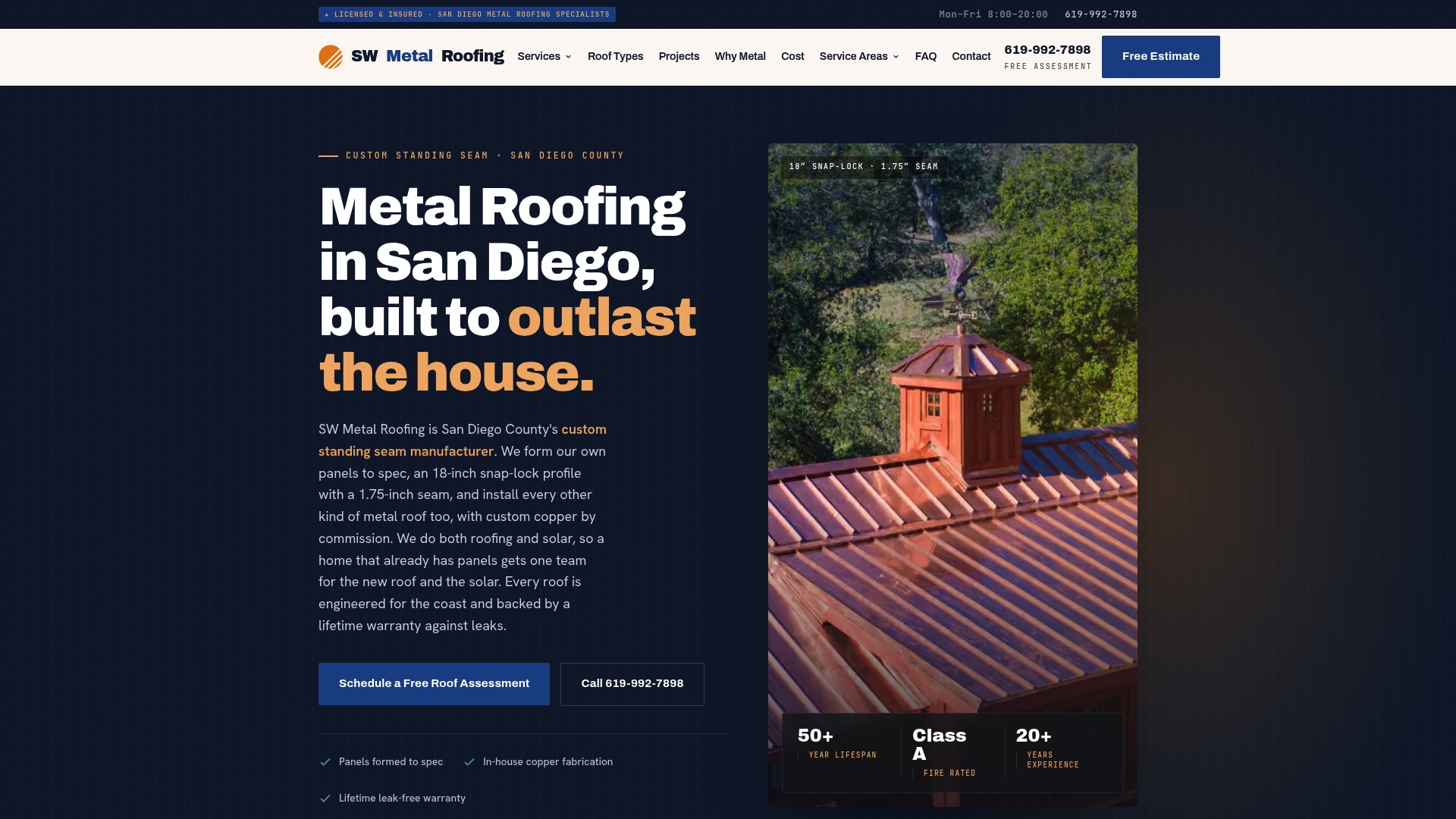
This is the reason we fabricate an 18-inch snap-lock standing seam profile designed specifically for coastal wind and salt air, and why our warranty is a lifetime leak-free warranty on the work rather than a pass-through of someone else’s exclusions. If you live near the water, read our guides on metal roofs and coastal salt air in San Diego and on coastal metal roofing specs before you compare quotes.
Maintenance can be a warranty condition
Many owners assume a metal roof needs nothing. Warranties often say otherwise. A sample coil warranty calls for regular washing with clean water or mild detergent, followed by rinsing, which makes maintenance an explicit condition of coverage. Salt deposits, leaf debris and trapped moisture under gutters or solar mounts are what a coastal roof needs cleared.
Practical habits that protect coverage:
- Rinse the roof with clean water on a schedule that suits your distance from the ocean.
- Avoid harsh cleaners and pressure washing, which can damage the finish. Our guide on cleaning a metal roof and what voids your warranty lists what to avoid.
- Keep dated photos and receipts for every service.
- Have the roof inspected on a regular schedule. Our maintenance and inspection service produces a record you can hold on to if you ever make a claim.
Registration, payment and paperwork deadlines
Warranties can be lost before the roof is finished. The sample coil warranty above requires registration within 45 days and full payment. Miss the window or withhold a final payment during a dispute, and coverage can fail to attach.
Before the work starts, get these in writing:
- The warranty documents for every layer: material, paint, leak and workmanship.
- The registration deadline and who files the registration.
- Any required product combinations: panels, underlayment, fasteners, sealants and flashing.
- The exclusions list, read against your address and your roof’s features such as skylights, chimneys and solar mounts.
Can you transfer a metal roof warranty?
Often yes, but with strings. The published manufacturer example allows one transfer, with written notice within one year. A transfer during the early protection period gives the second owner the same coverage, while a later transfer reduces coverage to two years after the ownership change.
If you may sell in the next decade, a transferable warranty is a selling point. Check:
- How many transfers are allowed (usually one).
- The deadline for notice after the sale.
- Whether a fee applies.
- Whether coverage drops for the new owner.
Keep the paperwork where you will find it at closing. A buyer’s agent and inspector will ask for it, and a dated maintenance record makes the transfer easier to stand behind.
Warranties and solar panels
Solar is where warranties collide. Penetrations for mounts and rails are a classic leak point, and a roofer and a solar installer can each blame the other when water gets in. That is why coordination matters: one party should be accountable for the roof penetrations, and the roof warranty should state clearly that solar mounting was part of the scope.
Before signing any solar contract on a metal roof, ask:
- Will the solar mounting method be installed by the roofer or by a separate crew?
- Does the roof warranty remain in force after penetrations or clamp-on attachments?
- Who pays to remove and reinstall panels if the roof needs repair later?
Because we handle roofing and solar panel integration as one service, clients deal with a single team instead of managing two contractors and two sets of paperwork. Our guide to solar panels on a metal roof walks through the mounting questions in more detail. Roofing first, then solar, in a single plan, is the cleanest path.
Multi-unit buildings and contractors
Property managers and contractors face the same layers at larger scale. Warranty terms on commercial and multi-unit roofs often depend on the roof system, the installer and the maintenance routine, and a missed inspection on one building can compromise coverage on that building only if the paperwork is clear. Put the roof’s warranty, its inspection schedule and the responsible party into one file for each building. Our commercial metal roofing work covers multi-unit properties, and every installation is carried out by our own crew rather than subcontractors.
A checklist before you sign
- Which of the four layers are included, and who issues each?
- What is the term of each, and what does “lifetime” mean in this document?
- Is any period non-prorated, and does the remedy cover labor?
- What is excluded: fastening errors, storms, ice, corrosive environments, coastal distance?
- What maintenance is required, and how do you prove it?
- When must registration be filed and by whom?
- Is the warranty transferable, how many times, and with what notice?
- If solar is planned, is it covered in the same warranty scope?
- Does the installer do the work or hire it out?
Our perspective
Most warranty disappointments we hear about are not about metal failing. They are about the gap between what a homeowner thought was covered and what the documents say. A headline number looks great, then the exclusions, the proration and the coastal distance rule show up later.
That is why we build around the problem instead of around the paperwork. Our panels are custom fabricated to spec, including an 18-inch snap-lock profile made for San Diego wind and salt air. Our crews install the roof themselves, with no subcontracting, because a leak-free promise only means something when the people who made the promise did the work. When solar is part of the project, one team handles both, so no one can point at someone else when a mount needs attention.
Our lifetime leak-free warranty is meant to be simple to understand and simple to rely on. If you are comparing roofs, compare who will be standing behind the work in year 15, not only the number on the brochure.
Marcus
Get a warranty you can rely on
If you are planning a metal roof in San Diego, a replacement, a repair or a new roof with solar, we will walk you through the warranty layers for your address and roof type. Our metal roof replacement projects are published at $40,000 to $60,000 as a one-off price, and each one comes with our lifetime leak-free warranty. See the metal roof replacement page for details, or start from our main site.
If you already have a metal roof and want to keep your coverage healthy, book a maintenance and inspection visit. If you have a leak right now, our metal roof repair service is the place to start.
FAQ
How long is the warranty on a metal roof?
It depends on the layer. Paint warranties often run 30 to 40 years, material warranties commonly run 25 years or more, and standard weathertightness coverage is often sold in terms of 5, 10 or 15 years. Workmanship coverage comes from the installer, so its length is whatever the installer writes down.
Is a lifetime roof warranty really for life?
No. It usually lasts as long as the original owner owns the home, and benefits can be prorated after an initial full-coverage period. Ask what the non-prorated period is and whether labor is included in the remedy.
Does a metal roof warranty cover leaks?
Only the leaks the document names. Manufacturer leak coverage typically addresses manufacturing defects and excludes improper fastening, storms, ice damming and corrosive coastal locations. A leak-free warranty from the installer, like ours, is what covers the installation side.
Can I transfer my metal roof warranty when I sell?
Often once, with written notice within a set deadline. In the published example, a later transfer reduced coverage to two years after the change of ownership, so check the terms and keep your records.
Does cleaning my roof affect the warranty?
It can. Some warranties require regular washing with clean water or mild detergent, and harsh cleaning methods can damage a finish. Follow the written instructions and keep a record of each service.
Sources
- Exploring Warranties in Roofing, Roofing Contractor
- Limited warranty document for a metal shingle roofing system, installed after January 2025
- Sample 25-year perforation warranty for coated steel coil
- Built for the Extremes: Heavy-Duty Engineering Standard