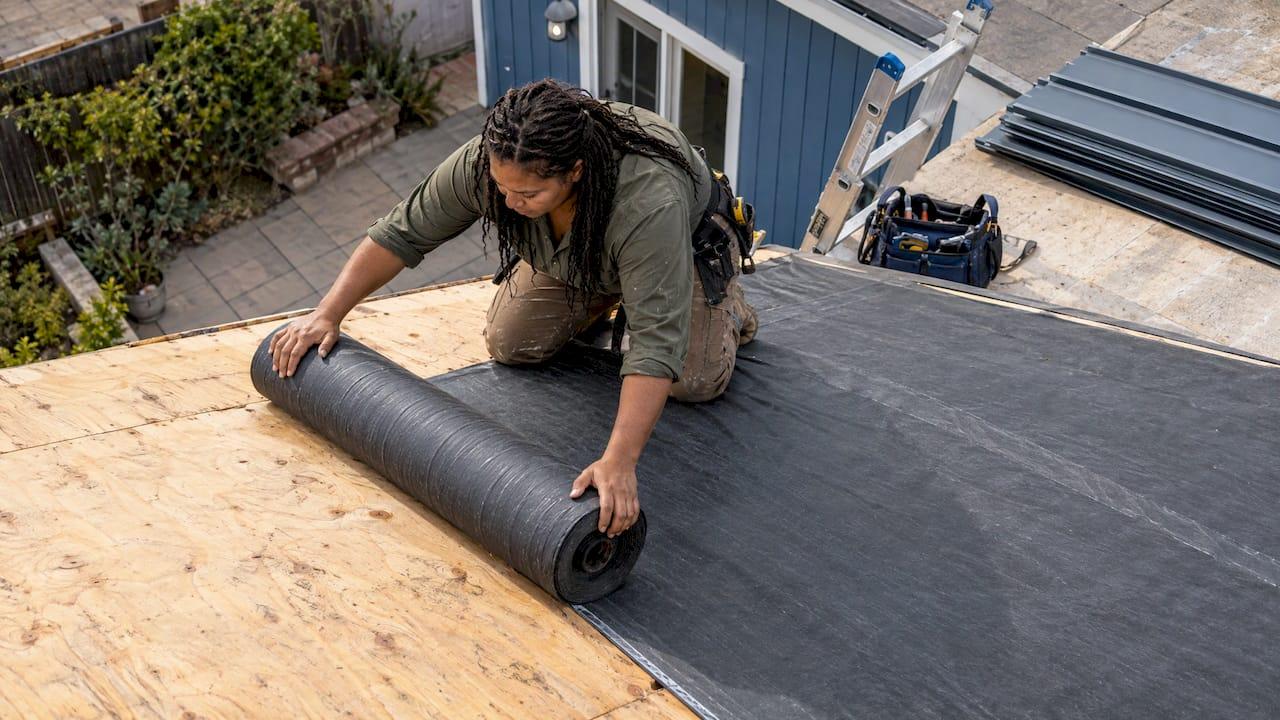
Under a metal roof you want a high-temperature-rated synthetic or self-adhered underlayment, chosen to match the panel maker’s specification and installed over a sound deck. Standard 15-pound felt is the weak link in a roof that is meant to last decades. The layer you never see again decides whether a small fastener leak or wind-driven rain turns into rotted decking. In coastal San Diego, where salt air and wind work on a roof year-round, it is worth getting right the first time.
TL;DR
- Underlayment is the secondary water barrier between the metal panels and the roof deck. It also lets the roof dry in during construction and handles stray moisture on the underside of the panels.
- Metal roofs run hot, so the underlayment needs a high-temperature rating. Ordinary asphalt felt and shingle-grade peel-and-stick products often do not have one.
- Synthetic and self-adhered membranes are the common choice under metal. Self-adhered products seal around the screws and clips that pierce them.
- California’s residential code requires underlayment under metal roof panels and shingles, with specific fastening rules. Your panel manufacturer’s instructions and the local building department have the final word.
- Underlayment is not insulation, ventilation or a vapor-control layer. Those are separate decisions in the same roof assembly.
Table of Contents
- What underlayment does under a metal roof
- The main types of underlayment for metal roofs
- Synthetic vs. felt under metal: how to decide
- What the building code says
- Attachment and slope details that go wrong
- What underlayment does not do
- Checklist before you choose
- Underlayment on a coastal San Diego roof
- How we work with underlayment and the rest of the roof
- Our perspective
- FAQ
- Sources
What underlayment does under a metal roof
Underlayment is a water-shedding layer laid over the roof deck, usually plywood or OSB, and under the metal panels. Metal panels shed most water, but they are not the only line of defense. Wind can push rain up under laps, and condensation can form on the underside of the panels. Every screw, clip or seam is a place where water can get in.
Metal Construction News describes underlayment as a secondary barrier against water intrusion and condensation. It also notes that good underlayments self-seal around nails, screws and clips. That last point matters on any roof with exposed fasteners, and on standing seam roofs it matters at clips, penetrations and flashings.
Underlayment has three practical jobs:
- Drying in. The roof is protected from weather once the deck is covered, before the panels go on. Panels are often fabricated to order, so the deck can sit covered for days or weeks.
- Secondary moisture barrier. It catches whatever gets past the panels in a storm.
- A slip surface. Metal expands and contracts with temperature. A smooth film surface lets standing seam panels slide freely, which Metal Construction News points out is one reason a synthetic film top surface is typically recommended for metal roofing.
The deck matters as much as the layer on it. We cover decking types and fastening in our guide to metal roof decking. Underlayment over soft, damaged or uneven sheathing hides the problem and does not fix it. For how water is managed at the deck edge and around openings, see this explanation of deck flashing and moisture management.
The main types of underlayment for metal roofs
There are three families you will meet in a quote or a spec sheet.
| Type | Strengths | Watch for |
|---|---|---|
| Asphalt-saturated felt (tar paper) | Cheap, widely stocked, familiar to every crew | Weak at high temperatures, tears in wind, short exposure time |
| Synthetic (polypropylene or polyethylene-based sheet) | Tough, light, water-repellent, non-skid walking surface | Must carry a high-temperature rating for metal, and must be approved by the panel maker |
| Self-adhered (peel-and-stick) membrane | Seals around fasteners, strong in wind-driven rain | Must be the high-temperature version, not a product made only for shingles |
The three are not mutually exclusive. A common approach is self-adhered membrane at eaves, valleys, penetrations and low-slope areas, with synthetic over the rest of the field.
Felt and tar paper
Felt was the default before synthetics existed. Metal Construction News notes that synthetics improved on it in toughness, installation speed, safety and water repellency. For metal specifically, the same publication reports that asphalt-saturated organic felts are generally not available for high-temperature applications, which is a typical requirement under metal.
The trouble is lifespan. A metal roof is a 40 to 70 year investment (we compare profiles in our guide to standing seam versus corrugated). Putting a short-lived paper under it means the weakest layer sets the real service life of the assembly. Felt can still be used where a manufacturer allows it, but it is rarely the best fit for a hot, dark standing seam roof.
Synthetic underlayment
Synthetics are woven or laminated polymer sheets. They do not absorb water, they are lighter and tougher than felt, and many have a slip-resistant surface that makes the deck safer to work on. For metal, the key word is the temperature rating. A synthetic made for asphalt shingles may not be rated for the heat under a dark metal panel in direct sun. Read the product’s data sheet for its maximum service temperature and confirm that it is approved for use under metal roofing.
Self-adhered membranes
Self-adhered underlayments are rubberized asphalt or polymer-modified bitumen sheets with a sticky back. Because they bond to the deck, the holes made by fasteners tend to seal around the shank. Metal Construction News says modified bitumen self-adhered products are popular in regions with wind-driven rain and ice damming. The same publication states that self-adhering underlayments are designed for slopes of 2:12 or greater.
A standard peel-and-stick product is not automatically a high-temperature one. Specify the high-temperature version for any metal application, and check that the top surface is smooth enough for panels to move.

Synthetic vs. felt under metal: how to decide
If you are comparing the two, these are the questions that settle it:
- Heat. Metal panels can get very hot, and asphalt felt can soften and run. Synthetic and high-temperature self-adhered products are built for this.
- Exposure time. Custom panels may arrive weeks after the deck is covered. Felt is designed to lie uncovered only briefly. Synthetics and self-adhered membranes generally tolerate longer exposure, but the limit is printed on each product’s data sheet.
- Panel movement. Panels need to slide on thermal cycles. A smooth film surface helps. A tacky or rough surface can bind panels and mark the finish.
- Panel maker’s requirements. Warranties on panels and finishes often name acceptable underlayments. Using something else can cause problems later.
- Cost. Synthetics and self-adhered membranes cost more per square than felt. That difference is small next to the cost of tearing a metal roof off to fix a failed underlayment.
The cost trade-off has a practical middle path: self-adhered membrane at penetrations, eaves and valleys, with synthetic across the field. That puts the most sealing power where leaks begin.
What the building code says
Code rules vary by state and sometimes by city, so look at your own jurisdiction. For homes in California, including San Diego County, section R905.1.1 of the 2025 California Residential Code requires underlayment for metal roof shingles and metal roof panels. The code edition took effect on January 1, 2026. Materials must comply with the listed ASTM standards and carry a compliance label.
For mechanically fastened underlayment under metal roof shingles, the same section calls for corrosion-resistant fasteners in a 12-inch grid between side laps, with 6-inch spacing at side and end laps, and metal or plastic caps at least 1 inch in diameter. Self-adhered polymer-modified bitumen underlayment must follow both the underlayment maker’s and the roof covering maker’s instructions for the deck material, the ventilation configuration and the climate exposure.
Other states set different details. One example: the 2020 Florida Building Code requires two layers of ASTM D226 Type II or ASTM D4869 Type III or IV underlayment, and metal caps where the design wind speed is high. A building department handout applying the 2021 model codes likewise lists two layers and says 15-pound felt is not allowed there. It also notes an exception for structural metal panels that do not require a substrate or underlayment, when the manufacturer’s installation instructions are given at plan review.
Two takeaways for homeowners and property managers. First, the permit drawings should name the underlayment product and its standard. Second, the panel maker’s installation instructions are part of what the inspector looks at. A good installer works from both.
Attachment and slope details that go wrong
The product on the label is only half the job. Where roofs fail is in the details:
- Fastening. Caps and fastener spacing follow the code and the product instructions. Too few fasteners and the layer flaps in wind before the panels arrive.
- Laps. Courses run horizontally from the eave upward, each overlapping the one below, so water sheds. Metal Construction News notes that underlayment is often installed horizontally from the bottom of the deck up in overlapping strips, and that many manufacturers recommend wrapping fascia boards along the rake edge and eaves.
- Eaves, valleys and penetrations. These are the places water finds first. Extra layers or self-adhered membrane are common here.
- Low slopes. Metal roofs can be built on very low pitches, but every layer below the panels has to be rated for the slope. Our guide to low-slope metal roofing goes through those details.
- Wind. On coastal sites, uplift is a bigger concern. See our notes on wind-resistant roofing for how fastening and tight nailing work together.
What underlayment does not do
Underlayment is not a catch-all for moisture. Insulation, air sealing, ventilation and vapor control are separate layers with their own rules, and adding one without thinking about the others can cause the very problem you wanted to avoid. Building envelope basics lays out how these layers relate. Our insulation guide for metal roofs explains why moisture control comes before R-value on a metal roof.
The practical point for owners: when someone says the roof is “waterproofed,” ask which layers do which job. Underlayment is a backup for the panels. It does not replace correct flashing, sealed penetrations or a ventilated assembly.
Checklist before you choose
Whether you are a homeowner, a property manager or a contractor, run through this list before signing off on a roof:
- Which panel and finish? The underlayment must be approved by the panel maker. Copper and aluminum expand more than steel, so the slip-sheet question is different from one metal to the next.
- What is the maximum service temperature? The number should match the roof color and exposure. Dark panels in full sun run hottest.
- Is the product approved for metal roofing? Many peel-and-stick products are made only for shingles.
- How long can it stay exposed? Compare the printed limit with the time between tear-off and panel installation.
- What is the deck condition? Soft, rotted or loose sheathing should be repaired before anything is laid over it.
- What does the permit say? The product, standard and fastening pattern should be on the plans.
- Is the warranty intact? Product choices can affect panel, finish and workmanship warranties.
Underlayment on a coastal San Diego roof
Homes near the coast deal with salt-laden air, marine moisture and wind, and many roofs here have dark panels or solar arrays that add heat. Those conditions favor a high-temperature synthetic or self-adhered membrane, fasteners that resist corrosion, and careful detailing at every edge and penetration. If the roof will carry solar, the mounting points add more penetrations, so sealing around them gets more attention. For a roofing and solar job, the plan for those penetrations should be settled before the underlayment goes down, not after.
How we work with underlayment and the rest of the roof
We fabricate our panels to custom specifications, including an 18-inch snap-lock profile designed for coastal conditions, and our installation is not subcontracted. Our work carries a lifetime leak-free warranty, and when a roof includes solar, one team handles both. If you are replacing a roof, our metal roof replacement service is listed at $40,000 to $60,000. You can see the panel options on our metal roof types page.
If you are weighing a new roof or a replacement, start with the SW Metal Roofing home page and tell us about your home, your roof and whether you are planning solar.
Our perspective
Most roof conversations start with the panel: the profile, the color, the finish. We understand why. It is what you see from the street. But the roofs that last are the ones where every hidden layer was chosen to match the panel, the deck and the climate.
We build metal roofs for San Diego homes, including coastal properties where salt air and wind are constant. That is why we fabricate panels to the job, including our 18-inch snap-lock profile for coastal conditions, and why we install with our own crew rather than subcontracting. A roof is a system, and the people who build the panels should be the same people responsible for what goes beneath them.
Underlayment is a good example. It is the layer that no one photographs and no one inspects after the panels go on. It must handle heat, hold up through the exposure between tear-off and panel installation, and stay sealed around every fastener for decades. Treat it as a line item to minimize and you invite problems. Treat it as part of the system and it does its quiet job for the life of the roof.
That is the thinking behind a lifetime leak-free warranty: one team, one roof, and responsibility for the whole assembly, from deck to ridge, with solar coordinated in the same plan.
Marcus
FAQ
Do you need underlayment under a metal roof?
In most cases, yes. In California, the residential code requires underlayment under metal roof panels and shingles. Even where a code exception exists for certain structural panels, it depends on the manufacturer’s instructions being provided at plan review. Underlayment also dries in the deck and adds a secondary barrier.
What is the best underlayment for a metal roof?
There is no single answer, because the right product depends on the panel, the deck, the slope and the climate. For most standing seam roofs, a high-temperature synthetic or self-adhered underlayment approved by the panel maker is the usual choice. Self-adhered membrane is often used at eaves, valleys and penetrations.
Is tar paper a good underlayment for metal roofing?
It is an old standard, but it is a weak match for a modern metal roof. Asphalt felt is generally not available for high-temperature applications, and metal roofs run hot. Felt also has a short service life compared with the roof above it. A synthetic or high-temperature self-adhered product is a better fit.
Is synthetic underlayment better than felt under metal?
For metal, usually yes. Synthetics are tougher, repel water and offer faster, safer installation. A smooth film surface also lets panels move with temperature changes. Check that the product carries a high-temperature rating and is approved for metal roofing.
Can I add a vapor barrier under my metal roof?
Only after looking at your climate, how the building is used, the insulation and the other roof layers. Underlayment, vapor control, insulation and ventilation do different jobs. Have a roofing professional look at the whole assembly before adding one.
Sources
- The underlayment is the key to better metal roofing systems, Metal Construction News
- Achieving Moisture Protection with Roof Underlayments, Metal Construction News
- Underlayment and Ventilation, Metal Construction News
- R905 Requirements for Roof Coverings, 2025 California Residential Code
- Underlayment for Asphalt, Metal, Mineral Surfaced, Slate and Slate-Type Roof Coverings, 2020 Florida Building Code
- Roof Covering Replacement, IBC/IRC 2021 handout