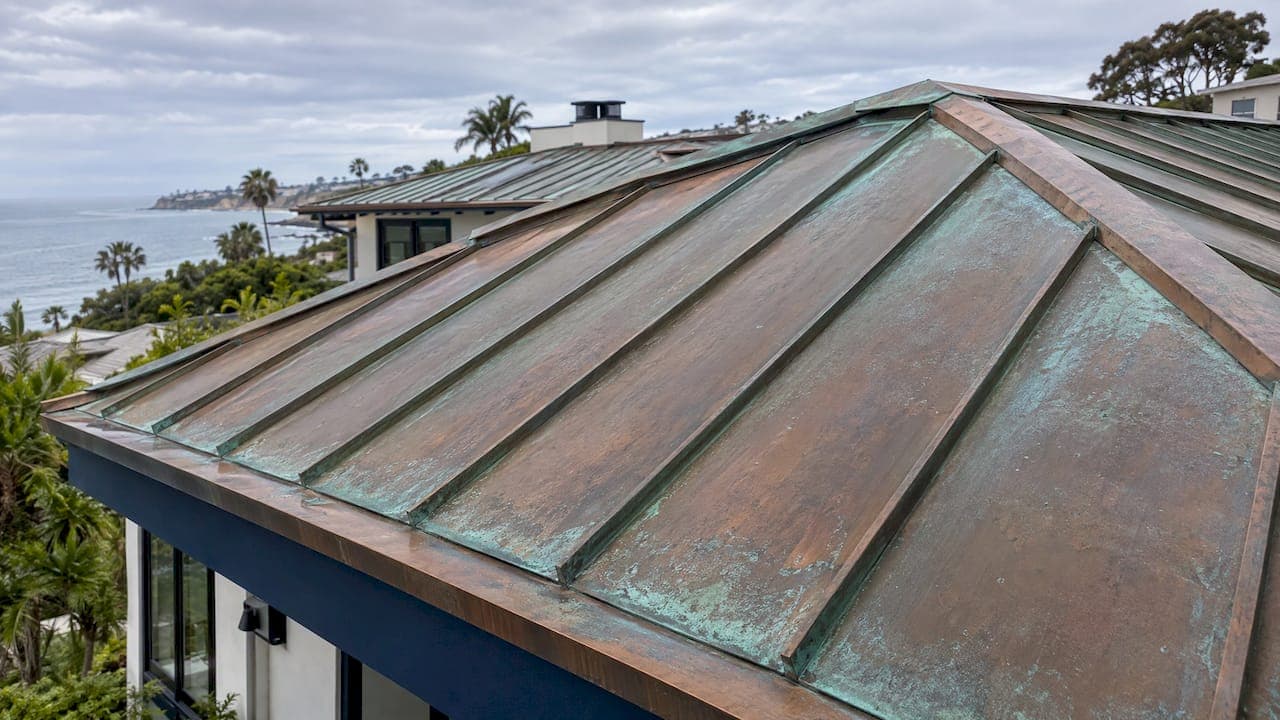
A copper roof needs very little upkeep, and most of that upkeep is looking, not scrubbing. Keep gutters and valleys clear, inspect the roof twice a year, rinse off dirt with clean water, and leave the patina alone. Call a roofer when you see bright, bare spots, loose flashings, pulled-up panels or water standing where it should drain.
This guide walks through each of those steps in the order you would do them, explains what to avoid, and covers the details that matter on coastal and solar-equipped roofs like many we see in San Diego.
TL;DR
- Copper roofs often stay intact for more than 80 years, according to the Insurance Institute for Business & Home Safety (IBHS), when they are designed and installed well and inspected regularly.
- Routine care is simple: clear dirt, leaves and debris from the roof and gutters, then rinse with clean water.
- Do not strip or scrub the green or brown patina. It is a natural protective layer, not damage.
- Inspect in spring and fall, and look at flashings, edges, ridges, drainage and anything attached to the roof.
- Bright, unpatinated patches, pulled-up panels or stains from acidic runoff are reasons to call a professional, not to experiment with chemicals.
Table of Contents
- What a copper roof actually needs
- A yearly maintenance calendar
- How to inspect a copper roof
- Cleaning a copper roof the right way
- Patina: leave it, or protect it?
- Stains, bright spots and corrosion: when to worry
- Gutters, seams, flashings and solar attachments
- Our perspective
- Work with a team that knows copper
- Maintenance mistakes we see most often
- FAQ
- Sources
What a copper roof actually needs
Copper is one of the most forgiving roofing metals. IBHS says copper roofs generally require very little additional maintenance when they are properly designed and installed. Its guidance puts the focus on four things: periodic inspection, loose or damaged flashings, standing water, and debris, especially in gutters and drainage components.

That shapes the whole maintenance routine. You are not preserving the copper itself so much as protecting the system around it: the seams, flashings, fasteners, gutters and the deck underneath. When those stay dry and clear, the copper does its job for decades.
IBHS also notes that copper systems often remain intact for over 80 years. The factors it ties to that long life are the ones above: proper design and installation, periodic inspection, clearing standing water and removing debris.
A yearly maintenance calendar
A simple schedule keeps this manageable. Chubb’s risk engineering guidance recommends a semiannual baseline for roof inspections, preferably in spring and fall. That works well for copper too.
| When | What to do |
|---|---|
| Spring | Inspect the roof and attic, clear winter debris from gutters and valleys, check flashings and penetrations |
| After a major storm or wind event | Look from the ground first for displaced panels, debris and sagging gutters |
| Fall | Clear leaves and needles before rain, check drainage, look for standing water |
| As needed | Rinse off dirt, bird droppings or dust with clean water |
In San Diego the rainy season is short, so the fall check matters. Dust, salt and debris build up over the dry months, and the first heavy rain moves everything into your gutters and valleys at once.
How to inspect a copper roof
Chubb’s checklist covers the interior and exterior, roof covering, flashings, drainage, debris, standing water, rooftop equipment and penetrations. IBHS adds that copper roof inspections are best done at roof level, where you can see roof edges, ridge and hip areas, connections to fascia or gable ends, pulled-up panels and possible deck damage. It also recommends checking the roof-deck assembly from inside the building.
Here is how that translates into a practical walk-through.
From the ground and the attic
Start without a ladder. Use binoculars to scan for panels that look lifted, trim that has shifted, discolored streaks below roof edges, and gutters that sag or overflow. Then go into the attic on a dry day with a flashlight. Look for stains on the underside of the deck, damp insulation, daylight where there should be none, and a musty smell near chimneys, vents or valleys.
At roof level
Roof-level work is where the risk is. OSHA requires employers to provide fall protection for workers on residential roofs four feet or more above a lower level, and a roof is a hazard whether you are paid to be on it or not. Copper is also slick, especially when wet or covered in dust or leaves. Standing seam panels can dent under a knee or boot, and the slope matters. If you are not completely comfortable on your roof, hire someone. Our guide to walking on a metal roof safely covers the basics for lower-slope metal panels.
Whoever does the inspection should check:
- Roof edges, ridges and hips. These take the most wind and are where pulled-up panels start.
- Connections to fascia and gable ends. Look for gaps, lifted trim or fasteners that have backed out.
- Flashings. Chimneys, skylights, walls and vents are the usual leak points on any roof.
- Seams. Look for opened or distorted seams.
- Valleys and gutters. Debris here holds water against the metal.
- Anything bolted or mounted to the roof. Satellite mounts, vents and solar attachments are covered below.
Write down what you see and take photos. A dated record makes it easy to spot slow changes from one season to the next.
Cleaning a copper roof the right way
Most searches for copper roof cleaning turn up aggressive recipes: lemon and salt, muriatic acid followed by oxalic acid, bleach solutions. For an installed roof, the better advice is far more modest.
IBHS lists routine upkeep as removing dirt and foliage from the roof and gutters, then rinsing with clean water. It also says staining typically blends into the surrounding copper over time. That is the whole standard routine.
A simple cleaning routine
- Pick a calm, cool day so water does not dry too fast and leave spots.
- Remove leaves, needles and loose debris by hand or with a soft brush. Work from the ridge toward the eave.
- Clear the gutters, downspouts and valleys completely.
- Rinse the roof with clean water from a garden hose at normal pressure, top to bottom.
- Check that water runs freely off the roof and out of the gutters, with no pooling.
That is it. If a stain is not going away, it is usually better to wait, because staining tends to blend in as the copper weathers.
What to avoid
- Pressure washers. High pressure can force water under laps and flashings and mark the surface. A garden hose is enough.
- Acids, bleach and abrasive scrubbing. Homemade and forum recipes strip the surface and can leave bright, uneven patches that then weather unevenly. Online threads about “restoring” copper are mostly about polishing bright copper objects, not about an installed, weathered roof.
- Runoff from other materials. Do not wash chemicals or cleaning products off other surfaces onto the copper.
- Walking on wet or dusty panels. It is a safety risk and can scuff the finish.
If you do want a specific commercial gel or protective coating, follow the manufacturer’s directions exactly. Ask whoever installed your roof first, because the wrong product can make a roof look worse than leaving it alone. On any metal roof, cleaning products can also affect a warranty, which we cover in what works and what voids your warranty.
Patina: leave it, or protect it?
New copper starts bright, darkens to brown and, over years, can turn blue-green. The Copper Development Association describes the blue-green patina as a natural protective coating that characterizes older copper roofs. In other words, it is the copper protecting itself.
That has a few practical consequences:
- Do not remove an established patina just because the color changed. It is not rust and it is not a defect.
- Uneven color is normal in the first years. Different slopes and exposures weather at different rates, and stains tend to blend as the roof ages.
- If you prefer the bright or brown look, that is a design decision to make with your installer before or during the project. Clear coatings exist, but they need coverage and renewal, and they are a commitment.
- If you want green quickly, pre-patinated copper can be specified at installation.
One caution applies to coatings of any kind. Professional Roofing’s article on copper corrosion says coatings require complete coverage plus periodic inspection and renewal. A patchy coating can look worse than bare copper.
Stains, bright spots and corrosion: when to worry
Patina and corrosion look different, and the difference matters. Professional Roofing explains that copper corrosion can result when acidic water from other materials drains onto copper. Bright, unpatinated areas indicate corrosion, and corroded holes can cause leaks. The article’s guidance is that roof design should prevent incompatible runoff in the first place.
So watch for these signs:
- Bright, shiny or bare patches in an otherwise weathered roof, especially below another material.
- Streaking below a chimney, a neighboring roof section or another surface that sheds water onto the copper.
- Pinholes, soft spots or thinning near fasteners or flashings.
- Water stains in the attic that line up with a flashing, valley or seam.
- Standing water in a valley, behind a penetration or in a gutter.
If you see any of these, take photos and call a roofer who works with copper. Spot repairs are far cheaper than replacing a section, and the cause (runoff, a dissimilar metal, a blocked gutter) needs to be fixed or the problem returns. Our metal roof repair service starts with finding the source of the water, not just sealing the symptom. If you are weighing a spot fix against something bigger, this guide to leak repair shows how we think about it. For iron-based roofing materials, the question is different; see our rust decision guide.
Gutters, seams, flashings and solar attachments
These are the parts of a copper roof that actually need attention.
Gutters and valleys
IBHS guidance is plain: keep valleys and gutters clear of debris. In San Diego, that means eucalyptus leaves and bark, palm fronds, pine needles and windblown dust. Wet debris holds moisture against metal and can send water where it should not go. If you cannot keep up with it, a maintenance visit twice a year is cheaper than a repair.

Seams and flashings
Standing seam copper relies on its seams and trim details to stay watertight. Watch for panels pulling up at edges, loose trim and flashings that have lifted. Standing seam copper workmanship is a big topic in itself, and we explain the common mistakes in our copper standing seam article.
Solar panels on copper
If your roof carries solar, IBHS advises making sure attachments and flashings allow for thermal movement, let water and debris drain, and are galvanically compatible with the copper. That last point matters. When dissimilar metals touch in the presence of water, one can corrode faster. Check that mounts, fasteners and flashings were chosen for use with copper, and look at them during every inspection. Debris collecting upslope of a mount is one of the most common problems.
When the roof and the solar array are planned and installed by one team, those details get settled once, in the right order.
Our perspective
We build and maintain metal roofs in a coastal city, so we see what salt air, wind and neglected gutters do to roofs of every kind. Copper is the metal we trust most to forgive a little neglect, but it does not forgive bad details.
In our experience, the maintenance questions people ask about copper are really installation questions. Will water run where it should? Are the flashings made of compatible metal? Can a solar mount move with the roof as it heats and cools? If the answers were right on day one, upkeep is a few hours a year. If not, no amount of cleaning will fix it.
That is why we fabricate panels to the job’s specifications and install them with our own crews, not subcontractors. It is also why we handle solar integration on the same roof: one team is accountable for every penetration and attachment. Our work is backed by a lifetime leak-free warranty, and we would rather you call us for a twenty-minute look at a questionable flashing than for a leak repair later.
Marcus
Work with a team that knows copper
We fabricate and install custom copper roofing in San Diego and offer inspections and maintenance for metal roofs, including roofs that carry solar. If you want a professional set of eyes on your seams, flashings and drainage, see our metal roof maintenance and inspections page.

Thinking about a new copper roof or replacing an aging one? Look at our custom copper roofing options, or contact us to talk through your roof.
Maintenance mistakes we see most often
- Treating patina as a problem. Homeowners strip a perfectly healthy weathered surface, then deal with bright patches for years.
- Skipping the gutters. This is the most common cause of avoidable trouble, and the cheapest to prevent.
- Using the wrong tools. Pressure washers, wire brushes and harsh chemicals do more harm than dust ever did.
- Ignoring runoff. If another material drains onto copper, the fix is in the roof design, not in more cleaning.
- Adding equipment without a plan. Antennas, solar mounts and vents added later need flashings and fasteners that suit copper.
- Waiting for a stain in the ceiling. By then water has been getting in for a while. The twice-a-year check is meant to catch problems earlier.
FAQ
How do I clean a copper roof?
Remove leaves and debris by hand or with a soft brush, clear the gutters and valleys, then rinse with clean water at normal hose pressure. IBHS lists this as routine upkeep and notes that staining typically blends in over time. Skip acids, bleach and pressure washers.
How often should a copper roof be inspected?
Twice a year is a sound baseline, preferably in spring and fall, and after any major storm. Check the roof edges, flashings, seams, gutters, valleys and anything attached to the roof. A professional should do any inspection that requires walking on the roof.
Should I remove the green patina from my copper roof?
No. The blue-green patina is a natural protective layer that develops as copper weathers. If you prefer a different look, discuss pre-patinated copper or clear coatings with your installer, and know that coatings need full coverage and periodic renewal.
How long does a copper roof last?
IBHS says copper roof systems often remain intact for more than 80 years. Design and installation quality, regular inspection, clearing standing water and removing debris are what support that kind of life span.
When should I call a professional?
Call when you see bright bare patches, pinholes, lifted flashings, pulled-up panels, attic stains or water that does not drain. Also call before adding solar panels or other equipment, so the attachments are compatible with copper and do not trap water.
Sources
- Copper, Insurance Institute for Business & Home Safety
- To The Point: Roofs and Roof Inspection Checklist, Chubb
- What fall protection must employers provide on residential roofs, OSHA
- Environmental corrosion of copper, Professional Roofing
- Green Patina Finishes, Copper Development Association