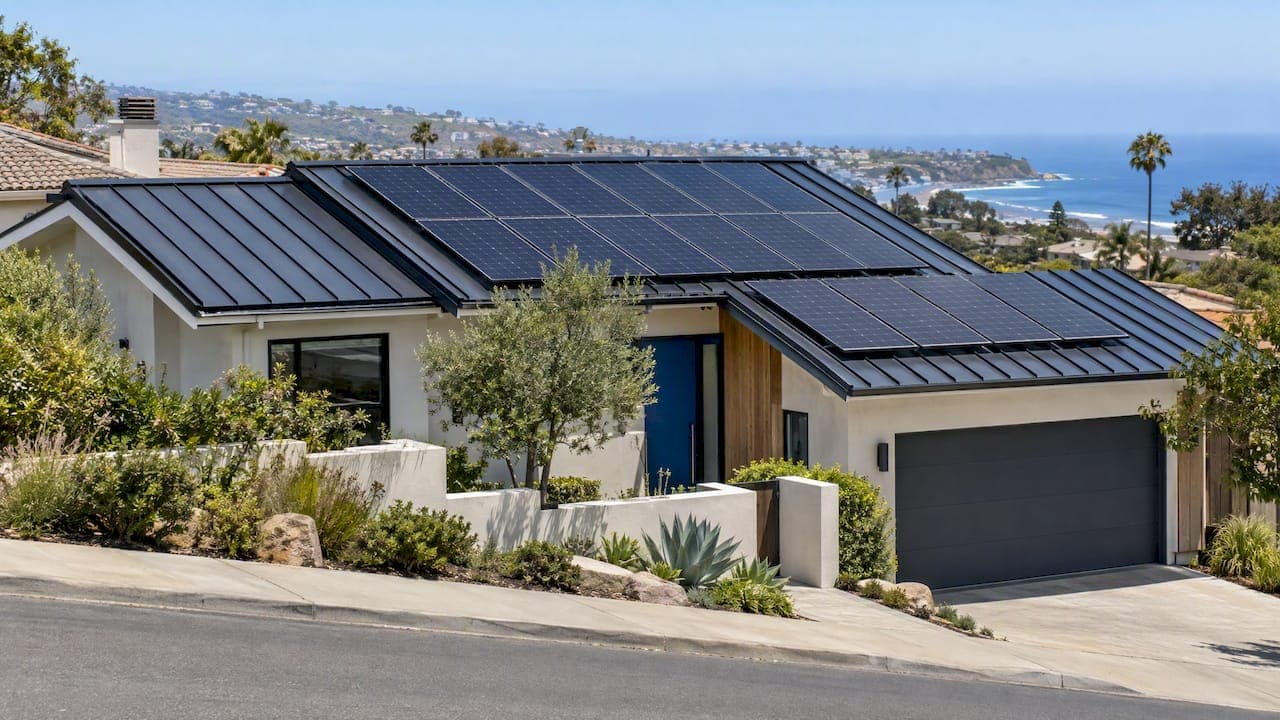
An integrated solar roof is a roof whose surface also generates electricity. The solar material replaces part of the roofing instead of sitting on top of it. In practice, homeowners usually get this in one of two ways. The first is solar shingles or tiles, which are true building-integrated products. The second is a standing seam metal roof with solar attached through seam clamps, so the roof and the array work as one system without drilling into the metal. We install the second kind in San Diego, and this guide explains how each works, what each costs, and how to choose.
TL;DR
- Building-integrated photovoltaics (BIPV) replace conventional roofing material, while standard panels are mounted on top of a finished roof.
- Solar shingles look cleaner but typically cost more per watt than conventional panels, and fewer installers handle them.
- A standing seam metal roof accepts solar panels with seam clamps that do not penetrate the metal, which protects the roof’s leak resistance.
- Solar panels typically last 25 to 30 years, so the best moment to add solar is when the roof is replaced.
- Ask one team to own both the roof and the array, and get the warranty terms in writing before work starts.
Table of Contents
- What an integrated solar roof actually is
- How integrated systems are installed
- Solar shingles versus panels: an honest comparison
- Why standing seam metal is a strong base for solar
- What to confirm before you commit
- Warranties: where integration can go wrong
- Our perspective on integrated solar roofs
- What it costs in San Diego
- Roof and solar from one team
- Choosing between the options
- FAQ
- Sources
What an integrated solar roof actually is
The U.S. Department of Energy describes building-integrated photovoltaics as solar-generating materials used in place of conventional building materials. Unlike conventional rooftop panels, which are placed on top of a roof, BIPV can become the roof itself. Industry guidance adds that BIPV modules have to meet both electrical and construction requirements for the role they play in the building envelope. That means they must keep water out as well as make power.
Three product families get called “integrated” in search results:
- Solar shingles and solar tiles. Small modules that replace asphalt shingles, slate or tile, with the solar cells built into the roofing unit.
- In-roof panel systems. Larger framed modules set flush into the roof plane with their own flashing, sitting lower than standard panels.
- Panels on standing seam metal. Conventional modules clamped to the raised seams of a metal roof. Strictly speaking this is not BIPV, but the result is integrated in the way that matters to a homeowner: no penetrations, a low profile, and a roof and array designed together.
The search phrase “integrated solar panels roof” covers all three, so it helps to know which one a quote is actually describing.
How integrated systems are installed
PV shingles can be fastened directly to the roof deck like standard shingles, generally while the roof covering is being installed and without a separate rack, according to the Department of Energy’s Building America Solution Center. The same source says an experienced PV-shingle roofing contractor can do the work. That detail is the catch. Roofers know weatherproofing but may not hold electrical licenses, and electricians know wiring but not underlayment, so integrated products tend to need two trades working in sequence.
Conventional rack-mounted systems are different. The same Solution Center page says they normally use rails bolted to rafters, clamps, flashing and hardware, and that each penetration and its flashing must be integrated with the underlayment and the roof covering to keep the roof weathertight. Every bolt is a place the roof could eventually leak if it is done carelessly.
Solar shingles versus panels: an honest comparison
| Factor | Solar shingles / tiles | Rack-mounted panels | Panels clamped to standing seam |
|---|---|---|---|
| Appearance | Blends with roof, no rails | Visible rails and gap | Low profile, uniform with seams |
| Roof penetrations | Part of the roofing | Many bolts through the roof | None, clamps grip the seams |
| Installer pool | Small | Large | Moderate, needs metal roof knowledge |
| Cost per watt | Highest | Lowest | Close to conventional panels |
| Best timing | New roof | Any time | Any time, ideal with a new roof |
Cost is where shingles struggle. One consumer buying guide puts solar shingles at roughly $3.50 to $8.00 per watt depending on brand, and reports a total installation typically 15% to 25% higher than a traditional panel system. Because pricing is per watt and not per square foot, total cost depends mostly on how large an array your electric bill justifies, not on how big the roof is. The Department of Energy also notes that system economics depend on size, net-metering arrangements and available incentives, so get an itemized quote and ask how each of those was handled.
There is another practical limit. A shingle array covers a lot of roof area but generates less per square foot than full-size panels, so a home with a small or shaded roof may not reach its target output with shingles alone.
Why standing seam metal is a strong base for solar
The federal Solar Ready Buildings Planning Guide says a standing seam roof is often the best option for later solar integration because panels can be attached without penetrating the roof. The same guide warns that the roof itself must be securely attached to carry the array’s added load.
Here is why that matters:
- No holes, no leak paths. Penetrations for rack systems can also create thermal bridges and condensation problems, per the same guide, which is why flashing and sealing by a professional roofer matter. Seam clamps sidestep the issue. One manufacturer describes its standing seam clamp system as attaching rails or modules to the seam without drilling or collapsing the ridge.
- Matching lifespans. A metal roof is built to outlast a typical asphalt roof by decades. Solar panels typically last 25 to 30 years, and the Department of Energy points out that combining roof replacement and solar avoids removing and reinstalling the panels later.
- Cooler, tougher surface. Steel does not shed granules or crack under a panel, and the seams are the same on every panel, so clamp spacing is predictable.
For more on the metal-specific details, we cover what to know before putting solar panels on a metal roof and the standing seam and solar combination in San Diego in separate guides.
What to confirm before you commit
Some of these checks sound technical, but they decide whether the project goes smoothly.
Structural capacity. The EPA’s residential specifications for solar recommend documenting that the roof can support an additional 6 lb/ft² dead load for a future PV system. Ask your roofer to confirm this in writing, particularly on older homes or heavy tile roofs.
Design factors. The Building America Solution Center lists roof material, slope, weatherproofing, wind loads and, where relevant, structural weight as items the design must account for. In coastal San Diego, wind and salt air are the two that deserve extra attention. Our guide to wind resistant roofing and tight nailing explains how we approach the first.

Orientation and shading. South and west faces with little shade give the best production. A roofer can lay out panel zones around vents, skylights and valleys before the metal is ordered, so nothing needs to be moved later.
Electrical scope. Confirm who handles the permit, the inverter, the utility interconnection and the final inspection. If the answer is “you, separately,” your roof and solar are two projects with two warranties and possibly two finger-pointing contractors.
Warranties: where integration can go wrong
Solar systems typically carry 25-year component warranties, with production warranties on output, while installer workmanship warranties typically last up to 10 years, per a 2022 Department of Energy fact sheet. Roof warranties are separate again. The risk is a gap where each party says the problem belongs to the other.
The Department of Energy notes that rooftop PV installed correctly should have no negative effect on roof integrity, and that reputable installers can coordinate with the original roof manufacturer to keep warranty coverage. That was written for commercial roofs, but the principle holds at home. Before signing, ask:
- Does the roof manufacturer’s warranty stay valid with solar attached, and is that confirmed in writing?
- Who is liable if a leak appears near the array?
- Is the workmanship warranty from the installer or from a subcontractor who may not be around later?
Knowing the difference between product and workmanship coverage helps here, and a clear walkthrough of protecting your warranty coverage shows the kinds of written demands worth making on any contractor.
Maintenance is light. Solar panels are typically cleaned by regular rainfall, and minor dust does not significantly affect performance, though the same DOE fact sheet says water cleaning is an option during long droughts. In dry Southern California, an occasional rinse is reasonable, and a yearly roof inspection catches loose flashing or a damaged seam before it becomes a leak.
Our perspective on integrated solar roofs
We build metal roofs in San Diego, so we see the same failure pattern repeatedly: a roof that was fine when the solar went up, then years of small problems at the bolts. Homeowners rarely connect the leak to the array because a different company installed each one.
That is why we favor the roof-first approach. A standing seam roof with panels clamped to the seams keeps the roof as one unbroken weather surface, and the roof and the array are planned together. On the coast we fabricate an 18-inch snap-lock profile built for wind and salt air, and we do our installation work with our own crews instead of subcontracting it. Our roofs carry a lifetime leak-free warranty, and handling the solar coordination ourselves means there is one team to call if something goes wrong.
Solar shingles are a legitimate choice if appearance is the priority and the budget allows it. But for most homeowners we talk to, durable metal plus efficient full-size panels delivers more power per dollar and a longer, simpler warranty story.
— Marcus
What it costs in San Diego
Solar cost depends on array size, equipment and incentives, so we do not publish one number for it. The roof is easier to anchor. Our metal roof replacement projects run $40,000 to $60,000 depending on size, panel type and roof complexity. Solar is quoted on top of that, by watt, once we know your energy use and roof layout.
Two things reduce the total in practice. Doing both at once means one mobilization, one set of permits and no panel removal later. And roofing with clamp-ready seams removes the cost of rack hardware and flashing at each penetration. Our cost page explains how panel type, whether standing seam steel, metal shingle or stone-coated steel, changes the roofing side of the number.
If you want to compare panel styles first, our overview of standing seam metal roofing is a good starting point.
Roof and solar from one team
If your roof is near the end of its life and you plan to add solar, we can replace it with standing seam steel and integrate the array in the same project. We handle the roofing, the solar coordination and the warranty paperwork together, so you are not managing two contractors. See our roofing and solar service or ask for a site visit and a written scope.

If your roof is sound and you only want solar, we will inspect the seams and attachment first through our metal roof maintenance and inspections, so you know the roof can carry the array for its full life.
Choosing between the options
Use this short filter:
- Roof is under 10 years old and metal: add panels with seam clamps. Confirm the structural load and warranty.
- Roof is old or failing: replace it first or together with solar. Never put a 25-year array on a 10-year roof.
- Appearance is the top concern and budget is flexible: price solar shingles, and ask for installer references on that specific product.
- Coastal or high-wind site: prioritize fastening, panel profile and corrosion resistance over looks.
- Multi-unit or commercial building: loads, access and drainage change the design, so start with a commercial metal roofing review.
FAQ
Is an integrated solar roof the same as solar shingles?
Not exactly. Solar shingles and tiles are one type of integrated product, but in-roof panels and even panels clamped to a standing seam roof are also called integrated. What they share is a low profile and a design that treats roof and array as one system.
Can you put solar on a standing seam metal roof?
Yes. Federal guidance notes that standing seam roofing is often the best option for solar because panels can be attached without penetrating the roof. The roof has to be securely attached to carry the extra weight, so have it checked first.
Do integrated solar panels cost more than regular panels?
Solar shingles usually do. One buyer’s guide puts them at about $3.50 to $8.00 per watt and typically 15% to 25% above a standard system. Panels on a metal roof with seam clamps are priced much closer to conventional installations.
Will solar void my roof warranty?
It can if the installation breaks the roof manufacturer’s terms, for example by adding penetrations that the warranty does not allow. Get written confirmation from both the roofer and the solar installer before work begins.
Is it better to add solar when replacing the roof?
In most cases, yes. Panels typically last 25 to 30 years, similar to a long-lived roof, so doing both together avoids paying to remove and reinstall the array later.
Sources
- Expanding Solar Energy Opportunities: From Rooftops to Building Integration (U.S. Department of Energy)
- Building-Integrated Photovoltaics: A Technical Guidebook (IEA PVPS)
- Roof Anchor System for Solar Panels (Building America Solution Center)
- Solar Ready Buildings Planning Guide (U.S. Department of Energy)
- A Consumer’s Guide: Get Your Power from the Sun (U.S. Department of Energy)
- Replacing Your Roof? It’s a Great Time to Add Solar (U.S. Department of Energy)
- Commercial Rooftop Solar FAQ (Better Buildings Solution Center)
- WAP Solar Frequently Asked Questions (U.S. Department of Energy)
- Solar Photovoltaic: Specification, Checklist and Guide (EPA / DOE)
- Solar Roof Shingles Cost and Homeowners Guide (EcoWatch)
- SnapNrack Standing Seam System (Solar Electric Supply)