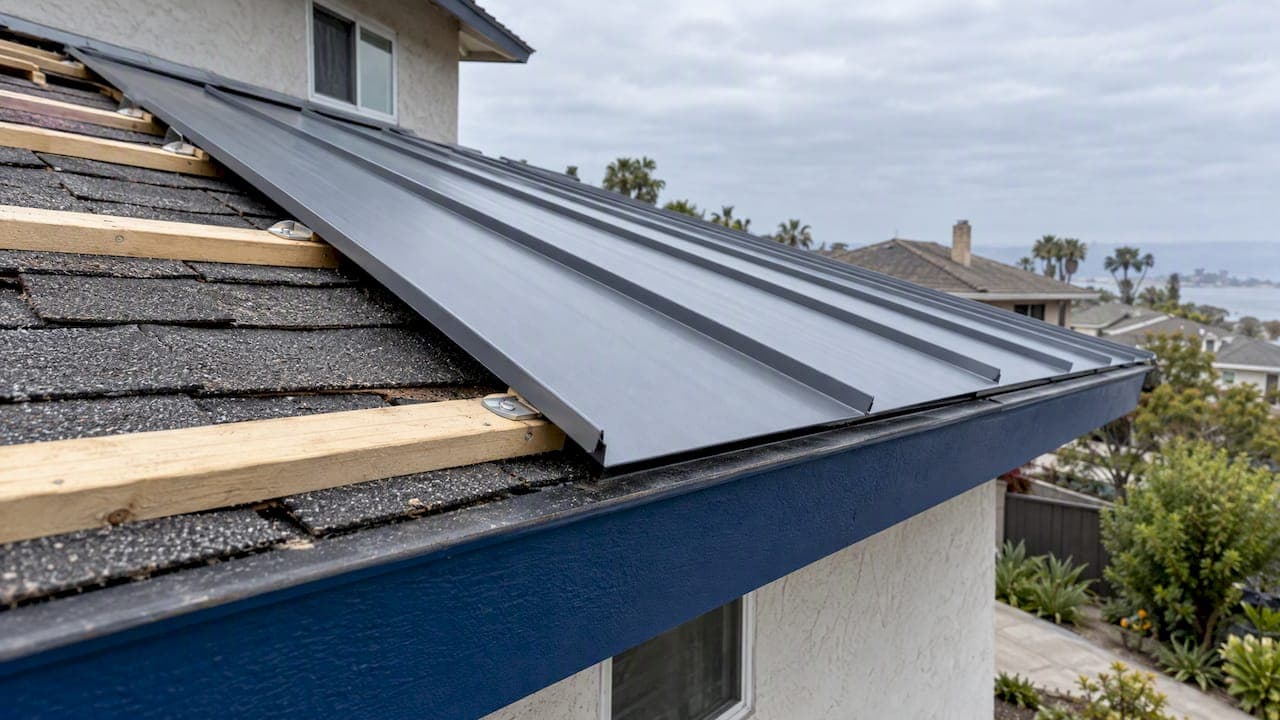
Yes, you can put a metal roof over existing asphalt shingles, but only when the roof underneath is in good shape and carries a single layer. Model building code allows a recover under those conditions, and many metal panel makers publish instructions for it. Whether it is the right move for your house depends on the condition of the deck, how you attach the panels, and what your local permit office requires.
This guide covers when a recover is allowed, the two installation methods, what the work involves step by step, the real trade-offs, and how to handle solar panels. We install metal roofs in San Diego, so we also say where we would and would not recommend leaving the old shingles in place.
TL;DR
- A metal roof can go over one layer of asphalt shingles in good condition. It generally cannot go over two or more layers, a water-soaked roof, or a deteriorated base.
- You attach the panels either directly over the shingles on a flat base or over furring strips or purlins. Follow the panel manufacturer’s written instructions either way.
- Skipping tear-off saves disposal and labor, but the furring-strip method can cost about as much as removal and adds weight and height at the edges.
- The big risk is hiding problems. Wet decking, rot and bad flashing stay under the new metal unless someone finds them first.
- Solar panels have to be removed and reinstalled by their installer, so plan the order of work before you book either trade.
Table of Contents
- Is your existing roof a candidate?
- Two ways to install metal over shingles
- How the installation goes, step by step
- Advantages of metal over shingles
- Disadvantages and risks
- Our perspective: why we often tear off in San Diego
- Solar panels and a metal reroof
- Maintenance after a metal recover
- How to decide: a short checklist
- Talk to us about your roof
- FAQ
- Sources
Is your existing roof a candidate?
The model code language on re-covering is clear about what disqualifies a roof. A new roof covering is permitted when it is installed per the manufacturer’s approved instructions or as a separate system that transfers loads directly to the structure. A re-cover is not permitted if the existing roof is water-soaked, is inadequate as a base, is slate, clay, cement or asbestos-cement tile, or already has two or more roof-covering applications.
In plain terms, a good candidate looks like this:
- One layer of asphalt shingles. If a previous owner already roofed over an old roof, you have two layers and tear-off is the path.
- A flat, dry, solid deck. No soft spots when you walk it, no sagging between rafters, no stains in the attic below.
- Shingles that are worn but not failing. Curling, granule loss and brittleness are fine to cover. Active leaks are not.
- Framing that can carry the load. A retrofit should be evaluated for an added dead load of roughly 3 to 5 pounds per square foot, depending on the metal gauge and the support framing required.
A roof that fails any of these needs tear-off, or at least repair of the failed areas first. A roofer who tells you any shingle roof can be covered without looking in the attic is guessing.
Check local rules before you price the job
The code above is the model code. Cities and counties adopt it with their own changes, and some jurisdictions require full removal so the inspector can see the bare deck. Call your building department, or have your contractor do it, before you collect quotes. In San Diego County, the permit office for your address is the authority on what is allowed for your house, and a licensed contractor pulls the permit.
Two ways to install metal over shingles
There is no single method. You can install directly over shingles when the base is flat, or use furring strips or purlins to create a new framed surface, and the panel manufacturer’s instructions decide which is allowed for a given product.
| Direct over shingles | Over furring strips or purlins | |
|---|---|---|
| What it is | Underlayment goes on the shingles, panels on top | A new strapped framework is fastened through the shingles to the deck or rafters |
| Best when | The old roof is flat and even | The old roof is wavy or uneven, or the panel needs a spaced substrate |
| Main upside | Lowest added height and weight | Levels the surface and can add an air space |
| Main downside | Shingle and deck irregularities can telegraph through the panels | More material and labor, more height at eaves and rakes, more weight |
| Cost relative to tear-off | Usually lower | Can be close to tear-off |
Direct attachment
Direct installation is fastest, but the shingle surface is abrasive and gets hot. Panels moving against granules can wear the finish over years of expansion and contraction, which is why this method usually calls for a high-temperature synthetic underlayment or the one the panel maker specifies. Any bumps in the old roof show up in the finished metal, especially with flat-pan profiles in raking light.
Furring strips and purlins
Strapping evens out an uneven roof and gives panels a proper plane to sit on. The furring approach is more environmentally friendly than removal, but the combined material and installation cost can be similar to a full tear-off, and it adds weight.
Two details matter here:
- Lumber type. Copper-based pressure-treated wood can corrode metal panels. Delta Metals’ install guide warns against treated lumber because it can corrode the metal and void the warranty. Ask what the strapping is made of and what the panel warranty says about it.
- Height at the edges. Raising the roof plane by the thickness of the strapping changes how drip edge, rake trim and closures fit. Soffit airflow can also get crowded at the eave, so it is worth checking your soffit vents before and after any raised-deck work. Our own guide to metal roof drip edge details shows why the edge is the place a recover can go wrong.
How the installation goes, step by step
Every system differs, so treat this as the general order and the manufacturer’s sheet as the rule. Product instructions are specific. GAF’s TimberSteel instructions, for example, call for roof-wide peel-and-stick underlayment with a 6-inch end lap, a 3-inch course overlap, and at least 5 inches up vertical wall or curb faces, with eave and rake flashing fastened 8 inches on center. Those figures belong to that product and do not carry over to every metal roof.
- Inspect the roof from above and below. Walk the deck, check the attic for stains, daylight and damp insulation, and confirm the roof is square. Delta Metals’ guide also tells installers to clean the surface and check squareness on shingle overlays.
- Fix or remove what cannot stay. Failed sections, soft decking, vents, old flashings and other obstructions come off. New flashing should never depend on old shingle pieces.
- Install underlayment. Delta Metals calls for an ice-and-water or high-temperature underlayment on shingle overlays. Some products require peel-and-stick over the whole roof.
- Add strapping if the method calls for it. Delta’s guide notes 1-by-4s every 2 feet from eave to ridge where the roof is uneven.
- Set eave and starter flashing, then panels or shingles. TAMKO’s MetalWorks recover instructions run in this order: eave underlayment and starter flashing, underlayment over the roof, valley and gable flashing, then metal shingles installed with clips.
- Finish penetrations, valleys, ridge and trim. These are where leaks start, on any roof. Details at chimneys, skylights and wall junctions matter more than the field of the roof.
One point from the instructions above is worth repeating: fasteners must reach solid framing or deck, and they will be longer than normal because they pass through the old shingles. A crew that does not adjust fastener length is a crew to avoid.
Advantages of metal over shingles
No tear-off and less waste. A recover avoids stripping and hauling away the old layer, which is the dirtiest and most disruptive part of a reroof.
Possible savings on labor. On a direct installation over a flat roof, you skip the removal labor and disposal fees. That is the main reason homeowners ask about it.
A bit of extra insulation and sound buffering. The old layer stays in place under the metal. We would not promise a number for either, since results depend on the assembly.
Fewer days with an open roof. The old roof keeps the house dry during the job, which matters in the wet months.
A metal roof also brings the long-term benefits metal is chosen for, including longevity and resale appeal. Our article on whether a metal roof increases home value goes into the numbers.
Disadvantages and risks
You cannot see the deck. This is the biggest risk. Rot, delamination or nail damage hidden under shingles stays hidden, and a metal roof is expected to last decades. If the deck fails in year 10, someone has to pull the new roof to fix it.
Telegraphing. Direct attachment can show deck and shingle inconsistencies through the panels. Ribs and textured profiles hide this better than flat panels.
Added weight. Metal is light, but strapping plus the old layer plus panels adds up. Have the framing checked.
Trim complications. Strapping changes heights at eaves, rakes, chimneys and walls, so flashing and closures need to be designed for the new thickness.
Resale and inspection questions. A buyer’s inspector may ask what is under the metal. Photos of the deck condition before covering, kept with your records, answer that.
Future repairs and removal. When the metal eventually needs replacing, two layers of material come off together instead of one.
What it costs
The savings from skipping tear-off are real but smaller than people expect, especially with strapping. Material, underlayment, flashing and the metal itself make up most of the cost of a metal roof, and those do not change. At SW Metal Roofing, a full metal roof replacement is listed at $40,000 to $60,000. Where your quote lands depends on roof size, complexity, panel profile and condition, so ask for any recover option to be priced next to a tear-off, line by line.
Our perspective: why we often tear off in San Diego
We build custom standing seam roofs, including an 18-inch snap-lock profile designed for coastal wind and salt air, and we back our work with a lifetime leak-free warranty. That shapes how we look at recovers. A warranty on a roof is only as good as what it sits on. Salt air and wind-driven moisture are hard on any deck that has a hidden problem, and we prefer to put eyes on bare sheathing before we promise a house will stay dry.

That does not mean we refuse every recover. When the old roof is one layer, flat and sound, and the panel system allows it, covering can be a legitimate choice. What we will not do is quote one without looking at the attic and the roof surface first, and we will tell you plainly if we think tear-off is the better value over the life of the roof. Our crews do the installation themselves rather than subcontracting it, so the person who sees the deck condition is the person who builds the roof.
If you are on the fence, ask every contractor the same question: what will you do if you find rot after the metal is on? The answer tells you how they think.
— Marcus
Solar panels and a metal reroof
If you already have solar, the order of work matters. When a roof needs replacement, the solar system must be removed by its installer and reinstalled after the new roof is done. That guidance, from the US Department of Energy’s weatherization program materials, adds that homeowner’s insurance should cover it, but you should confirm with your own insurer. Reinstalling solar also typically means an electrical permit, so ask both trades who handles it.
If you are planning solar, reroofing first is the cheaper sequence, since you avoid paying to take panels off later. Metal is also a good base for mounting. See solar panels on a metal roof and our standing seam and solar guide for San Diego for how attachments work without penetrating the panels.
Maintenance after a metal recover
Metal needs less upkeep than shingles, but not none. For a roof installed over shingles, plan on:
- A yearly look at flashing, sealants and penetrations. These age faster than the panels.
- Keeping gutters and valleys clear of leaves and debris so water drains properly.
- Checking for movement or noise at panel edges, which can point to loose fasteners.
- Rinsing off salt and grime near the coast, and touching up scratches before they rust.
- Watching ceilings and attic for new stains. With a recover, a small leak can travel before it shows.
A scheduled metal roof maintenance and inspection visit is the simplest way to catch these early, and repairs are far cheaper when the problem is small.
How to decide: a short checklist
Ask yourself:
- Is there only one layer of shingles?
- Is the attic dry, with no staining or sagging decking?
- Does the panel maker’s written instruction allow a recover with this method?
- Does my local permit office accept it?
- Have I seen a priced alternative with tear-off, so I can compare?
- Is the added weight and edge height accounted for in the plan?
- If I have solar, who is removing and reinstalling it, and when?
If every answer is yes, a recover is a reasonable option. If any answer is no or unknown, resolve it before you sign.
Talk to us about your roof
If you want a straight read on whether your roof can be covered or should come off, contact SW Metal Roofing for an inspection. We install standing seam steel, metal shingle, corrugated, stone-coated steel and copper, and we can handle the solar side as well. See the profiles and options we offer and some finished projects before you call.
FAQ
Can you put a metal roof over shingles without furring strips?
Yes, if the existing roof is flat and the panel manufacturer’s instructions allow direct application. The panels usually go over a suitable underlayment, often a high-temperature synthetic one. If the roof is uneven, strapping is the better choice because direct attachment can show every bump.
How many layers of shingles can a metal roof go over?
One. Re-covering is not permitted when the roof already has two or more applications of roof covering. Some jurisdictions are stricter and require tear-off regardless, so confirm with your local building department.
Does installing metal over shingles void the warranty?
It can, if the method is not what the panel manufacturer approves. Using the wrong strapping, such as copper-treated lumber, is one example that can void a manufacturer’s warranty. Get the installation method and warranty terms in writing before work begins.
Is it cheaper to go over shingles than to tear off?
Sometimes, mostly on direct attachment over a flat roof. With furring strips, the combined material and labor cost can approach that of a full tear-off. Ask for both options priced separately so you can compare.
What if my shingles have already started leaking?
A leaking roof usually means wet decking or failed flashing, and a re-cover is not permitted over a water-soaked roof. The wet areas have to be found and repaired or replaced first, and in many cases full tear-off is the sensible fix.
Sources
- Roof Re-cover, UpCodes
- How to Install Metal Roofing Over Shingles, McElroy Metal
- Install Guide for DM Legacy and Pro Panel, Delta Metals
- TimberSteel Installation Instructions, GAF
- MetalWorks Application Instructions, TAMKO
- WAP Solar Frequently Asked Questions, US Department of Energy