A metal roof does increase home value, but not by as much as most homeowners assume. National data puts metal roofing’s resale recoup at roughly 50% of installation cost, versus about 68% for asphalt shingles, according to the Cost vs. Value report that tracks this yearly. The real payoff for metal shows up over 10, 20, or 40 years, through avoided replacements, lower energy bills, and fewer appraisal headaches when it’s time to sell.
TL;DR:
- Metal roofs recover about 50% of their installation cost at resale, compared to 68% for asphalt shingles, making them more cost-effective over a long lifespan.
- Long-term homeowners or those in storm-prone environments benefit the most from metal roofs, as they avoid multiple replacements and enjoy lower energy and maintenance costs.
- Costs for metal roof replacement range from $40,000 to $60,000, with high-end options like copper, standing seam, and coastal-specific panels priced accordingly.
- Valuation and insurance discounts depend on proper installation, warranty transferability, and local climate, with appraisers focusing on roof condition and remaining lifespan rather than purchase price.
Table of Contents
- Does a metal roof increase home value? What the numbers actually say
- Who actually gets a return: matching the roof to your timeline
- What a metal roof actually costs, and where the trade-offs are
- How appraisers and buyers actually treat a new roof
- SW Metal Roofing: built for the coastal conditions where metal earns its value
- My take: stop asking if metal “pays off” and start asking what problem it solves
- Get an estimate before you decide
- Sources
- FAQ
Does a metal roof increase home value? What the numbers actually say
The gap between metal and asphalt recoup rates comes down to simple arithmetic, and it surprises most homeowners the first time they see it.
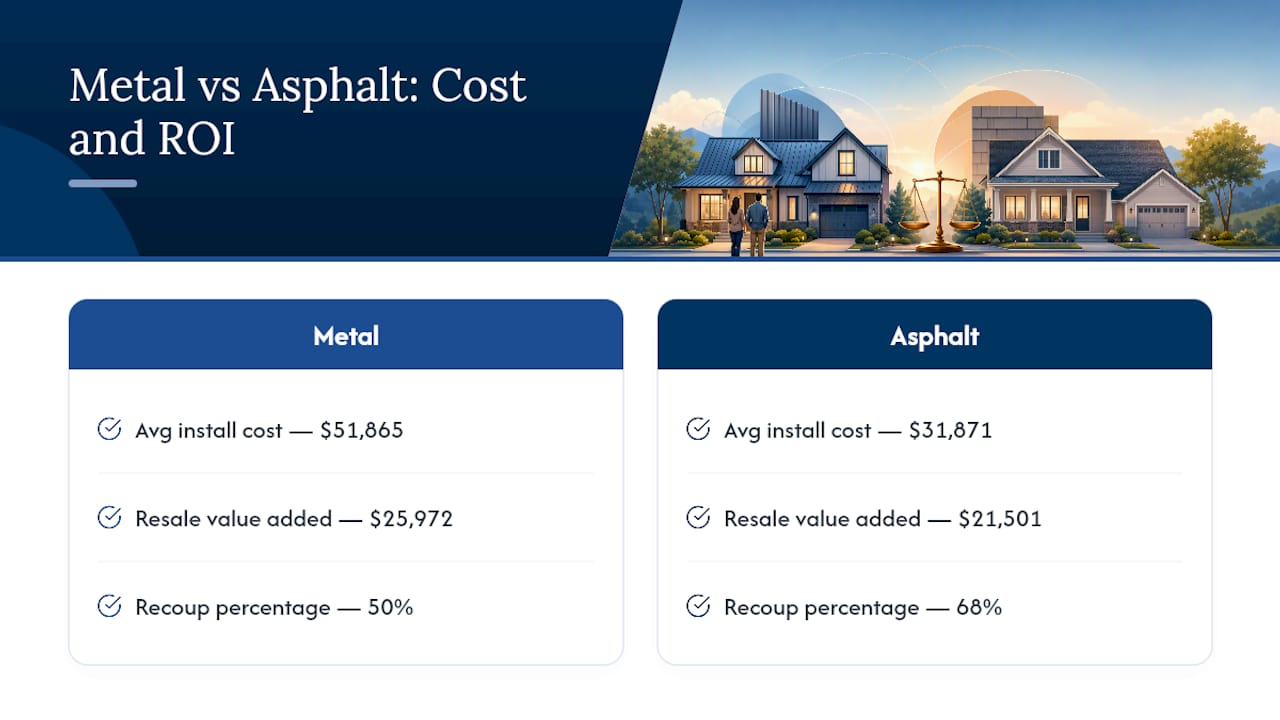
According to the 2025 Cost vs. Value data, a metal roof costs an average of $51,865 to install and adds about $25,972 to resale value. That’s a 50% recoup. Asphalt shingles cost $31,871 on average, add $21,501 in resale value, and recoup 68%. Metal actually adds more dollars at resale, over $4,000 more than asphalt. It just costs so much more upfront that the percentage looks worse on paper.
The math: Resale value added ÷ job cost = recoup percentage. Metal: $25,972 ÷ $51,865 = 50%. Asphalt: $21,501 ÷ $31,871 = 68%. Metal wins on raw dollars, loses on the ratio.
This is the number every roofing salesperson glosses over: recoup percentage measures efficiency, not total value. If you’re chasing the highest ROI ratio, a $9,000 asphalt job will usually beat a $50,000 metal job on paper. If you’re trying to maximize actual resale dollars while also getting a 40 to 70 year roof instead of one that needs replacing again in 20, the math looks different.
This Old House puts typical metal roof costs at $46,000 to $51,000 nationally and frames the investment as worthwhile primarily for longevity and energy performance, not for beating asphalt on resale ratio.
Local market conditions swing these numbers hard. A coastal home in a hurricane zone sees a different resale response than an inland home in a mild climate, because buyers and insurers in storm-prone regions price durability directly into their offers. Recoup percentages are national averages. Your local comps, buyer pool, and climate exposure can push your actual number 10 to 15 points in either direction.
Who actually gets a return: matching the roof to your timeline
Whether a metal roof pays off depends less on the roof and more on how long you plan to own the house. Three homeowner profiles capture most of the real-world outcomes.
- Short-term seller (under 5 years): You’re unlikely to fully recoup a metal roof’s installation cost in this window. But if your existing roof is near the end of its life, replacing it with anything, metal included, prevents the appraisal deduction and buyer credit demands that come with an aging roof. You’re not buying upside here. You’re avoiding a discount.
- Long-term owner (10+ years): This is where metal roofing earns its cost. You avoid one or two full re-roofing cycles that asphalt owners will face, and you capture years of lower energy bills and reduced maintenance calls. The 50% recoup at eventual sale becomes almost incidental next to what you saved by not replacing a roof twice.
- Coastal or severe-weather homeowner: Wind, salt air, and hail change the calculus regardless of timeline. A standing seam profile built for coastal exposure, like an 18-inch snap-lock panel, holds up where asphalt granules erode and shingles lift. Buyers in these markets increasingly ask about roof material before they ask about the kitchen.
Pro Tip: If you’re within 5 years of selling and your current roof still has 10+ years of life left, don’t replace it for resale reasons alone. Put that money into a project with a higher recoup ratio and let the roof do its job.
What a metal roof actually costs, and where the trade-offs are
Metal roof replacement typically runs $40,000 to $60,000 for a full residential project, though pitch, panel complexity, and coastal corrosion protection push costs up or down within that range. A simple gable roof in a mild climate costs less than a steep, multi-plane roof requiring custom flashing and marine-grade coatings for salt air exposure.
Material choice changes both the price and how buyers perceive the roof:
- Standing seam offers the cleanest look and best wind performance, and it’s the standard choice for coastal homes facing salt air and storm exposure.
- Metal shingle and corrugated panels mimic traditional roofing textures at a lower cost than standing seam, appealing to buyers who want the durability without the modern aesthetic.
- Stone-coated steel adds a textured, dimensional look that reads as “traditional roof” to buyers who might otherwise hesitate at a metal roof’s appearance.
- Custom copper sits at the premium end, valued for both longevity and a distinctive weathered patina that some buyers actively seek out.
Maintenance costs drop sharply compared to asphalt: no granule loss, no algae streaking, and far fewer storm-damage repair calls. A transferable warranty matters more than most sellers realize, since it hands the next owner the same lifetime leak-free coverage rather than starting their clock at zero. On the utility side, EIA energy data shows that reflective roofing materials measurably reduce cooling demand in hot climates, which is part of why some insurers offer discounts for metal roofing in wind or hail-prone regions.
How appraisers and buyers actually treat a new roof
Appraisers don’t add your roof’s invoice total to your home’s value. They value the roof based on remaining useful life and condition, comparing it against similar homes with similar-age roofs, a method sometimes called the age-life approach. A $50,000 metal roof doesn’t appraise for $50,000 more. It appraises as “new condition, 40 to 70 year expected life,” which strengthens your overall condition rating without matching the receipt dollar-for-dollar, according to appraisal industry reporting.
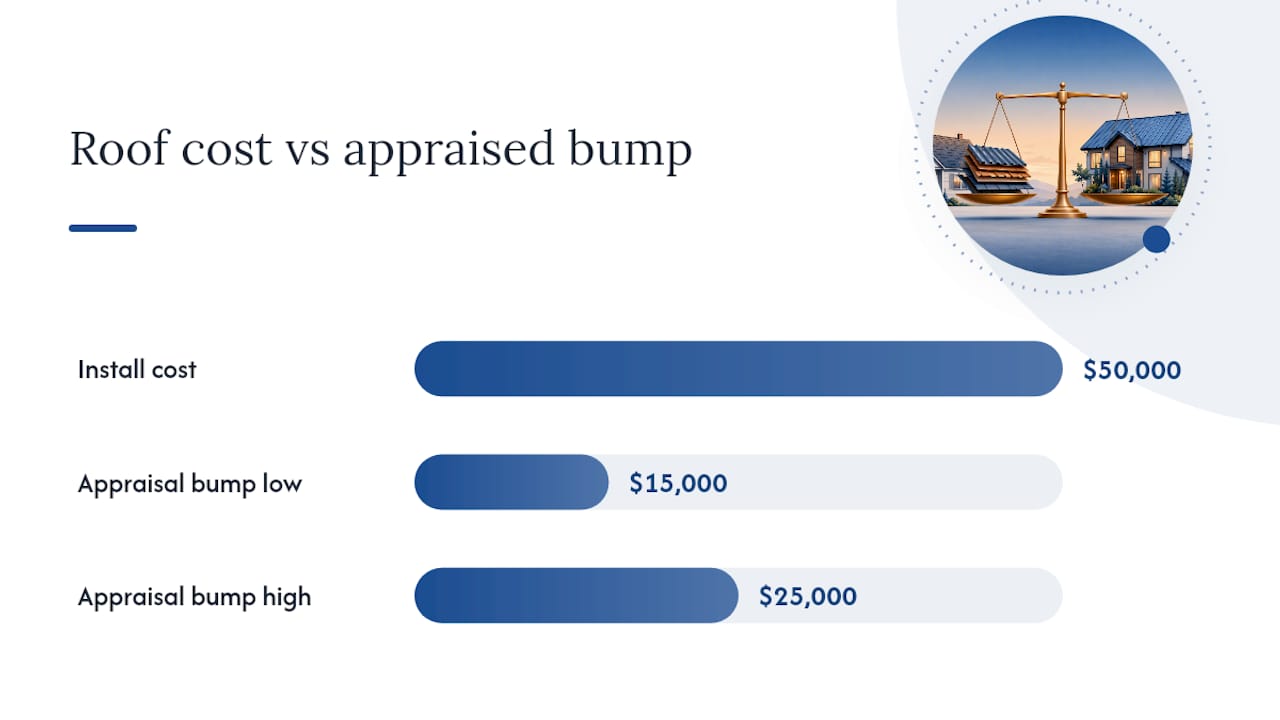
Where a new roof earns its keep is in what it prevents. An aging or damaged roof commonly triggers buyer credit requests, lender conditions, or outright appraisal deductions before closing. Industry data puts the typical value bump from a new roof at $15,000 to $25,000, depending on material and market, largely by removing that friction rather than adding luxury value.
If you’re selling soon after a metal roof install, document it for the appraiser and buyer:
- Keep the transferable warranty paperwork and hand it to your listing agent.
- Request an itemized invoice from your installer showing materials and labor separately.
- Take before and after photos, especially of any storm damage or wear the old roof showed.
- Save any insurance premium adjustment letters and energy bill comparisons if you have them.
SW Metal Roofing: built for the coastal conditions where metal earns its value
SW Metal Roofing fabricates custom standing seam panels in San Diego, including an 18-inch snap-lock profile engineered specifically for wind resistance and salt air exposure, backed by a lifetime leak-free warranty. That combination matters most for the homeowner profiles above: long-term owners, coastal properties, and anyone planning to add solar alongside the roof.
If you’re a long-term owner in a wind or salt-exposed area, or you want roofing and solar handled by one crew instead of two, this is the situation where SW Metal Roofing typically makes the most sense. Recent installs are visible in the project gallery, and every job comes with the documentation a future appraiser or buyer will actually want to see.
My take: stop asking if metal “pays off” and start asking what problem it solves
The 50% recoup figure gets treated like a verdict, but it’s really just an average across millions of homes with wildly different timelines. Nobody asks whether a furnace or a foundation “pays off at resale.” A metal roof belongs in that same category for the right owner: it’s an infrastructure decision, not a staging decision. Judge it against what you’d otherwise spend on a second asphalt replacement and a decade of higher energy bills, not against a granite countertop’s return.
- How many more years do you plan to own this home?
- What condition is your current roof in, and does it have visible wear or storm damage?
- Does your climate involve hail, hurricanes, wildfire, or salt air?
- Can you accept a 50% resale recoup in exchange for 40 to 70 years of roof life?
- Does your installer offer a transferable, documented warranty?
Pro Tip: Ask your installer for dated, timestamped photos of every stage of the tear off and install. Appraisers and future buyers respond better to visual proof of quality than to a line item on an invoice.
— Marcus
Get an estimate before you decide
Some companies handle the full project from custom standing seam fabrication to installation, metal roof replacement, and solar integration, so clients may avoid coordinating separate crews for the roof and the panels. Every installation includes the transferable warranty documentation and photo records that matter most if you sell in the next decade.
An on-site estimate covers your roof’s pitch, complexity, and any coastal corrosion protection your home needs, which is where most of the cost variation in this article actually comes from. If you’re weighing standing seam against stone-coated steel or copper, that conversation happens during the estimate, not before it. Check current pricing and cost ranges for your project, and if roofer-specific marketing questions come up along the way, roofer SEO resources are worth a look for contractors reading this too.
FAQ
What are the disadvantages of a metal roof?
Higher upfront cost is the main drawback, with national averages running $46,000 to $51,000 for a full metal replacement, versus far less for asphalt. Some homeowners also cite noise during heavy rain and a more limited pool of installers experienced in standing seam or custom fabrication work.
What type of roof adds the most value to a home?
Metal roofing generally offers a strong value, according to the Cost vs. Value report, but metal adds more raw resale dollars and lasts two to three times longer. The “best” choice depends on whether you’re optimizing for resale ratio or long-term ownership cost.
Will a metal roof lower my homeowners insurance?
Some insurers offer discounts for metal roofing in wind or hail-prone regions because of its storm resistance, though the size of any discount varies by insurer and location. Ask your provider directly, since this isn’t guaranteed everywhere.
What decreases property value the most?
An aging, damaged, or leaking roof is one of the fastest ways to trigger buyer credit demands or appraisal deductions, according to appraisal industry reporting. Deferred maintenance generally, along with outdated systems and poor curb appeal, tends to hit resale value harder than any single roofing material choice.