Homeowners in La Jolla, Del Mar, Coronado, Encinitas and Solana Beach ask us the same question before anything else: does metal rust by the ocean. It is the right question, and the honest answer is that the wrong metal roof will disappoint you on the coast and the right one will outlive everything else on the house.
The difference is not luck. It is gauge, coating and detailing, decided before a single panel is formed.
What salt air actually does
Marine air carries chloride. It settles on every surface, it holds moisture against that surface, and it attacks any point where the protective coating has been broken. On a roof, the vulnerable points are cut edges, fastener holes and scratches, not the broad flat face of the panel.
That tells you exactly what a coastal roof needs to get right. Fewer openings in the metal, a finish that stays intact, and edges detailed so water leaves rather than sits.
What we specify within a few miles of the water
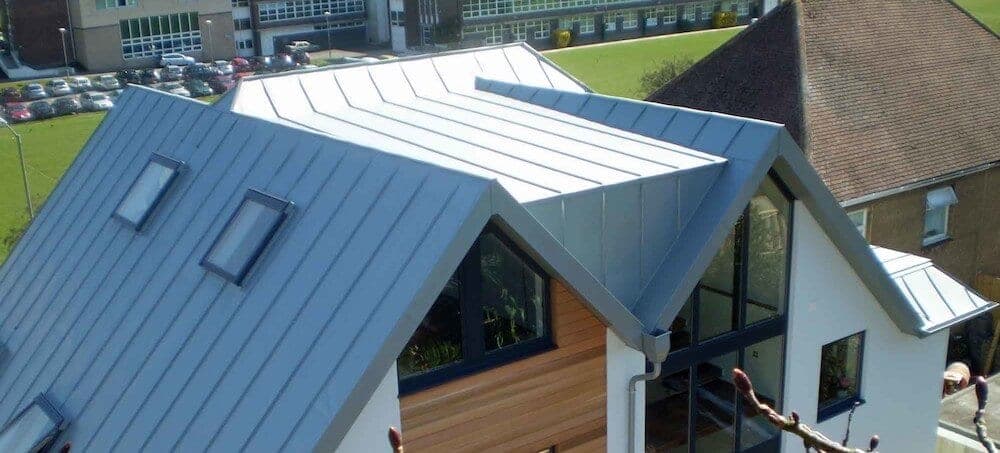
Our standard standing seam is 24-gauge galvanized steel with a Kynar (PVDF) finish, formed in our own shop into 18-inch snap-lock panels with a 1.75-inch seam. Kynar is the architectural-grade coating, and it is the one that holds color and film integrity under constant UV and salt load rather than chalking out early.
Because standing seam hides its fasteners under the panel, the coastal weak point on most roofs simply does not exist. There are no exposed screw heads on the face of the roof to corrode, back out or wick moisture into the deck.
- 24-gauge galvanized steel, heavier than the thin panels sold for barns and sheds
- Kynar (PVDF) architectural finish rather than a standard polyester coat
- Concealed fasteners, so nothing metal is exposed on the face of the roof
- Marine-grade specification on the flashings, trim and gutters, not just the panels
A coastal roof fails at its details long before it fails at its panels. Penetrations, valleys, edges and the metal you cannot see are where the specification has to hold.
Copper is the other coastal answer
Copper does not need a coating to survive salt air. It weathers into a patina that protects the metal underneath, which is why so much of the historic architectural metalwork near the water is copper and why it is still standing.
Our copper work is hand-formed in house by German-trained master tinsmith Hans Lipscher, and it is taken by commission. It starts around $38,000 and it is the roof people choose when they intend the house to outlast them.
So how long does it actually last
Fifty years or more, installed correctly, on the coast as well as inland. That is two to three times an asphalt shingle roof, and coastal shingle roofs tend to reach the low end of their range rather than the high end because the same salt and sun that a metal panel shrugs off accelerates granule loss and curling.
Every residential installation we do carries a lifetime warranty against leaks on our workmanship, transferable to the next owner with the remainder of 15 years, on top of the manufacturer warranty on the metal and the finish.
What maintenance looks like
Less than people expect, but not zero. Rinsing salt deposits off the roof and the gutters, keeping debris out of the valleys, and having the penetrations and sealant points inspected periodically is the whole program on a coastal home.
We offer scheduled inspection and maintenance for exactly this reason. It is also how the warranty stays intact.