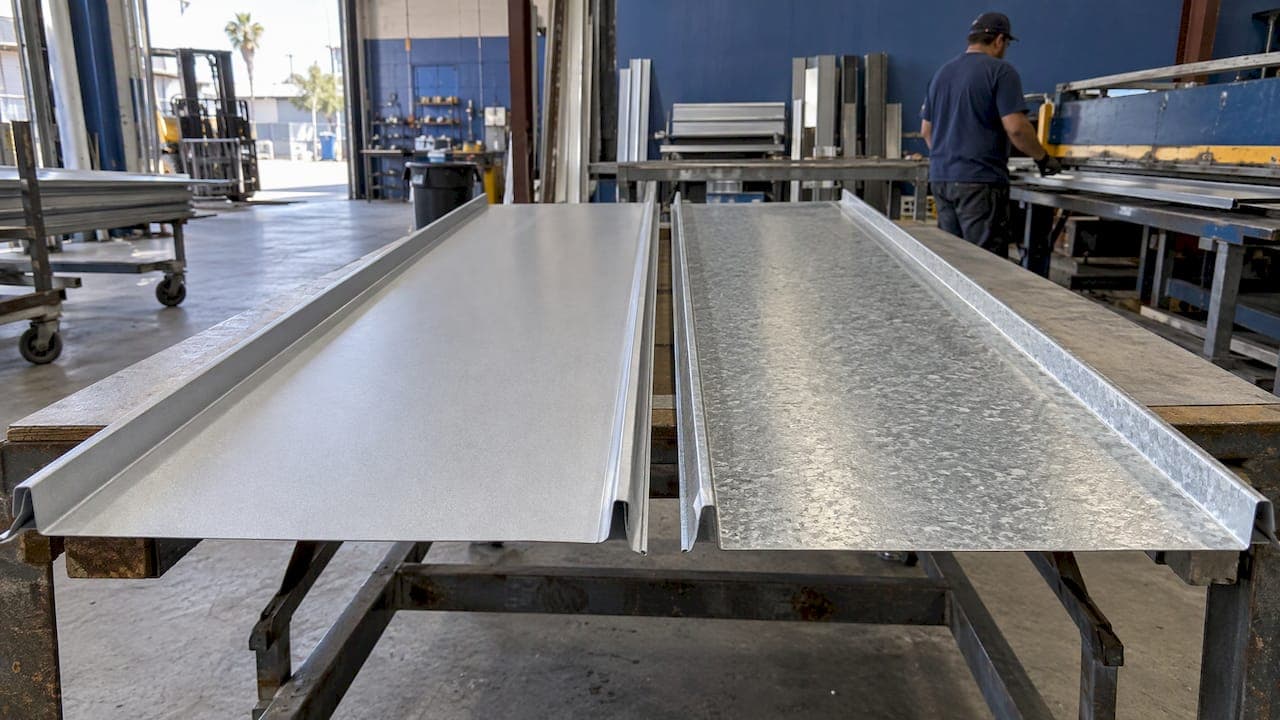
For most roofs, Galvalume outlasts galvanized steel. Its aluminum-zinc coating resists corrosion for far longer on flat panel surfaces, which is why it is the standard base metal for standing seam roofs. Galvanized steel is zinc-only, and it protects cut edges and scratches better. Near the ocean, neither coating is the whole answer: the panel profile, the finish, the fasteners and the warranty terms at your address matter as much as the base metal.
TL;DR
- Galvalume is coated with aluminum and zinc. Galvanized steel is coated with zinc only.
- On open panel surfaces, Galvalume’s coating lasts roughly two to four times as long as standard G90 galvanizing, depending on the environment.
- Galvanized steel heals cut edges and scratches better. Galvalume can show rust staining at sheared edges.
- Within 1,500 feet of the coast, some Galvalume substrate and paint warranties are not offered, so check the fine print before you buy.
- Installed price depends far more on roof complexity and tear-off than on the coating alone.
Table of Contents
- What each coating is made of
- How they compare, side by side
- Which one lasts longer?
- Does Galvalume rust?
- Is Galvalume more expensive than galvanized?
- Galvalume near the coast
- Choosing between them: a practical checklist
- Our perspective
- Standing seam, stone-coated steel and copper: where the coating question fits
- Get a roof specified for your address
- FAQ
- Sources
What each coating is made of
Both products start as a steel coil that is dipped in molten metal. The difference is what is in the bath.
Galvanized steel carries a protective zinc coating. Galvalume is a coating of 55% aluminum, 43.4% zinc and 1.6% silicon. That mix is the whole story behind how the two behave.

Zinc protects steel sacrificially. If the coating is scratched, the zinc corrodes first and shields the exposed steel next to it. Aluminum works differently. It forms a barrier layer that slows corrosion across the surface. Galvalume combines both. According to GalvInfo, its dendritic coating structure has zinc-rich areas that give early galvanic protection and aluminum-rich areas that act as a barrier as the coating weathers.
The practical consequence: galvanized steel protects through sacrifice, and Galvalume protects mostly through its barrier. Each has a place where it shines.
How they compare, side by side
| Factor | Galvalume | Galvanized |
|---|---|---|
| Coating | Aluminum, zinc and silicon | Zinc |
| Main protection | Barrier plus some galvanic action | Galvanic (sacrificial) |
| Life of coating on flat surfaces | Two to four times that of G90 galvanized, depending on environment | Baseline |
| Cut edges and scratches | More prone to red rust staining | Self-heals better |
| Forming | Best on simpler profiles such as standing seam | Tolerates more bending and shaping |
| Typical use | Roof and wall panels, often painted | Roofing, flashing, structural and agricultural uses |
Which one lasts longer?
On the flat field of a roof panel, Galvalume wins. GalvInfo reports that its coating outlasts G90 galvanized steel by two to four times, depending on the environment. The coating weight and thickness still matter, because how well a galvanized coating protects steel depends on its thickness, and a roof that is installed poorly can fail early whatever it is made of.
Manufacturer warranties give a sense of the scale. One Galvalume specification sheet describes conditional coverage against perforation from corrosion of up to 25 years and six months for building panel applications. That is a coating warranty on the sheet, not a promise about your roof as installed. Conditions apply, and they are worth reading.
There is one wrinkle you will see in the search results. Galvalume can show a little rust staining at cut edges earlier than galvanized steel does, in the short term. Early staining at an edge is not the same as the panel failing, but it is why edge detailing matters.
Does Galvalume rust?
Yes, in specific places, and it helps to know where.
Cut and sheared edges. Galvalume can develop rust staining at sheared edges. Because galvanized steel relies on galvanic action, it protects exposed steel at cut edges and scratches better, while Galvalume leans on barrier protection and is more susceptible to red rust at those points.

Bends. Galvalume is susceptible to tension-bend staining, where microscopic cracks form in the coating while a panel is being shaped, which can lead to rust. That is why it is generally limited to simpler profiles like standing seam. Roll-formed, well-engineered standing seam panels are the natural home for it.
Wet storage stain. Both Galvalume and galvanized sheet can develop a stain when moisture is trapped between coil laps, stacked sheets or formed parts. The manufacturer guidance is to keep material dry in transit, storage and at the job site. Ask your roofer where panels are stored between fabrication and installation.
Contact with other materials. Galvalume should not sit in direct contact with copper, lead, treated lumber or concrete where moisture is present, because that can trigger accelerated galvanic corrosion. Copper gutters over a steel roof, or copper flashing tied into steel panels without isolation, are the classic mistakes.
Animal buildings. Ammonia from manure reacts with the coating, so Galvalume is a poor choice for animal confinement structures. This rarely applies to a house, but it shows that the environment, not just the product, decides performance.
Is Galvalume more expensive than galvanized?
Usually a little, at the coil level, because of the more complex coating. What you pay for a finished roof is dominated by other things: roof size, pitch and complexity, the panel system, flashing details, and whether the old roof must be torn off.
For a sense of scale, one roofing cost guide puts a high-end standing seam roof at an average of $1,100 to $1,850 per square, materials and professional installation included, and says tear-off and disposal, when required, usually add about $100 per square. A square is 100 square feet.
On our own site, a full metal roof replacement is listed at $40,000 to $60,000. The range reflects roof size and complexity, so the useful number for your home comes from a measured estimate. You can see how we frame it on our metal roof replacement page and the cost page.
The price gap between the two coatings is small next to the cost of redoing a roof early. A coating that holds up longer and needs less maintenance is the cheaper option over the life of the roof, which is why most standing seam work uses Galvalume-class substrates.
Weight and lifespan versus other materials
Steel panels are light compared with heavy roofing. If you are weighing metal against tile, the structural load and expected life are the two numbers that change the decision, and a reference on tiled roof options shows what the alternative involves. Metal generally asks less of your framing, which matters on older San Diego homes and on re-roofs where you would rather not add structural work.
Galvalume near the coast
This is where most San Diego homeowners should slow down. A salt-laden marine layer is harder on a roof than inland sun, and the guidance from the industry is blunt.
One metal supplier does not recommend Galvalume in coastal environments because saltwater can degrade its coating, and it notes that Galvalume substrate or paint warranties are not available within 1,500 feet of a coast. It points to engineered aluminum for those locations. Metal Roofing Magazine likewise says aluminum handles salt-spray environments well while galvanized steel can corrode quickly near the coast.
The U.S. Department of Energy’s Building America Solution Center, drawing on FEMA guidance, says metal roofing is durable and low-maintenance and that products should be selected for corrosion resistance in coastal areas. It adds that coastal metal roofs should be designed to avoid ponding water and debris buildup, and that panels, screws, flashing and accessories should be chemically compatible rather than mixing dissimilar metals.
That last point is the one homeowners overlook. A roof is a system. The panel can be excellent and the roof can still fail at a fastener, a gutter junction or a flashing made of the wrong metal.
Aluminum or steel for a coastal roof
Aluminum is the material most often named for salt air, and it is fair to understand its trade-offs. Metal Roofing Magazine notes that aluminum is lighter than steel, which reduces structural load, but softer and less resistant to severe hail, and that its wind performance and warranty may be lower than other materials (source). San Diego has little hail, but wind during Santa Ana events is real, and panel profile and attachment matter.
The answer is not one metal for every address. A home a few blocks from the water, a home on a canyon rim in Rancho Bernardo and a condo building in Coronado do not face the same exposure. What they need is a specification written for the actual site: base metal, finish, panel profile, fasteners and flashing, all chosen together. We go through that thinking in more depth in our guides to metal roofs and salt air in San Diego and coastal metal roofing specs.
Choosing between them: a practical checklist
- Measure your distance from the water. Anything within sight of the ocean or bay should be treated as coastal, whatever the zip code suggests. Read the warranty’s distance limits before anything else.
- Match the profile to the metal. Galvalume is best on standing seam, where bending is limited. If you want a profile with tighter bends, ask how the roofer avoids tension-bend staining.
- Ask about edges. How are cut edges and penetrations treated and sealed? This is where Galvalume shows its weakest point.
- Insist on compatible accessories. Fasteners, flashing, gutters and trim should not create a dissimilar-metal pairing. Copper elements need isolation or a different design.
- Read the warranty in two layers. There is the material warranty from the coating or paint supplier, and there is the roofer’s own workmanship warranty. They cover different failures.
- Ask who does the work. Subcontracted crews mean the person who sold you the detail is not the person installing it.
- Plan for upkeep. Even a durable metal roof benefits from periodic inspection, especially at the coast, where salt deposits and trapped debris speed corrosion.
Our perspective
We get this question constantly, usually phrased as which metal is better. The more useful question is which roof system will survive your address for forty years or more.
In San Diego, salt air, wind and a rainy season that arrives in short, hard bursts decide how a roof ages. That is why we fabricate panels to custom specifications, including an 18-inch snap-lock profile designed for coastal conditions. A profile built for wind and salt, with detailing that sheds water instead of trapping it, does more for a roof than arguing over a coating chart.
We also do the installation ourselves rather than handing it to a subcontractor, because corrosion problems tend to start in the details: an edge, a fastener, a flashing, a gutter tie-in. The person who designs the detail should be the person who installs it.
Every roof we install is backed by a lifetime leak-free warranty, and we handle solar integration with the same team so panels are mounted without puncturing the system carelessly. If you want a roof that is specified for your exact location, we are glad to walk the roof with you.
Marcus
Standing seam, stone-coated steel and copper: where the coating question fits
The galvalume-or-galvanized choice sits inside a bigger one: what kind of roof you want.
Standing seam steel is the profile where the coating question matters most, because the panels are long, lightly formed and concealed-fastened. If you are comparing it with corrugated or exposed-fastener roofing, our guide to standing seam versus corrugated lays out lifespan and maintenance differences. You can also see our standing seam metal roofing service.
Stone-coated steel adds a textured granular surface over a protected steel base and suits homeowners who want the look of tile or shake with metal’s durability. Details are on our stone-coated steel roofing page.
Copper is a different category altogether. It is a distinct material with its own behavior and its own rules about what it can touch, so it is fabricated and detailed separately from steel. See our custom copper options.
Get a roof specified for your address
If you own a home, multi-unit building or commercial property in San Diego County and you are planning a replacement, we will look at your roof, your exposure and your budget, and write a specification that fits them, instead of selling one product to everyone. We build and install custom standing seam systems, stone-coated steel and copper, add seamless gutters, and coordinate solar so you deal with one team.
Start on our metal roofing page or go straight to metal roof replacement to see how an estimate works. We serve areas including Coronado and Oceanside.
FAQ
Which is better, Galvalume or galvanized steel?
For roof panels, Galvalume is usually the better base metal because its aluminum-zinc coating lasts two to four times longer than G90 galvanizing, depending on the environment. Galvanized steel is better where lots of bending is needed or where cut edges are exposed. The right choice depends on profile and location, not on the coating alone.
Does Galvalume rust?
It can, mainly at sheared edges, at bends where the coating has cracked during forming, and where it touches incompatible materials such as copper or treated lumber. The panel surface itself resists corrosion well. Good edge detailing, compatible accessories and dry storage before installation prevent most problems.
Is Galvalume more expensive than galvanized?
The coil usually costs somewhat more, but the finished roof price is driven by roof size, complexity, panel system and tear-off. Tear-off and disposal commonly add about $100 per square, according to a roofing cost guide. Because the coating lasts longer, many homeowners find the life-cycle cost is lower.
Can I use Galvalume near the ocean in San Diego?
Check the warranty first. Some Galvalume substrate and paint warranties are not available within 1,500 feet of a coast, and suppliers often point to other materials or specially engineered systems there. A roofer who knows coastal exposure should specify the metal, finish, profile and fasteners together for your address.
What are the disadvantages of Galvalume?
It is prone to tension-bend staining, so it suits simpler profiles like standing seam. Scratches and cut edges are also less protected than on galvanized steel, and it should not be used in animal confinement buildings. Proper design and installation handle these points in a house roof.
Sources
- Mastering Roof Inspections: Metal Roofs, Part 4 (InterNACHI)
- Galvalume vs. Galvanized Metal Roofing: The Differences
- Galvalume Steel vs. Aluminum: What Metal Roof Material to Choose
- GalvInfo Note 1.4: Introduction
- Galvalume Spec Sheet
- Metal Roofs, Building America Solution Center
- Metal Roofing by the Sea, Metal Roofing Magazine
- Metal Roofing Buying Guide: Facts, Myths, Installed Prices