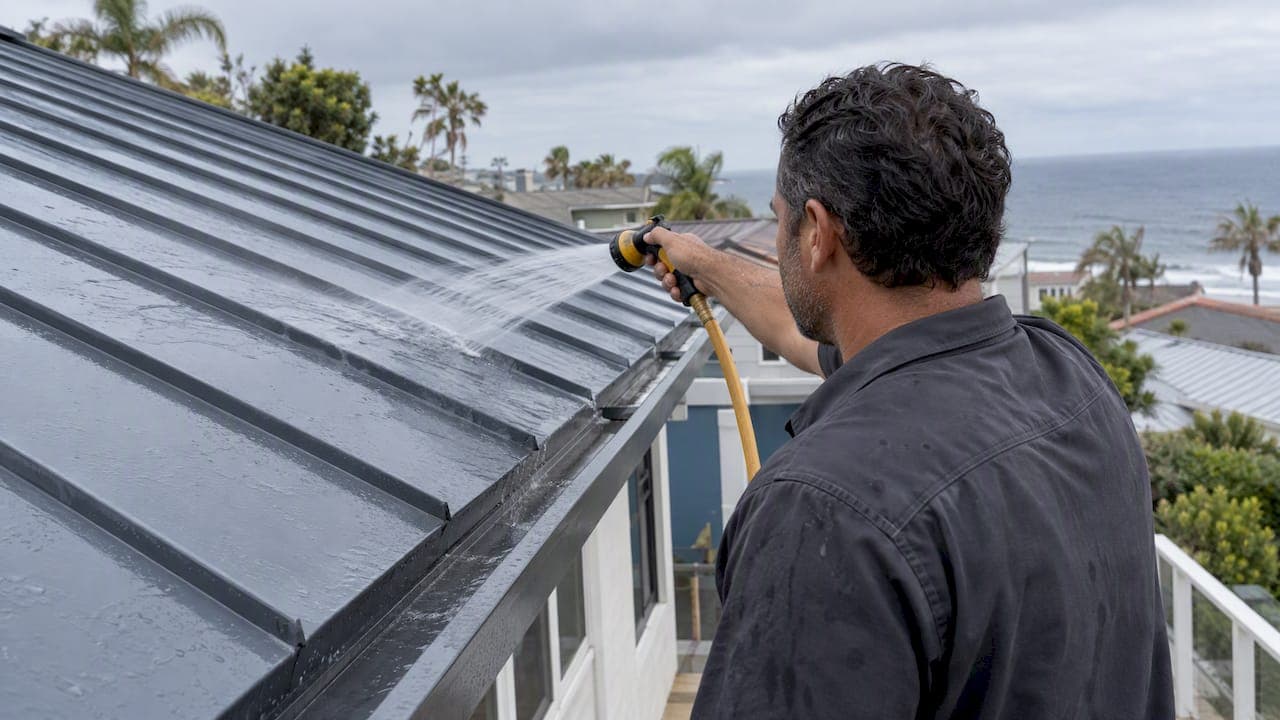
Most metal roofs need less cleaning than people think. A garden hose, a soft-bristled brush, a mild detergent and a dry, overcast day will handle ordinary dirt on a painted steel roof. What damages roofs is the opposite: pressure washers, wire brushes, strong chemicals and washing too often. Near the coast, where salt builds up on the panels, a regular rinse matters more than any scrubbing.
This guide covers how to clean a metal roof, how often to do it, the mistakes that strip finishes, and the point where you should stay on the ground and call a professional. We install and maintain metal roofs in San Diego, so we also say what coastal air does to them.
TL;DR
- Use low pressure only: a garden hose, a soft-bristled brush and a mild detergent. Skip pressure washers, wire brushes, abrasive pads and harsh solvents.
- Light rinse or inspection once a year. Deep cleaning every two to three years. Within sight of the ocean, plan on washing at least every six months to remove salt.
- Follow your roof manufacturer’s cleaning instructions. Over-cleaning and the wrong product can strip the finish and put your warranty at risk.
- Roofs are slippery and falls are the main danger. If the slope is steep, the roof is wet or you are unsure, hire someone with fall protection.
- Clear debris and keep water draining, especially around gutters, solar arrays and rooftop equipment. Ponding water does more harm than dirt.
Table of Contents
- What dirt actually does to a metal roof
- How often to clean a metal roof
- Before you climb: is this a job for you?
- What you need
- How to clean a metal roof, step by step
- What not to do
- Coastal roofs: salt is the thing to wash off
- Cleaning around solar panels, skylights and HVAC
- Washing a metal roof before painting
- Our perspective: clean less, inspect more
- When to hire a pro
- FAQ
- Sources
What dirt actually does to a metal roof
A factory finish on a metal roof is built to shed dirt. Rain does a lot of the work. Still, pollen, leaves, bird droppings, dust and mildew collect in valleys, behind chimneys and along the lower edge of the panels, and they hold moisture against the surface.
That is the real problem. According to California’s Department of General Services maintenance guidance, the aim of exterior upkeep is to keep debris and standing water from sitting on the building, and harsh chemicals are not usually needed for most exterior maintenance. Wet organic material leads to early rust, finish failure, mold and mildew. A roof that looks a little dusty but drains freely is in better shape than a clean-looking roof with a clogged valley.
So the goal of cleaning is not a showroom shine. It is to remove what holds moisture, wash off salt and pollutants, and give you a reason to look closely at the roof once or twice a year.
How often to clean a metal roof
Angi’s guide on cleaning a metal roof recommends a deep cleaning every two to three years, with a lighter annual cleaning or inspection in between. It says roofs in marine or industrial areas should be washed more often, at least every six months, because salt spray and fallout corrode aggressively.
For most San Diego homes, a practical schedule looks like this:
| Location | Light rinse or inspection | Deeper wash |
|---|---|---|
| Inland, under tree cover | After leaf drop and again in spring | Every two to three years |
| Inland, open sky | Once a year | Every two to three years |
| Coastal, within a mile or two of the water | Every six months | As the finish and manufacturer’s instructions call for |
These are guidelines, not rules. The manufacturer’s instructions for your specific panel come first. A roof under eucalyptus or pine needs debris cleared far more often than the table suggests, and a roof facing the surf needs the salt rinsed off regardless of how clean it looks.
There is also a ceiling. The New Zealand Metal Roofing Manufacturers’ code of practice describes regular washing as a way to reduce attack from airborne salts and pollutants, and coating technical bulletins warn that too-frequent or too-concentrated cleaners can wear down the finish. Wash for a reason, not on a calendar alone.
Before you climb: is this a job for you?
Cleaning a roof sounds like a weekend chore. It is one of the more dangerous things a homeowner does. OSHA’s National Emphasis Program on falls exists because falls from height are a leading cause of workplace deaths, and metal under a film of water or detergent is slick.
Stay off the roof and hire a professional if any of these apply:
- The pitch is steep, or the roof is two stories or higher.
- The panels are wet, damp from marine layer, or you would be working in the morning dew.
- You cannot tie off to a proper anchor with a harness.
- You see signs of rust, loose fasteners, lifted seams or sagging, which need an inspection, not a scrub.
- You have solar panels, skylights or rooftop equipment to work around.
If you can do the work from the ground, do. A hose with a spray nozzle and a long-handled soft brush reaches a surprising amount of a single-story roof from a ladder placed safely at the eave. Never lean a ladder against a gutter.
If you do walk the roof, where you step matters. Our guide to walking on a metal roof safely explains how to stay on the flats of the panels, away from seams, trim and flashing, and how slope changes the risk.
What you need
The list is short. The Lowe’s walkthrough lists much the same gear:
- Safety glasses and gloves
- A stable ladder and, if you go on the roof, a safety harness
- A garden hose with a spray nozzle
- A plastic pump sprayer
- A soft-bristled brush, ideally on a long handle
- A leaf blower for dry debris
- A tarp to protect plants and catch runoff
- A mild detergent or a cleaner approved for your roof finish
Skip the metal brushes, scouring pads and sandpaper. Abrasives scratch the paint, and once the coating is scratched, corrosion has a starting point.
How to clean a metal roof, step by step
1. Pick the right day
Choose a cool, overcast day with no rain in the forecast. Direct sun dries cleaner on the panels before you can rinse it, which leaves streaks. If the roof is hot, wet it down with plain water first. In San Diego, that usually means avoiding midday in summer and skipping mornings when the marine layer leaves the panels damp.
2. Protect what is below
Cover or soak nearby plants, and lay a tarp at the edge of the roof where you can. Professionals commonly do this to catch debris and runoff. Rinse water carries detergent, dirt and salt, and you should keep it off landscaping and out of the street. The County of San Diego’s stormwater standards manual covers non-storm discharges to the storm drain system, so ask your city or the county what applies to you before rinsing a large roof toward the curb.
3. Clear dry debris first
Remove leaves, needles and twigs with a leaf blower or a soft broom. Then clear the gutters and downspouts and check that valleys drain. Do this before you add water, or you will turn debris into mud.

4. Rinse from the top down
Start at the ridge and work toward the eave, so dirty water never runs over panels you have already cleaned. Use the hose on a normal spray setting, not a jet. Often this is all the roof needs. As one industry write-up put it, plain water is often enough to wash away dirt and dust, and that matches what we see on well-maintained roofs.
5. Scrub only where needed
For stubborn grime, mix a mild detergent in water. A common recommendation is a low-phosphate powdered laundry detergent, and a weak solution is all that is necessary for ordinary dirt. Apply it with a pump sprayer or soft brush, working in small sections along the panel, not across the seams. Let it sit briefly, but never let it dry on the metal.
Do not blend products. The Lowe’s guide notes that mixing bleach with other cleaners is dangerous. Many roof finishes also have limits on bleach and strong solvents, so check your warranty paperwork before you use either.
6. Rinse everything, twice
Rinse thoroughly with clean water. Left-behind detergent attracts more dirt and can leave a film. Rinse the gutters and downspouts too, then check that water is running freely and not pooling anywhere.
7. Look at the roof while you are there
Cleaning is the best time to inspect. Look for scratches, exposed metal, rust spots, loose or backed-out fasteners, failing sealant at penetrations and lifted seams. Photograph anything that worries you. If you find rust, our guide on deciding between repair, recoat or a pro can help you triage it.
What not to do
Do not pressure wash. It is the most common mistake. High pressure can damage the finish, and it can force water under panels, around vents and into seams, where it causes interior moisture damage you may not see for months. It is also a fall hazard: OSHA’s emphasis program directive specifically names power washing buildings among its fall-hazard targets. If a roof is so soiled that it needs pressure, that is a job for a professional using low-pressure equipment, and the manufacturer’s guidance should approve it first.
Do not use abrasives. Wire brushes, wool scrubbers, sandpaper and scouring pads permanently scratch the finish.
Do not use strong solvents or paint thinners. They can soften or dull coatings. The state guidance cited earlier says cleaning solutions should be only as strong as it takes to get satisfactory results.
Do not over-clean. Frequent washing with concentrated products wears the finish. The NZ code of practice and coating technical bulletins both point to the manufacturer’s own cleaning guidance for the specific finish, since different finishes tolerate different chemistry.
Do not walk on trim, seams or flashing. Step only on the flat areas of the panels, and clear any metal shavings or debris left from earlier work. Fragments stick to shoe soles and scratch the finish.

Coastal roofs: salt is the thing to wash off
On the coast, salt deposits are the main reason to clean. Salt-laden air settles on panels, and in sheltered spots like under eaves, where rain does not reach, it stays. Combined with moisture, it drives corrosion at cut edges, fasteners and any scratch in the coating.
Two habits matter more than any product:
- Rinse the protected areas. Panels under overhangs, the underside of the eaves and the lower courses of the roof are where salt stays longest. Fresh water from a hose, regularly, is the fix.
- Keep the paperwork. Many manufacturers tie warranty coverage to documented maintenance in coastal zones. Keep dates, photos and what you used.
This is one reason we designed our 18-inch snap-lock panel profile for coastal wind and salt air. A well-chosen profile and finish help, but no coating replaces rinsing.
Cleaning around solar panels, skylights and HVAC
Roofs with equipment on them collect water and debris in the wrong places. The Lowe’s guide and the maintenance guidance we reviewed both stress keeping drainage from rooftop equipment unobstructed, because ponding water around installations is a primary driver of early roof failure.
If you have solar, do not wash the roof and the array in one pass with the same product. Check the panel maker’s cleaning requirements first, as many specify plain water and a soft tool only. Our piece on solar panels on a metal roof explains how arrays are mounted and why the roof beneath them still needs inspection.
Washing a metal roof before painting
If you are cleaning to repaint, the standard is higher. A surface to be coated must be free of grease, oil, dirt and loose rust or oxidation. A dedicated cleaner designed for the substrate is the usual route, because soap residue and oxidation both prevent paint from sticking. Freshly galvanized steel has its own timing rules, and chromate or quench treatments interfere with adhesion, according to Tikkurila’s technical product page. Always follow the paint maker’s data sheet, and check that the new coating is compatible with the roof’s existing finish and does not void the warranty. For anything beyond light surface rust, have a roofer assess the roof before you recoat.
Our perspective: clean less, inspect more
We fabricate and install standing seam, stone-coated steel and copper roofs across San Diego, and the most common maintenance mistake we hear about is a well-meaning owner with a pressure washer. It strips finish, drives water into laps and leaves a roof that looks clean and performs worse.
Our advice is plain. Treat cleaning as part of an inspection. Rinse the salt, clear the debris, check the drainage, and photograph what you see. A metal roof installed properly and kept draining will outlast the people who bought it, and most of its problems start with water that has nowhere to go, not with dirt.
Because we do our own installation and do not subcontract it, we know how each roof was put together, where the seams and penetrations are and what is likely to need attention. That is why we steer homeowners toward the hose and soft brush for routine care and toward an inspection when something looks off.
— Marcus
When to hire a pro
Call for help when the roof is steep or high, when you see rust, damaged seams or leaks, when moss or heavy staining has built up, or when you have solar and want one team to handle both. A professional brings fall protection, low-pressure equipment and the experience to tell a cosmetic stain from a failing seam.
We offer metal roof maintenance and inspections in San Diego. If an inspection turns up a problem, our metal roof repair team can fix it, and every roof we install carries a lifetime leak-free warranty. If the roof is past saving, metal roof replacement is published on our site at $40,000 to $60,000. If you are weighing a new roof with solar, start at our homepage to talk with the team handling both. Owners of multi-unit buildings can look at our commercial metal roofing service.
A leak is a different problem from dirt. If you already have water coming in, read our guide to metal roof leak repair before you do anything else.
FAQ
How do I wash a metal roof before painting?
Remove all grease, oil, dirt and loose rust or oxidation, using a cleaner suited to the metal and the coating. Rinse it fully, let it dry, and follow the paint manufacturer’s prep and priming instructions. Fresh galvanized surfaces have strict timing windows, so read the data sheet first.
What is the biggest problem with metal roofs?
Usually it is not the metal but moisture that stays on it. Debris, ponding water and poor drainage cause early rust and finish failure. Regular debris removal and clear gutters prevent most of it, and a professional inspection catches the rest.
How often do metal roofs need to be cleaned?
A deep cleaning every two to three years is typical, with a light rinse or inspection each year. Near salt water, wash at least every six months to remove salt. Your manufacturer’s instructions override any general schedule.
Should you power wash a metal roof?
No. High pressure can damage the finish, push water under panels and into seams, and it is a serious fall hazard. Use a garden hose and a soft brush, and if a roof needs more than that, hire a professional who uses low-pressure equipment.
Sources
- Angi: How to Clean a Metal Roof
- California Department of General Services: building exterior maintenance
- OSHA: National Emphasis Program on falls (CPL 03-00-025)
- NZ Metal Roofing Manufacturers: washing
- Lowe’s: How to Clean a Metal Roof
- County of San Diego Stormwater Standards Manual
- Tikkurila: surface preparation for painting