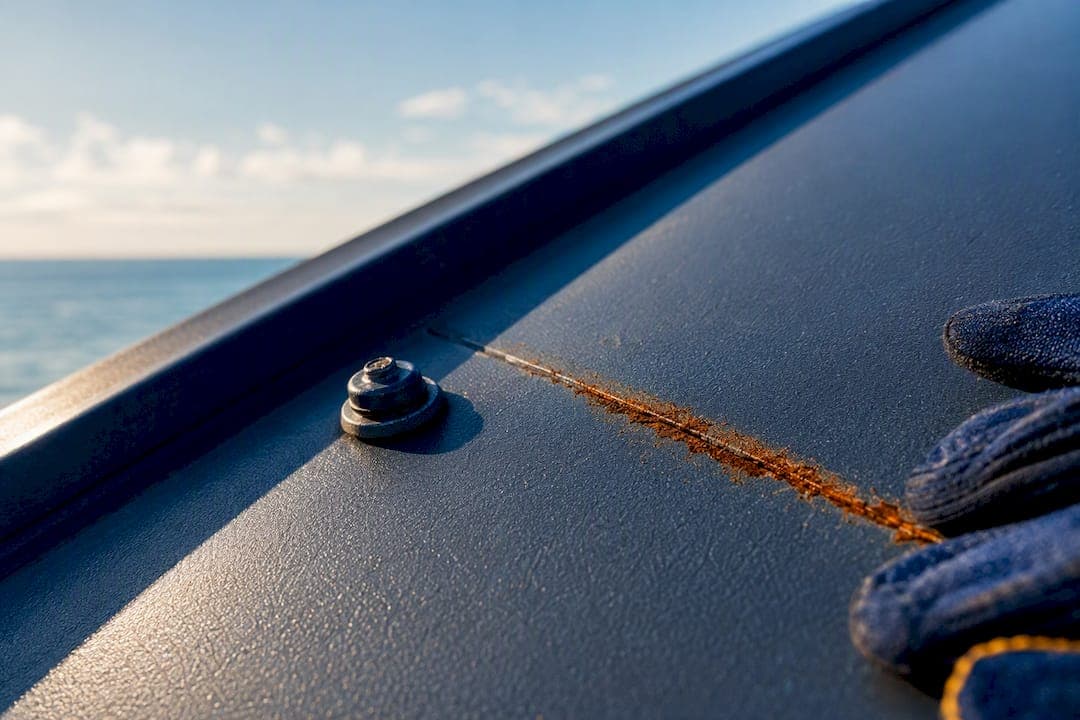
Most rust on a metal roof is fixable, not fatal. If the metal is still solid and fasteners haven’t loosened, cleaning, priming, and recoating will usually stop it cold. Deep pitting, holes, or fasteners that spin loosely in punky metal are a different story: that’s structural loss, and it calls for panel repair or replacement. Not sure which camp yours falls into? Grab binoculars before you grab a ladder, and if anything looks unstable, skip the DIY step and call a roofer.
TL;DR:
- Rust that is limited to surface discoloration and does not cause pitting or holes can be repaired with cleaning, priming, and recoating, especially if fasteners are tight.
- Coastal zones and certain areas like valleys, seams, and penetrating flashings are more prone to corrosion, requiring more frequent inspections and maintenance.
- Inspecting rust from the ground using binoculars or drones is sufficient for most cases, while unsafe or steep roofs require professional evaluation.
- Fastener replacement with stainless steel screws and regular sealant checks are among the most cost-effective preventative measures for ongoing rust control.
- Professional assessment is recommended when corrosion shows structural loss, loose fasteners in soft metal, or signs of leaks to determine whether repair, recoating, or panel replacement is necessary.
Table of Contents
- What Causes Rust on Metal Roofs in the First Place
- How to Inspect Your Roof for Rust and Judge Its Severity
- DIY Rust Repair for Surface-Level Corrosion
- When Recoating Makes Sense (and When It’s a Bad Idea)
- When to Call a Professional Roofer
- A Maintenance Plan That Actually Prevents Rust
- How a Metal Roof Contractor Actually Evaluates Rust
- An Editor’s Take: Stop Treating Every Rust Spot the Same Way
- Sources
- FAQ
What Causes Rust on Metal Roofs in the First Place
Rust is iron reacting with oxygen and moisture, and it only gets a foothold once the metal’s protective layer is compromised. Galvanized steel relies on a zinc coating, Galvalume pairs zinc with aluminum for extra staying power, and painted panels lean on a factory finish plus a layer of aluminum oxide on bare aluminum panels to keep corrosion out. Scratch through any of those barriers and bare steel is exposed to the weather with nothing standing between it and rust.
Mechanical damage does most of the early damage: a dropped ladder, a dragged extension cord, hail, or foot traffic from a satellite dish install can scuff a coating down to bare metal in seconds. Cut edges are just as risky, since factory coatings rarely wrap all the way around a field-cut panel, leaving raw steel exposed at every trimmed edge. Add trapped moisture from wet leaves or pine needles sitting in a valley, and you’ve built a mini corrosion chamber that stays damp long after the rest of the roof has dried.

Salt air speeds all of this up. Coastal exposure concentrates airborne salts at laps, fasteners, and penetrations, which is why homes near the water see rust years before inland roofs do, according to Paletz Roofing’s analysis of coastal corrosion.
Certain zones take the brunt of it:
- Seams and laps, where water can wick between panels if the seam isn’t fully engaged.
- Fastener heads, especially exposed screws whose washers have cracked or shrunk.
- Valleys, where debris collects and moisture sits the longest.
- Penetrations, like vent boots, pipe collars, and skylight flashing, where sealant eventually fails.
- Cut panel edges, particularly near ridges, hips, and rake trim.
How to Inspect Your Roof for Rust and Judge Its Severity
You don’t need to walk the roof to start this. Binoculars from the ground, a zoom lens from a second-story window, or a drone photo pass will tell you most of what you need before you risk a climb. Skip the climb entirely if the roof is steep, wet, or you’re not confident on a ladder; follow bottom up deck safety inspection best practices before going up. That’s a job for a professional, not a Saturday project.
When conditions allow a safe, low-risk look, work through the roof in this order:
- Scan panel faces for orange or red staining, especially near the eaves and any low-slope sections.
- Check every seam for gaps, lifted edges, or streaking below the seam line.
- Inspect fasteners one by one; look for rust rings, raised heads, or washers that have gone brittle.
- Look at cut edges along ridges, hips, and trim where bare metal is most likely exposed.
- Examine valleys for debris buildup and standing water marks.
- Check the attic or ceiling for water stains, since interior leaks often show up before exterior rust looks dramatic.
Once you’ve gathered what you’re seeing, match it to a severity level:
- Cosmetic bloom: light surface discoloration that wipes off or barely returns after rain. Monitor it, no action needed yet.
- Stable surface rust: red staining that stays put and doesn’t grow between inspections. Clean, prime, and seal.
- Perimeter or fastener corrosion: rust spreading from seams or screw heads, sometimes returning after rain, a sign the coating has failed there according to field observations from Paletz Roofing. Repair the specific detail now.
- Structural thinning or perforation: pitting you can feel with a fingernail, or actual holes. This needs a professional and likely panel replacement.
Pro Tip: Take dated photos of every rust spot you find. Comparing this year’s photo to next year’s is the fastest way to tell cosmetic bloom from active corrosion without guessing.
DIY Rust Repair for Surface-Level Corrosion
Surface rust that hasn’t eaten into the metal is a genuinely reasonable weekend project, provided you respect the roof itself. That means real fall protection: a harness anchored to a stable point, rubber-soled shoes, gloves, and eye protection before you touch a wire brush. Stage your tools and materials at the base of the ladder so you’re not making multiple trips across a wet or sloped surface.
Work through rust removal and treatment in this order:
- Wash the area with a mild detergent and water to strip dirt and loose debris; skip the pressure washer or keep it on a low setting, since high-pressure water can force moisture under seams and fastener heads and make the problem worse.
- Remove loose rust with a wire brush, then finish with sandpaper to expose clean, sound metal, following the same approach Lowe’s outlines for metal roof repairs.
- Let the surface dry completely before applying anything. Rushing this step is the most common reason DIY rust jobs fail within a year.
- Apply a rust converter or a zinc-rich, rust-inhibiting primer, matched to whether the rust is fully removed (primer) or partially remaining (converter, which chemically changes rust into a stable, paintable compound).
- Topcoat with a compatible metal roof sealant or elastomeric coating once the primer has cured per the label, according to Lowe’s repair guidance.
A few materials notes worth keeping in mind:
- Rust-preventative primer, not generic exterior paint, is what actually stops the reaction from restarting.
- White, powdery corrosion on galvanized panels is a different animal than red rust and needs its own solvent- or water-based rust-preventative primer, per Roof Coatings Manufacturers Association technical guidance.
- Never mix coating chemistries; check that primer and topcoat are labeled compatible with each other.
While you’re up there, swap any corroded or backed-out fasteners for stainless steel screws with neoprene washers, and reseal around every penetration you touch. Fastener replacement is one of the highest-value, lowest-cost repairs a homeowner can make, since it closes off one of the most common paths water takes into the panel.
When Recoating Makes Sense (and When It’s a Bad Idea)
Recoating extends the life of a roof that’s mechanically sound but cosmetically or lightly corroded. It’s the wrong move on a roof that’s already lost structural integrity, and doing it anyway just buries the evidence.
The clearest industry benchmark comes from the Metal Building Manufacturers Association, which advises that panels with roughly 30% section loss should not simply be coated; at that point, testing panel coupons is the only reliable way to know whether coating or replacement is the right call.
Coating is a reasonable path when:
- The panel shows no perforation or visible holes.
- Fasteners are tight and don’t spin freely when checked.
- There’s no measurable thinning when you press or tap the surface.
- Rust is limited to staining rather than pitting.
Repair or replacement is the right call when:
- You find any holes or light shining through from below.
- Fasteners spin loosely in soft, corroded metal.
- Interior leaks have already shown up on ceilings or in the attic.
The NRCA Roofing Manual is blunt about the risk of skipping this evaluation: coatings applied over severely corroded metal can hide dangerous deterioration rather than fix it, which turns a maintenance job into a safety issue for anyone who later walks that roof.
When to Call a Professional Roofer
Some rust is a weekend fix. Some is a warning sign you shouldn’t be standing on. Call a licensed contractor when you see structural rust (soft spots, visible thinning, or holes), corrosion spreading across multiple panels rather than one isolated spot, leaks that keep returning after you’ve already sealed a penetration, or any roof section too steep or unstable to inspect safely from a ladder.
A qualified contractor brings tools and judgment a homeowner inspection can’t match. Expect a professional visit to cover:
- Panel thickness checks, often with a gauge or coupon sample, to measure actual metal loss.
- Underside inspection, since rust often looks worse (or better) from below than it does from the roof surface.
- Flashing and fastener integrity, checked detail by detail rather than spot-checked.
- Substrate and framing condition, since long-term leaks can rot decking or rust structural steel underneath the panels.
From there, the fix might be a spot patch, a full panel swap, a fastener and flashing upgrade, or a coating program, backed by a warranty and confirmed to meet local code. SW Metal Roofing’s repair service covers this full range rather than a single fix, which matters once a roof has more than one thing going wrong at once.
A Maintenance Plan That Actually Prevents Rust
Rust prevention is mostly a scheduling problem, not a materials problem. Two inspections a year, roughly spring and fall, catch most developing issues before they become expensive. Add a walk-around after any major storm, and if you’re within a few miles of saltwater, tighten that cadence further since salt aerosol accelerates corrosion at seams and fasteners faster than almost anything else, according to Paletz Roofing’s coastal maintenance guidance.
Between inspections, a short list of routine tasks does most of the heavy lifting:
- Clear leaves, needles, and branches out of valleys and off low-slope sections.
- Flush gutters so water isn’t backing up under the drip edge.
- Rinse accumulated salt off panels and fasteners if you’re in a coastal zone.
- Check sealant around penetrations annually and replace anything cracked or shrunk.
- Swap any fastener with a failed or missing washer before it becomes a leak point.
A few upgrades pay for themselves over the life of the roof: stainless steel fasteners with neoprene washers instead of standard steel screws, dielectric separation wherever dissimilar metals touch (aluminum flashing against a steel panel, for instance), and, in marine zones, choosing aluminum or a heavier factory coating from the start rather than retrofitting protection later.
Pro Tip: Set a phone reminder for your two annual inspections tied to a date you’ll actually remember, like the start of daylight saving time and the weekend after Halloween. Roofs that get “inspected whenever we think of it” get inspected once every three years, not twice a year.
How a Metal Roof Contractor Actually Evaluates Rust
Marcus, editorial contributor covering roofing materials and maintenance for SW Metal Roofing, has spent years watching the same pattern play out on service calls: homeowners assume rust means replacement, and contractors know that’s rarely the first question worth asking.
A contractor walking a corroded roof isn’t looking at color, they’re looking at structure. Does the panel still have its original thickness? Are fasteners tight or spinning? Is the underside as bad as the surface, or better? Those three answers decide everything else.
SW Metal Roofing fabricates custom standing seam panels, including an 18-inch snap-lock profile engineered specifically for coastal wind and salt exposure, the exact conditions that push rust fastest. When a roof qualifies for coating rather than replacement, that’s the recommendation. When it doesn’t, custom fabrication and full replacement come with warranty and, for homeowners planning ahead, integrated solar panel installation on the same project.
Panel replacement gets recommended over patching or recoating when:
- Section loss is significant enough that a patch would just be a weak point next to strong metal.
- Multiple panels show the same failure pattern, meaning it’s systemic, not isolated.
- The homeowner is already planning solar, roof replacement, or a long-term ownership horizon where new panels outperform repeated patch cycles.
An Editor’s Take: Stop Treating Every Rust Spot the Same Way
Here’s what most rust advice gets backwards: it treats every orange spot as either nothing or a crisis. Real roofs don’t work that way. They are not remotely the same problem.
The instinct to either ignore rust (“it’s just cosmetic”) or panic and replace the whole roof are both expensive mistakes, just in opposite directions. The actual skill here is diagnostic, not chemical: figuring out whether you’re looking at a coating failure or a structural one. Most homeowners can learn to tell the difference with a flashlight, a fingernail test, and the willingness to admit when something’s beyond a weekend project.
If I had to pick the single most underused move in this whole process, it’s the fastener swap. Cheap, fast, and it closes off the exact spot where most leaks and most rust actually start.
— Marcus
Sources
- How to repair metal roof — Lowe’s
- NRCA Roofing Manual updates — NRCA
- Coating of Metal Roofs — MBMA white paper
- Rust on Metal Roof: Causes, Risks, Repairs and Prevention — New England Metal Roof
- Coatings Tech Note 5 - Metal Roofing — Roof Coatings Manufacturers Association
FAQ
Does a Rusted Metal Roof Need to Be Replaced?
Not necessarily. Surface rust on a roof with intact metal thickness and tight fasteners usually just needs cleaning, priming, and recoating. Replacement becomes necessary once you’re dealing with pitting, holes, or roughly 30% section loss, which is the threshold where coating alone stops being reliable.
Can I Paint Over a Rusted Metal Roof?
Yes, but only after removing loose rust and applying the right primer first. Home repair guidance from Lowe’s recommends wire brushing and sanding down to clean metal, then priming with a rust-inhibiting product before any topcoat goes on; painting straight over active rust just seals in the corrosion.
Does Rust Permanently Damage Metal?
Rust that’s caught early and stays surface-level doesn’t cause lasting damage once it’s cleaned and sealed. Left alone, though, rust eats away metal thickness permanently. Deep pitting or perforation can’t be reversed by cleaning or coating and typically means that section of panel needs to be replaced.
What Removes Rust Without Damaging the Metal?
A wire brush followed by sandpaper removes loose rust safely without gouging sound metal underneath. For red rust, power washing, sandblasting, or wire brushing followed by a rust-preventative primer is the standard approach; avoid aggressive grinding, which can thin healthy metal along with the rust.