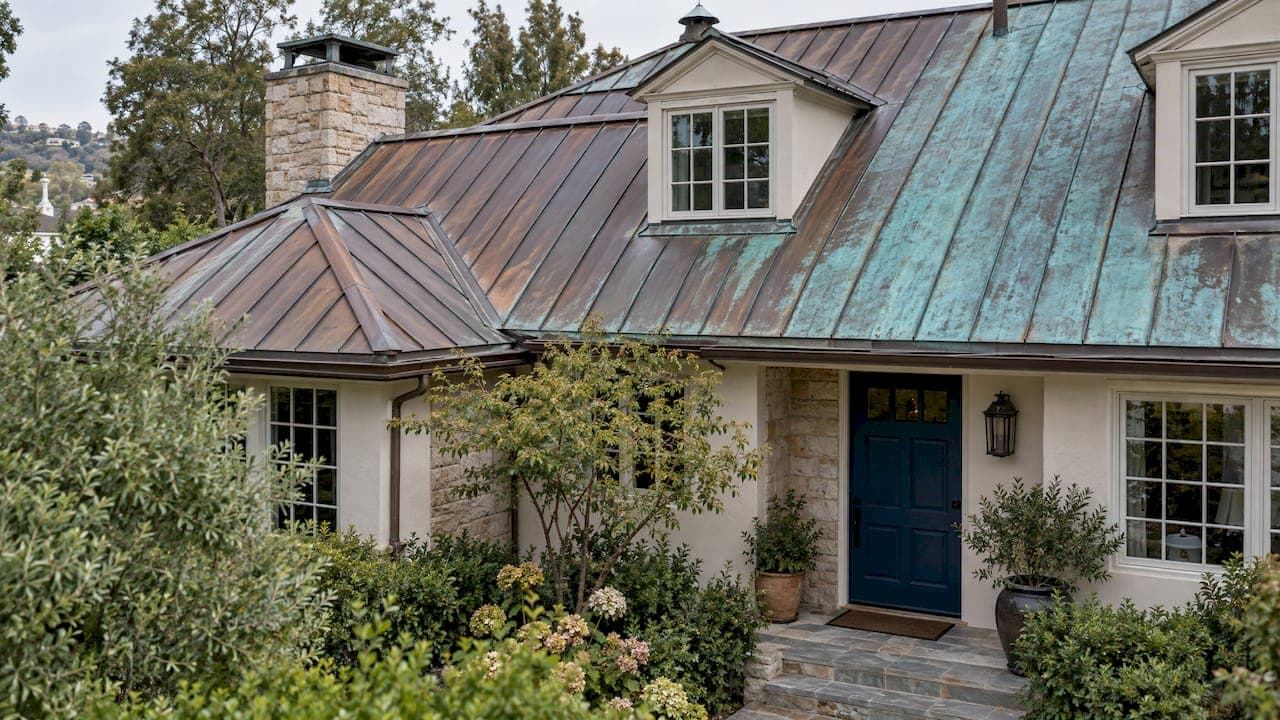
A copper roof patina is the thin, tightly bonded layer that forms on the metal as it reacts with air, rain and airborne salts. It moves from bright penny-orange to brown, often through dark brown or black, and in some climates ends in blue-green. It is not rust and not damage. It is the surface that protects the copper underneath. How fast it changes, and whether it ever turns green, depends mostly on where the roof sits.
TL;DR
- Patina is a protective oxide and salt layer, not corrosion that eats the roof. Once it is stable, it needs no maintenance.
- The usual color path is shiny copper, then brown, then black or gray, then green. Many roofs stop at brown or dark brown for decades.
- Timing depends on climate: roughly 5 to 7 years in seacoast or industrial air, 10 to 20 in clean rural air, and 50 or more (or never) in arid Western climates.
- In coastal Southern California, expect an uneven, evolving look rather than a quick, uniform green. Flashing, drainage and slope all affect the pattern.
- Painted “copper-look” panels are a different product from real copper and do not patinate the same way.
Table of Contents
- What the patina on a copper roof actually is
- How long does it take for a copper roof to turn green?
- The color stages, from penny to green
- Does patina protect the roof?
- Can you get or keep a brown patina?
- Real copper or a copper-look finish?
- Our perspective
- Planning a copper roof in San Diego
- Get a copper roof detailed for your home
- FAQ
- Sources
What the patina on a copper roof actually is
Fresh copper is bright and salmon-colored. Within weeks, oxygen starts building a film on the surface, and rain, humidity and trace gases in the air add to it. The result is a mineral skin that is part of the metal’s surface rather than a coating sitting on top of it.
The Copper Development Association describes the natural protective coating on exposed copper as a blue-green patina. Its major coloring agent is basic copper sulfate, with carbonate and chloride salts sometimes present, and chlorides may be essential in seacoast locations. Many people assume the green is copper carbonate. A Smithsonian Museum Conservation Institute summary of classic research on the subject says basic copper carbonate enters only to a minor extent, while sulfur compounds from combustion carried on the wind are the most potent agents in forming patina. In purely marine air, basic copper chloride predominates instead.
Two layers, not one
A peer-reviewed study in Corrosion Science found that the patina typically forms two distinct layers. Against the metal sits a thin, continuous layer of cuprite (copper oxide), about 5 to 10 micrometers thick. On top is a porous outer layer of 5 to 40 micrometers, made of brochantite (basic copper sulfate) or atacamite (basic copper chloride). Brochantite patinas are more common, and atacamite is typical of marine patinas.
That structure explains the colors. The same research and later work on the topic show the red-brown to black tones come from the cuprite, and the green comes from the sulfate and chloride salts layered over it.
Why it forms unevenly
The same Corrosion Science study notes that patina forms preferentially where rain washes the surface and water films are thicker than simple dew. On corrugated copper roofs, the troughs, which see more rainwater, show thicker, more obvious patina than the raised areas. On a standing seam roof, you may see similar differences between a south-facing slope and a shaded one, or between the middle of a pan and the area under an overhang.
How long does it take for a copper roof to turn green?
The honest answer is that it depends on the air around the building. The American Architectural Copper Association (ATAS) gives these ranges in its guide, Understanding Copper:
| Environment | Typical time to green patina |
|---|---|
| Industrial and seacoast | About 5 to 7 years |
| Relatively clean rural | About 10 to 20 years |
| Arid climates, such as the Western United States | Over 50 years, or it may never develop |
The academic range is even wider. The Corrosion Science study puts the transformation from clean copper to green patina anywhere from 6 to 50 years.
There is also a modern wrinkle. Hedberg and Odnevall Wallinder (2011) report that sulfur dioxide in the air has fallen substantially in Europe and the US over recent decades. As a result, black-brown patinas now tend to develop in preference to green ones. The initial copper oxide pushes the surface toward brown-black, while sulfates and chlorides make it greener. Cleaner air means less sulfur, so the green arrives later, or less fully, than older references suggest.
What this means in San Diego
San Diego sits in a mild, dry-leaning climate with marine air near the coast. Two of the three ATAS categories pull in opposite directions here: salt air speeds the chemistry along, while low rainfall slows the wet-dry cycling that builds the outer layer. We do not have a published timeline specific to San Diego, so treat the ranges above as bookends. In practice, a coastal roof is likely to move through brown and dark brown well before it shows green, and some slopes may show green streaks and blue-green accents long before others. If you want to understand how salt air affects metal roofs in general, our guide to metal roofs and coastal salt air in San Diego covers it in detail.
The color stages, from penny to green
The Insurance Institute for Business & Home Safety describes copper aging as patination caused by surface oxidation, and reports a typical progression from bright shiny copper to black, gray, brown and eventually green. In practice, here is what homeowners see:
- Bright copper (first days to weeks). Shiny and warm orange-pink. Fingerprints and rain spots show.
- Dull brown (first months). The cuprite layer builds. The roof looks like an old penny.
- Dark brown to near-black (one to several years). Often the most dramatic stage. Some owners worry it looks dirty. It is the oxide layer thickening.
- Gray or mottled tones. Streaks and patches appear where moisture and runoff differ.
- Blue-green (where the climate supports it). Sulfate or chloride salts form the outer layer, starting in the wettest areas and spreading.
Not every roof reaches stage 5. A dark chocolate-brown copper roof that stays that way for decades is a legitimate, stable outcome, not a roof that has “failed to patinate.”
Does patina protect the roof?
Yes. This is the main reason architects have used copper for centuries. The Corrosion Science review of patina evolution says copper patinas generally act as efficient barriers that reduce corrosion rates and extend service life, because the compounds are relatively insoluble and protective.
That runs against a common assumption that the green stuff is a salt that washes away. Hedberg and Odnevall Wallinder point out that the green patina is not a water-soluble salt that would dissolve rapidly. The basic copper compounds are chemically very different from soluble copper salts, are bound into the cuprite-dominated layer, and stay strongly adherent through repeated wet and dry cycles.
Building Conservation reports that this oxidized surface forms a protective coating that regulates corrosion through the sheet, and that copper sheet can last 100 years or more. The same article gives the safe-use caveat: acidic runoff or concentrated flue gases can strip the protective oxide and patina, accelerate corrosion and thin or perforate the metal. In practice, that means paying attention to what drains onto the copper:
- Keep the copper clear of runoff from materials that shed acid or concentrated exhaust, such as a flue outlet discharging directly onto the surface.
- Make sure flashing and drainage details are clean and tight, so water does not sit and stain in patches.
- Leave the patina alone. Scrubbing or polishing a stable patina strips the very layer that protects the roof.
If you are comparing how metals age more broadly, including what rust means on other metal roofs, our page on what to do about rust on a metal roof is a good companion, since copper behaves very differently from steel.
Can you get or keep a brown patina?
Many homeowners love the deep brown stage and ask if they can hold it there. There are two routes.
Maintaining a natural brown. The Copper Development Association says no maintenance is required for an existing natural patina or one in formation. If you want to freeze a statuary brown finish, weathering can be arrested by applying a suitable oil such as raw linseed oil or lemon oil every one to three years. It also records cases where an initial application in two thin coats kept the statuary finish for more than ten years. On a steep or large roof, this is recurring work at height, so most owners who want brown simply accept the natural progression.
Inducing brown chemically. The CDA describes a brown statuary finish made by brushing the surface with a 2% liquid ammonium sulfide solution, letting it dry, rubbing lightly with pumice and water, and repeating until the color is right. It also notes that periodic oiling with lemon oil, lemon grass oil or high-grade paraffin oil, or waxing, can maintain prefinished or naturally weathered statuary-bronze surfaces.
This is not a do-it-yourself weekend job on a roof. The same CDA page cautions that chemically induced patinas are prone to poor adhesion, staining of adjacent materials, or uneven color over large areas. Any applied finish also raises warranty questions. For a sense of how coatings and color treatments interact with manufacturer coverage on other roof types, this overview of roof color treatment and warranties shows why checking the terms first matters. On a copper roof, ask your installer before anything is applied.
Real copper or a copper-look finish?
This is where homeowners get surprised. Some products sold as “copper” are steel or aluminum panels with a painted copper-colored finish. They are designed to look like copper at a point in time, and they behave like painted metal: the color change you read about above is the behavior of real copper, not of paint. A painted panel will not develop the layered patina described here.
So before you sign, confirm which you are buying:
- Solid copper sheet: it patinates, and the color evolves over years or decades.
- Copper-colored painted metal: it holds a manufactured color, subject to the paint system’s own aging and warranty.
Neither is wrong, and the right choice depends on whether you want the living, changing character of copper or a fixed color. If you are weighing options across materials, our overview of metal roof types in San Diego lays out the main families we install.
Our perspective
We install and fabricate roofs for homes that sit within sight and smell of the Pacific, and copper is the material that teaches patience better than any other. Owners usually call us worried in year two, when a bright roof has gone chocolate or nearly black and they expected green. That is the roof doing its job.
Our view is simple. Real copper is a decision about time: you are choosing a roof whose look will keep evolving, and whose protective layer is built from the metal itself. That is why we put so much of our effort into what the owner never sees on day one: tight seams, clean flashing, correct drainage, and fabrication to the actual specification of the house. Patina forms best, and looks best, on a roof where water moves cleanly and nothing traps or concentrates runoff.
We fabricate panels to custom specifications and install with our own crews, not subcontractors, because the details that decide how a copper roof ages are made by hand. That includes the way coastal wind and salt air meet the roof edges. We back our work with a lifetime leak-free warranty, and if solar is part of your plan, we handle the roof and the panel integration as one job so penetrations and flashing are planned together rather than argued over later.
If you love the idea of a roof that gets more characterful with age, copper is the one to choose, and we would be glad to show you how we would detail it for your home.
Marcus
Planning a copper roof in San Diego
If you are considering copper, a few decisions shape how the patina will look.

Orientation and exposure. Slopes that see more rain and runoff patinate faster and more heavily than sheltered ones. Expect variation between faces of the house.
Detailing. Flashing, valleys and drip edges all affect where water runs and where staining shows. Our write-up on workmanship mistakes on copper standing seam roofs explains what poor detailing looks like and how to avoid it.
Panel flatness. Large flat copper pans can show waviness, and patina makes it more visible in raking light. See our guide to avoiding oil canning on metal roofs for how profile and installation reduce it.
Coastal specification. If your home is close to the water, material and fastener choices matter as much as the finish. Our page on coastal metal roofing specs walks through what to specify.
Gutters and adjacent materials. Copper runoff can stain light-colored stone, stucco and concrete below it. Plan drainage so water leaves the roof and lands where a green or brown tint will not matter, or choose gutter material with that in mind.

Get a copper roof detailed for your home
We fabricate and install custom copper roofs in San Diego, with the seams, flashing and drainage planned so the patina develops evenly and the roof stays watertight. Our work carries a lifetime leak-free warranty, and we can coordinate solar panel integration in the same project. See our custom copper roofing service or our copper roof options, then contact us to talk through your home.
If you already have a metal roof and want it looked over, we also offer metal roof maintenance and inspections.
FAQ
Is copper roof patina the same as rust?
No. Rust is iron oxide that flakes and eats through steel. Copper patina is a stable, insoluble layer that bonds to the metal and slows further corrosion. Research in Corrosion Science describes copper patinas as efficient barriers that extend service life, so you should not remove one.
Why is my new copper roof turning dark brown instead of green?
Brown and near-black are normal early stages, caused by the cuprite (copper oxide) layer building up. Green only forms when sulfates or chlorides build an outer layer, and that takes years, and may not happen at all in arid or low-sulfur environments. Many roofs stay brown for decades.
Should I clean or polish a copper roof to stop the patina?
No. The CDA says an existing natural patina or one that is forming needs no maintenance. Polishing removes the protective layer and starts the process over. If you want to hold a brown stage, the CDA describes periodic oil applications, which are best handled by a roofing professional.
Can I speed up the green color?
Chemical patination exists, but the CDA warns about poor adhesion, staining of adjacent materials and uneven color over large surfaces. On a real roof, patience and good drainage detailing usually give a better, longer-lasting result than a treatment. Ask your installer before any treatment goes on.
Does a copper-colored metal roof develop patina?
Only real copper does. A painted copper-colored steel or aluminum panel holds a manufactured finish rather than growing a natural patina. Confirm the material in your quote so you know which look you are buying.
Sources
- Green Patina Finishes, Copper Development Association
- Brown Statuary Finishes, Copper Development Association
- The chemistry of copper patination, Corrosion Science (ScienceDirect)
- Museum Conservation Institute, Smithsonian
- Understanding Copper, American Architectural Copper Association
- Copper, Insurance Institute for Business & Home Safety
- Patina Evolution, Corrosion Science
- Copper Sheet Roofing, Building Conservation
- Protective Green Patinas on Copper in Outdoor Constructions, Journal of Environmental Protection
- Roof color treatment and warranties