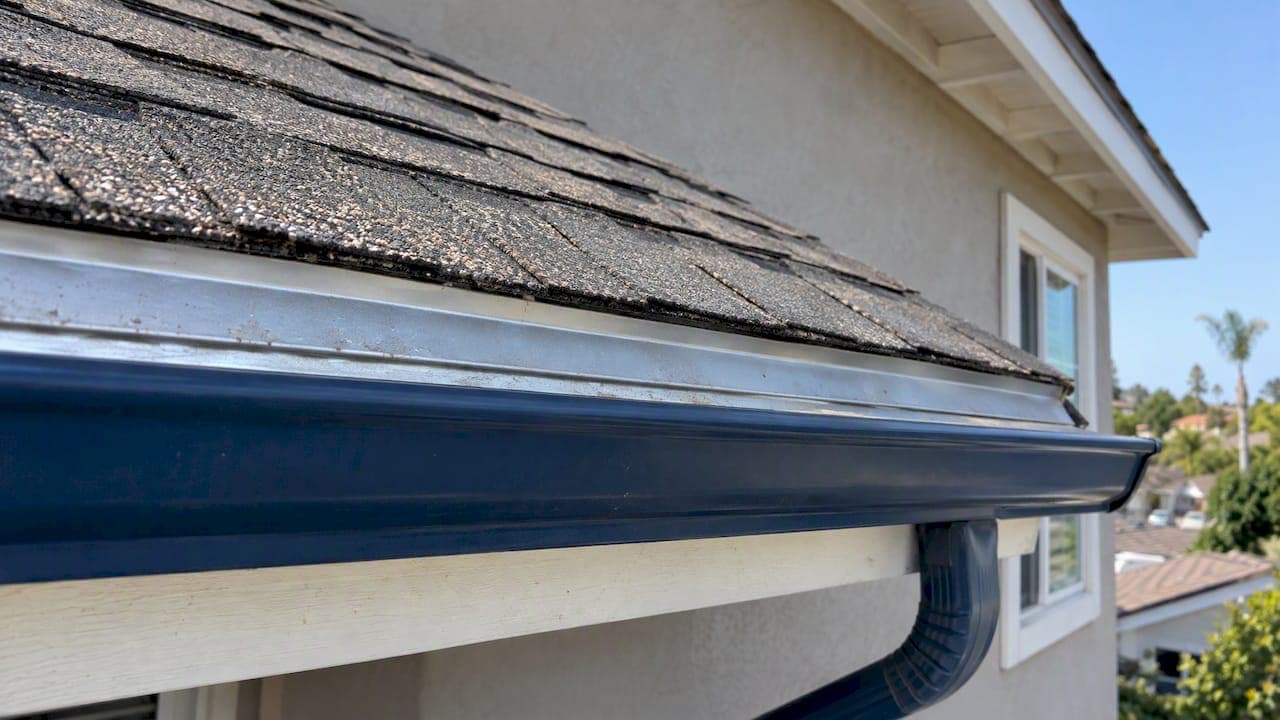
Most shingle roofs need drip edge at both the eaves and rakes, and when functioning gutters stay in place, a gutter apron often goes in at the eave as well since many roofing professionals install both for full edge protection. The distinction matters because ARMA guidance calls for different placement relative to the underlayment at each location. Keep reading for the installation sequence, fastening specs, and the maintenance checks that keep either product doing its job.
TL;DR:
- At eaves, install drip edge before underlayment; at rakes, reverse the order, then nail the flat flange every 8 to 10 inches.
- For roofs retaining gutters, use a gutter apron at the eaves and standard drip edge on both rakes; without gutters, standard eave flashing suffices.
- Extend drip edge 1/4 to 3/4 inch past the fascia, and tuck a gutter apron at least an inch into the gutter channel.
- Look for rust, gaps, loose nails, and deck separation; clear gutters regularly, replace corroded flashing, and call a professional for soft decking or recurring leaks.
Table of Contents
- What Is a Drip Edge: Profiles, Materials, and Why It Matters
- What Is a Gutter Apron and Where It’s Used at the Eave
- Key Differences and Decision Rules: When to Install Drip Edge, Gutter Apron, or Both
- Installation and Placement Best Practices (Sequence, Fastening, and Measurements)
- Common Problems, Inspection Checklist, and Simple Maintenance
- Why Edge Flashing Deserves More Attention Than It Gets
- If You Want Professional Installation or Integrated Metal Roof and Gutter Work
- FAQ
- Sources
What Is a Drip Edge: Profiles, Materials, and Why It Matters
A drip edge is a narrow metal flashing strip installed along the roof’s perimeter to shed water away from the fascia and roof deck instead of letting it curl back underneath the shingles. Without it, water tends to wick along the underside of the roofing material and soak into the wood edge, which is one of the more common causes of rot at the eaves and rakes.
Three profiles cover most residential jobs:
- Type C (L-shaped): a simple right-angle bend, the most common and least expensive option.
- Type D (T-shaped): adds a vertical hem for extra stiffness along steep or windy roof lines.
- Type F (extended): a longer vertical face, sometimes marketed as gutter apron because it reaches further into the gutter trough, according to Inspectapedia’s drip-edge guide.
Aluminum and galvanized steel dominate the market for cost reasons, while copper holds up longest in salt air but costs more. ARMA’s residential manual calls for corrosion-resistant material that extends a minimum distance back onto the sheathing, with a downward bend that directs runoff clear of the fascia board.
What Is a Gutter Apron and Where It’s Used at the Eave
A gutter apron is a flashing variant built specifically to bridge the gap between the roof edge and an existing gutter trough, extending further down than a standard drip edge so water drops directly into the gutter instead of behind it. Where a basic L-profile stops at the edge of the fascia, a gutter apron’s longer leading edge solves the common retrofit problem of a roofline that was never quite matched to the gutter position.
- Open-angle profiles: the dominant shape, installed over the roof deck and bent down into the gutter channel.
- Gauge options: most gutter apron products ship in 26 or 28 gauge, per the EDGEmaster product datasheet, with hemmed edges that reduce cuts during handling.
- Best fit: roofs keeping their existing gutters, or geometry where a standard drip edge would dump water short of the trough.
Starter shingles still lap over the gutter apron the same way they would over a standard drip edge, so the switch doesn’t change your shingle layout, only where the water lands once it leaves the roof.
Key Differences and Decision Rules: When to Install Drip Edge, Gutter Apron, or Both
The core difference comes down to where each piece sends water. Standard drip edge protects the fascia and deck edge; gutter apron goes a step further and aims that same water directly into the gutter trough. Here’s how to decide which applies to your project:
- Keeping your gutters? Install a gutter apron at the eave so water enters the trough cleanly instead of running behind it.
- Removing or replacing gutters? A standard L or T profile drip edge is sufficient at the eave.
- Working on the rakes? Use standard drip edge; gutter apron profiles are an eave-specific product and rarely apply there.
- Dealing with ice-dam-prone climates? Pair drip edge with an ice-and-water shield membrane rather than relying on the flashing profile alone.
- Installing on a metal roof? Match the drip edge gauge and finish to the panel system, since mismatched metals can accelerate galvanic corrosion at the edge.
In terms of tradeoffs, gutter apron offers a cleaner water path into existing gutters but can be trickier to retrofit onto an older fascia board without disturbing the gutter hangers. Standard drip edge installs faster and costs less but leaves a gap between the fascia and the gutter when the gutter sits slightly away from the roofline. The common professional approach: drip edge along both rakes, with a gutter apron style profile at eaves wherever gutters remain or the fascia-to-gutter gap calls for it.
Installation and Placement Best Practices (Sequence, Fastening, and Measurements)
Placement relative to the underlayment is the detail most installers get wrong. ARMA’s technical bulletin is specific about this: at the eaves, the drip edge goes down first, with underlayment laid over it so water that gets past the shingles still sheds onto the metal rather than soaking into felt or synthetic underlayment. At the rakes, the sequence reverses: underlayment goes down first, then drip edge on top, so wind-driven rain along the gable edge runs over the metal instead of finding a seam underneath it.
- Fastening: space nails 8 to 10 inches apart along the flat flange, never through the vertical lip.
- Overhang: let the drip edge extend 1/4 to 3/4 inch past the fascia for a clean drip line.
- Starter shingle alignment: keep the starter course flush with the drip edge’s outer edge to avoid gaps at the first course.
- Gutter apron tuck-in: the extended face should overlap into the gutter channel by at least an inch, and self-adhering underlayments can sandwich around it per manufacturer instructions.
Pro Tip: On a retrofit over an existing fascia, match the new flashing’s gauge and finish to what’s already there before you fasten anything. A mismatched profile or color is the fastest way to turn a clean repair into a visible patch job. For metal roof specifics, our guide on fastening and overlap for metal roof drip edge covers panel-specific spacing in more depth.
Common Problems, Inspection Checklist, and Simple Maintenance
Corrosion is the most frequent failure, particularly on uncoated steel exposed to salt air or standing moisture. Misplaced flashing, meaning drip edge installed under the underlayment at the rakes or over it at the eaves, lets water track behind the metal instead of over it, which ARMA’s manual ties directly to premature deck rot. Loose fasteners, poor overlaps at seams, and clogged gutters that back water up under the flashing round out the usual list.
- Check for: visible gaps or seams, rust streaks, popped nails, and separation between the flashing and the deck edge.
- Maintain by: clearing debris from gutters regularly, since backed-up drainage can force water under flashing it was never meant to reach.
- Reseal or replace: any section showing corrosion rather than patching over it.
- Call a pro when: you find soft or rotted decking, recurring leaks in the same spot, or a metal roof transition that needs custom-fabricated flashing rather than stock trim. Our maintenance and inspection service covers exactly this kind of diagnostic work. For a deeper look at how failures show up around other roof penetrations, this guide to chimney flashing leaks walks through similar diagnostic logic.
Why Edge Flashing Deserves More Attention Than It Gets
Most roofing discussions treat drip edge and gutter apron as an afterthought, something to check off after the shingles and underlayment decisions get made. That ordering is backward. Edge flashing is the detail most likely to fail quietly for years before anyone notices rot in the fascia, and by the time it shows, the repair usually involves more than a flashing swap.
The bigger issue is that generic retrofit trim rarely matches the roof it’s being added to. A stock aluminum L-profile dropped onto a standing seam metal roof, for instance, can set up a slow galvanic reaction if the metals don’t pair well, and a mismatched gauge looks wrong for years before it fails outright. Custom-fabricated panels and edge trim, built to the specific roof’s dimensions and coastal exposure, close that gap in a way off-the-shelf stock material can’t.
— Marcus
If You Want Professional Installation or Integrated Metal Roof and Gutter Work
We fabricate edge flashing, trim, and seamless gutters to match the exact roof we’re installing rather than pulling from generic stock sizes, including a custom 18-inch snap-lock panel profile built for coastal wind and salt exposure. Every installation we complete carries a warranty, and because we handle solar integration in-house as well, edge details, gutters, and panel work all come from one crew instead of several subcontractors passing the job between them.

If you’re weighing a repair against a full edge or gutter replacement, our seamless gutters page covers how we pair gutter work with roof edge detailing, and you can get a project estimate through our cost page.
FAQ
Can a gutter apron go over a drip edge?
Stacking both isn’t standard practice since a gutter apron is designed to replace the drip edge’s function at the eave, not layer on top of it. If your roof has a standard drip edge and you want better gutter alignment, the usual fix is swapping it for a gutter apron profile rather than adding a second layer.
Do I need a drip edge with gutters?
Yes, drip edge or its gutter apron variant is still needed even with gutters installed, since its job is protecting the fascia and deck edge, not just directing water into the trough. ARMA’s guidance treats it as standard practice regardless of gutter presence.
Do you need a gutter apron?
A gutter apron makes sense when you’re keeping existing gutters and want water to drop cleanly into the trough instead of behind it, which is common on retrofits where the original drip edge falls short. If you’re removing gutters entirely or starting from scratch with new ones properly aligned, a standard drip edge profile is often enough.
What are the common problems with drip edge on a roof?
The most frequent issues are corrosion from prolonged moisture exposure, flashing installed in the wrong sequence relative to the underlayment, and loose or missing fasteners that let the metal pull away from the deck. Each of these lets water track behind the flashing instead of over it, which over time leads to fascia and deck rot.
Sources
- Installation of Drip Edge at the Eaves and Rakes (ARMA technical bulletin)
- Guide to Drip Edges for Shingle Roofs (Inspectapedia/IKO technical guide)
- EDGEmaster Gutter Apron (Open Angle) product datasheet