A metal roof does not attract lightning, and it does not raise your odds of getting struck. Lightning targets the tallest, most exposed point in an area regardless of what covers it, and metal’s real advantage shows up after a strike happens: it conducts energy across a wide area instead of igniting. Most homeowners don’t need a lightning protection system. You should consider one only if your home sits exposed, sits high relative to its surroundings, or houses electronics and occupants you can’t afford to risk.
TL;DR:
- Lightning strikes are primarily influenced by the home’s elevation, isolation, and nearby tall structures, not by the roofing material.
- Metal roofs conduct lightning energy efficiently during a strike, reducing local fire risk, but do not attract more strikes than other materials.
- Proper grounding manages surge risks, while a full lightning protection system is mainly recommended for exposed or tall structures with high-value electronics.
- Installation quality and material compatibility are critical, with improper grounding or hardware attachment significantly shortening a metal roof’s lifespan.
- Most homeowners in developed areas do not require lightning rods or full LPS, relying instead on grounding and surge protection for safety.
Table of Contents
- Does a Metal Roof and Lightning Actually Go Together More Often?
- What Happens to a Metal Roof During a Strike?
- Grounding vs. a Full Lightning Protection System: What’s the Difference?
- Installation Concerns Unique to Metal Roofs
- When Should You Actually Consider Lightning Protection?
- What to Ask Before Anyone Touches Your Roof
- What I’ve Learned Watching This Fear Play Out
- How Sw-metalroofing Handles Roofing, Grounding, and Solar Together
- Sources
- FAQ
Does a Metal Roof and Lightning Actually Go Together More Often?
No. Lightning forms when a stepped leader descends from a storm cloud and connects with an upward streamer rising from the ground, a tree, a chimney, or whatever object offers the shortest, most attractive path. That path is decided by height, shape, and topography, not by what material sits on top of a building. A ranch house with a metal roof surrounded by taller trees is far less likely to get hit than a lone farmhouse on a hilltop with an asphalt roof.
The Metal Construction Association states plainly that metal roofing does not increase strike probability, and the National Weather Service lists “lightning is attracted to metal” among its most persistent public safety myths. What actually determines strike risk:
- Elevation of the structure relative to nearby trees, hills, or buildings
- Isolation (a standalone structure with no taller objects nearby)
- Sharp points or protrusions like antennas and chimneys
- Local thunderstorm frequency for your region
- Proximity to open water or elevated terrain
Roofing material never makes that list.
What Happens to a Metal Roof During a Strike?
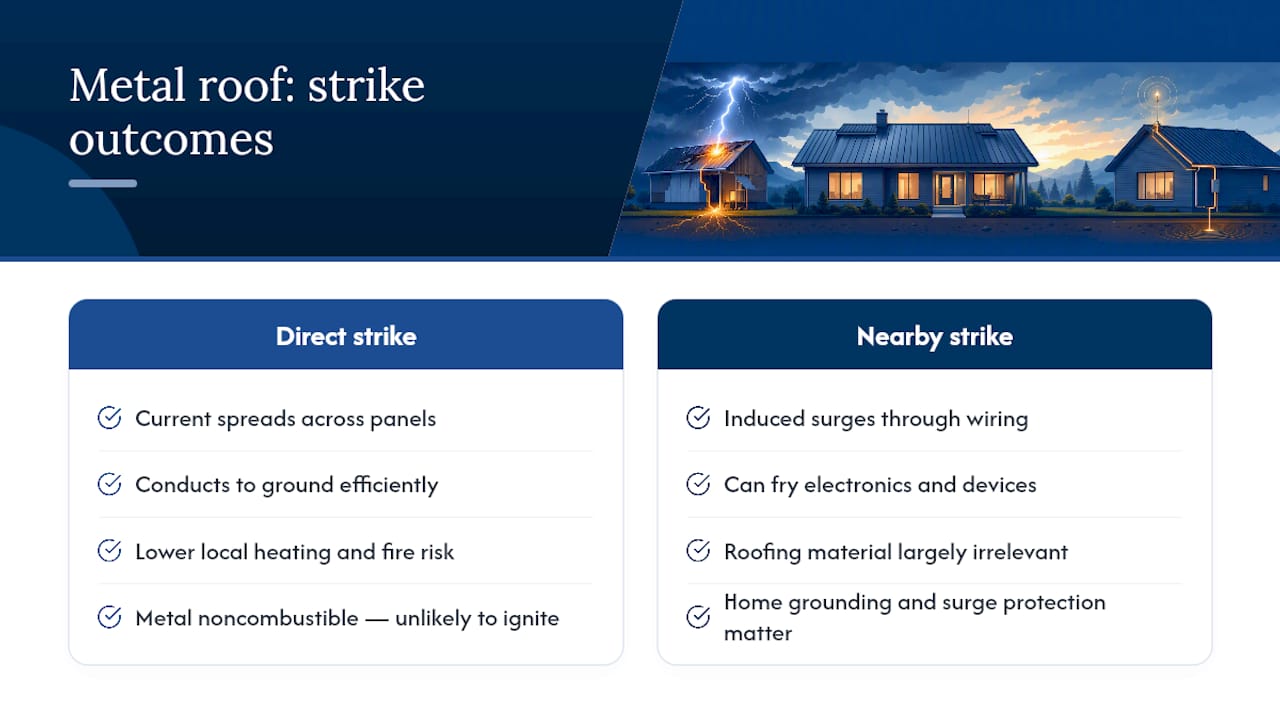
Metal’s real safety benefit isn’t prevention. It’s damage control. When lightning does strike a metal roof, the current spreads across the panel surface and travels to ground far more efficiently than it would through wood, asphalt shingles, or tile. That distribution matters because a properly grounded metal roof conducts energy over a broader area, reducing local heating and lowering fire potential compared with resistive materials. Metal is noncombustible, so a direct strike is far less likely to ignite the roof itself.
That’s the direct-strike scenario. A nearby strike, one hitting a tree or power line close to your property, poses a different risk: induced surges that travel through wiring and fry electronics even without the building taking a direct hit. Roofing material has almost no bearing on that outcome; your home’s grounding and surge protection do.
Quick fact: according to the Metal Roofing Alliance, when installed correctly with compatible materials, metal roofing paired with a professionally designed lightning protection system reduces risk to both life and property, not by stopping the strike, but by controlling where the energy goes.
Grounding vs. a Full Lightning Protection System: What’s the Difference?
These two terms get used interchangeably, and that confusion costs homeowners money on systems they may not need, or leaves them under protected when they actually are exposed.
Grounding typically refers to bonding the metal roof itself to the home’s electrical grounding system. It helps manage induced surges and static buildup but isn’t a dedicated defense against a direct strike.
A full lightning protection system (LPS) is a different animal entirely: air terminals (lightning rods) positioned at high points, connected by heavy copper or aluminum conductors running down the exterior, terminating in dedicated ground rods. The National Fire Protection Association’s NFPA 780 is the recognized installation standard, and it exists precisely because LPS components don’t attract strikes any more than a metal roof does. They intercept a strike that would have happened anyway and give it a controlled, low-resistance path to earth.
An LPS should always be designed and installed by a qualified, NFPA 780-certified contractor, not bolted on as an afterthought.
- Grounding: lower cost, manages surges, good baseline for most homes
- Full LPS: higher cost and more visible hardware, but designed for direct-strike interception
Pro Tip: A full LPS earns its cost on tall, isolated structures, homes on ridgelines, or properties with server rooms, home theaters, or expensive solar inverters. For a typical single-story home in a developed neighborhood, solid grounding and whole-house surge protection usually cover the real risk.
Installation Concerns Unique to Metal Roofs
Adding grounding hardware or a full LPS to a metal roof isn’t the same job as installing one on shingles, and a contractor unfamiliar with metal roofing can create problems that outlast the storm season.
- Galvanic corrosion. Pairing incompatible metals (copper conductors directly against galvanized steel panels, for example) sets off an electrochemical reaction that eats away at the roof over time. Isolation hardware or matched materials prevent this, and skipping that step is one of the fastest ways to void a roof warranty.
- Attachment integrity. Conductors need mechanical fastening rated for your roof profile. Adhesive-only mounting fails under wind and thermal cycling, and dragging cable across a painted finish scratches the coating and invites rust.
- Snow and wind loads. Conductors on a metal roof need to survive sliding snow, not just wind. Where snow guards already exist, installers often anchor conductors to them; where they don’t, the conductor path has to be engineered to withstand that force.
A standing seam profile with concealed clips tends to offer more consistent electrical continuity across panels than exposed-fastener systems, which is worth knowing if you’re comparing roof types before a lightning protection conversation even starts.
When Should You Actually Consider Lightning Protection?
Most homes don’t need a dedicated LPS. A handful of risk factors should push that conversation forward:
- Your home sits on a hill, ridge, or open lot with no taller structures nearby
- Your region sees frequent, severe thunderstorm activity
- The building houses high-value electronics, a home office, or medical equipment
- You’ve had prior strike damage or repeated surge related failures
If none of those apply, bonding your roof and adding whole-house surge protection is usually the more sensible, lower-cost move. If several do apply, the smart path is coordinating your roofer, a certified LPS installer, and your electrician before any hardware goes on the roof. That coordination is where a lot of DIY-adjacent lightning protection projects go wrong.
What to Ask Before Anyone Touches Your Roof
Before you hire anyone to add grounding or lightning protection hardware, get straight answers to a few questions:
- Are you familiar with NFPA 780 and will the installation meet that standard?
- What materials will you use for conductors, and are they compatible with my roof panels?
- Can you document the attachment method in writing before work begins?
- If copper conductors go near a different metal roof, what isolation method prevents corrosion?
An installer who can’t answer those clearly hasn’t done this work on metal roofing before. If you’re also adding solar, ask how rapid-shutdown wiring requirements interact with any grounding conductors already planned for the roof, since both systems ultimately tie into the same electrical ground.
Pro Tip: One coordinated contractor for roofing, grounding, and solar cuts down on finger-pointing later. When three separate trades touch the same roof deck, warranty disputes over a scratched panel or a voided seal become common. One team, one accountability chain.
What I’ve Learned Watching This Fear Play Out
Homeowners worry about the wrong thing. They ask whether a metal roof will “call down” a strike, when the real question is whether their home is exposed enough to need protection at all, and whether their existing electronics can survive a nearby hit through ordinary wiring. Coordination between trades matters more than any single component. A roof, a ground system, and a solar array installed by three disconnected contractors create more risk of a warranty dispute than lightning ever will.
— David
How Sw-metalroofing Handles Roofing, Grounding, and Solar Together
Sw-metalroofing builds custom standing seam metal roofing in San Diego, including an 18-inch snap-lock panel profile engineered for coastal wind and salt exposure, and every installation comes with a lifetime leak-free warranty.

If you’re planning a new roof, replacing an aging one, or adding solar to a home where grounding is part of the conversation, having one team handle the whole job removes the coordination gaps that cause corrosion issues, finish damage, or warranty headaches down the line. The company fabricates panels to spec and integrates solar directly into the roofing plan rather than treating it as a separate trade bolted on afterward. Homeowners weighing costs can check current pricing on standing seam, metal shingle, and stone-coated steel options, or review full replacement project scope if the existing roof is past its service life. Reach out to get a project assessment before storm season narrows your installation window.
Sources
- Lightning Strikes and Metal Roofing — Metal Construction Association
- Weather
- Lightning — University of Alabama Environmental Health & Safety
FAQ
How likely is lightning to strike a metal roof?
No more likely than any other roof material. Strike probability depends on your home’s height, isolation, and location, not on what covers the roof, according to the Metal Construction Association.
Is it safe to be under a metal roof in a thunderstorm?
Yes. A metal roof is noncombustible and, when grounded, spreads a strike’s energy across a wide surface rather than concentrating heat in one spot, which lowers fire risk compared with some other roofing materials.
Do houses with metal roofs need lightning rods?
Most don’t. Lightning rods, or a full LPS built to NFPA 780 standards, make sense mainly for tall, exposed, or isolated homes; typical homes in developed areas are usually well served by grounding and surge protection alone.
What is the biggest problem with metal roofs?
Installation quality, not lightning, is the real risk. Improper fastening, incompatible metal pairings that cause galvanic corrosion, and poor attachment of any added hardware are the issues that actually shorten a metal roof’s lifespan.
How much does adding lightning protection or grounding cost with a new metal roof?
Sw-metalroofing doesn’t publish a flat rate for grounding or LPS add-ons since scope varies by home and risk factors; current metal roof replacement pricing is available for full projects, with grounding work quoted separately based on site assessment.