Yes, in most cases. Homeowners who install a qualifying impact-resistant metal roof typically see a discount of roughly 5% to 35% on the wind or hail portion of their policy, though the exact number depends heavily on your carrier and state. The catch: nobody hands you this credit automatically. You need documentation like a UL 2218 Class 4 rating or an IBHS FORTIFIED designation, and an installer, such as SW Metal Roofing, willing to hand over the paperwork that proves it.
TL;DR:
- The impact-resistant metal roof discount usually applies only to the wind and hail risk portion of your policy, which can be 5% to 35% but depends on your carrier and state regulations.
- Proper documentation, including UL 2218 Class 4 impact rating and signed permits, is essential for insurers to grant the discount; incomplete proof often leads to denial.
- Standing seam metal roofs with impact ratings and assembled with certified installation methods qualify for the highest discounts, while exposed fastener and other systems typically receive smaller or no credits.
- Typical annual savings range from $200 to $800 depending on your premium size and storm exposure, with potential total savings over decades reaching several thousand dollars.
- Insurers may increase premiums if a new metal roof raises your replacement cost value, but this can be offset by better coverage and longer-lasting materials.
Table of Contents
- How Insurers Calculate Metal Roof Insurance Discounts
- Which Metal Roof Systems Qualify for Insurance Credits
- How Much Can You Actually Save?
- How Do You Actually Claim the Discount?
- Can a New Metal Roof Increase Your Premium?
- Do State Rules Change Your Discount?
- What Documentation Does an Installer Like SW Metal Roofing Provide?
- What Disqualifies You From a Metal Roof Insurance Discount?
- Does Roof Age Affect Your Discount Eligibility?
- How Do Metal Roof Discounts Compare to Other Materials?
- Balancing Insurance Savings With Long-Term Roof Value
- Where to Verify Metal Roof Insurance Rules
- Sources
- FAQ
How Insurers Calculate Metal Roof Insurance Discounts
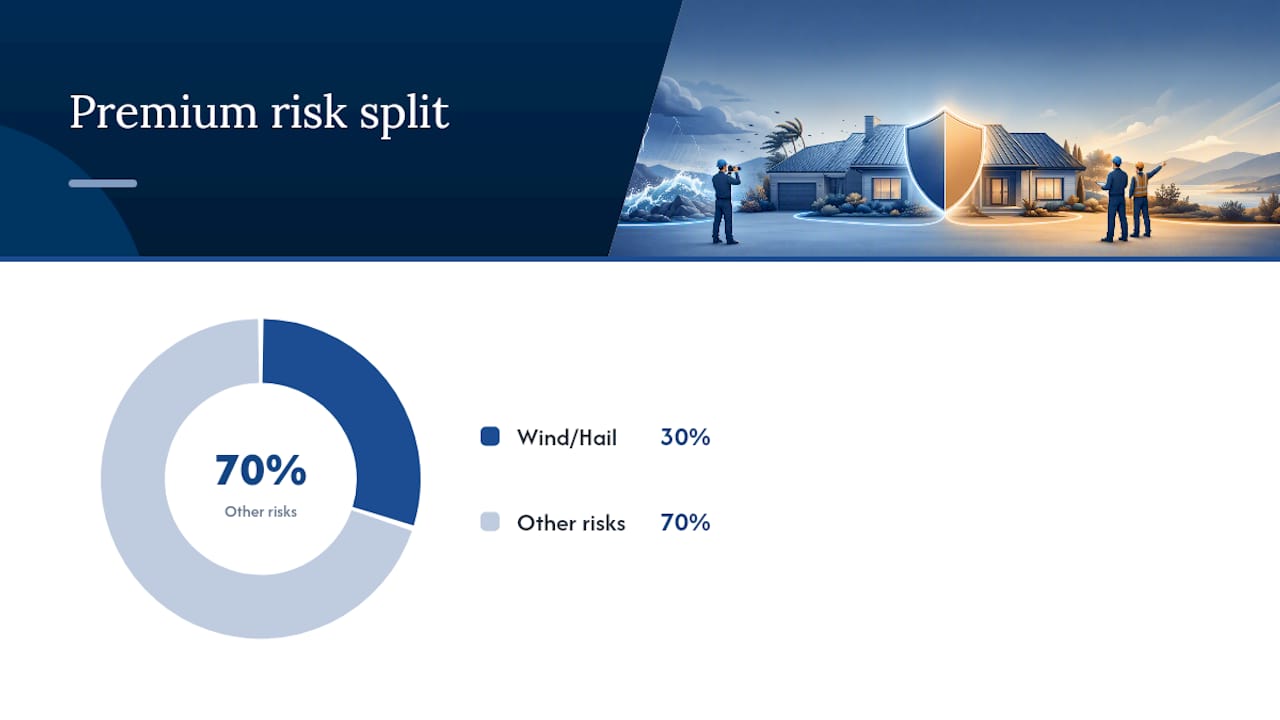
Insurers don’t look at your roof and slash your whole bill. They break your premium into risk buckets: wind, hail, fire, water, theft, liability. A metal roof insurance discount usually chips away at one bucket only, the wind/hail peril, because that’s where metal roofing actually changes the math.
Here’s why that distinction matters. Metal panels shed hail impact and hold up under sustained wind far better than three-tab asphalt shingles, so insurers see fewer and smaller claims from homes with metal roofs. Standing seam and other impact-rated systems also resist fire better and last two to three times longer than shingles, which lowers an insurer’s expected long-term payout even outside of storm claims. Some carriers offer these credits voluntarily as underwriting incentives. Others operate in states, Texas among them, where regulators require insurers to offer a credit once a roofing product meets a recognized impact-resistance standard.
The math shift matters more than the headline percentage. Consider a policy with a $2,000 annual premium where $600 of that covers wind/hail risk specifically.
- A 15% credit applied only to the wind/hail portion saves you $90 a year.
- The same 15% credit applied to the entire premium would save you $300 a year.
Ask your agent which model your carrier uses before you get excited about a number you saw in an ad. The Metal Roofing Alliance notes that discounts commonly land between 5% and 35%, but that range only makes sense once you know which slice of your bill it’s discounting.
Which Metal Roof Systems Qualify for Insurance Credits
Not every metal roof earns the same treatment from underwriters. The system matters as much as the material.
- Standing seam panels typically score highest with insurers because concealed fasteners and interlocking seams resist wind uplift better than exposed-fastener designs. A standing seam system built for coastal wind loads is often the strongest documentation case you can bring an adjuster.
- Exposed-fastener metal panels cost less but carry more risk of fastener blackout over time, so some carriers apply smaller credits or none at all.
- Metal shingles and stone-coated steel can qualify for solid credits when they carry the right impact rating, though insurers sometimes weigh them differently than full standing seam systems.
The certifications that actually move the needle are specific. UL 2218 measures impact resistance on a scale of Class 1 through Class 4, and Class 4 is what most insurer discount programs reference. FM 4473 or equivalent wind uplift testing verifies a roof can survive high wind events without failure. The IBHS FORTIFIED designation goes further, certifying the whole roof assembly (deck, underlayment, edge details, fasteners), not just the panel material.
Installation details count too. Insurers want to see a licensed, permitted installation with proper edge metal and fastening patterns, not a weekend patch job.
Pro Tip: Before your installer leaves the job site, ask for five things in writing: the manufacturer’s product data sheet, a photo of the UL label on the packaging or panel, the signed permit, dated as-built photos, and an itemized invoice. Insurers have rejected discount claims over a missing label photo alone.
How Much Can You Actually Save?
The dollar range depends on where your premium sits to begin with, but the pattern holds across most households.
Industry estimates put typical annual savings for metal roof homeowners at roughly $200 to $800 per year, and that gap widens or narrows based on your state’s storm exposure and your carrier’s specific program.
Run three sample households through the math:
- A homeowner paying $1,200 a year sees $120 saved at a 10% discount, or $300 at 25%.
- A homeowner paying $2,400 a year sees $240 at 10%, or $600 at 25%.
- A homeowner paying $3,600 a year, common in hail-prone or coastal wind zones, sees $360 at 10%, or $900 at 25%.
Multiply any of those figures across a metal roof’s expected lifespan, often 40 to 70 years compared to 15 to 20 for asphalt, and the insurance savings alone can add up to several thousand dollars over time, even before counting the reduced replacement frequency. That said, these are averages. Your specific credit depends on your carrier’s formula, your state’s rules, and whether the discount hits your full premium or just the wind/hail line. Ask your agent to run the actual numbers against your policy rather than assuming a headline percentage applies directly to your bill.
How Do You Actually Claim the Discount?
Getting the credit is a paperwork exercise more than anything else, and skipping a step is the single most common reason homeowners get denied.
- Before installation, call your insurer and ask exactly what documentation and ratings qualify for their metal roof or impact-resistant roofing credit. Programs differ enough that guessing wastes time.
- During installation, insist your contractor documents everything: labeled materials, the pulled permit, dated photos of the finished roof, and a detailed invoice listing the product and its rating.
- After installation, submit that full packet to your insurer and request a formal “with and without” premium comparison. This shows you the exact dollar impact rather than a vague percentage.
- At renewal, confirm the credit actually appears on your policy documents in writing, not just as a verbal confirmation from a phone rep.
If your insurer denies the credit, don’t assume that’s final. Ask for the specific reason in writing, check whether your documentation matches their stated requirements exactly, and if they still won’t budge, shop the policy to another carrier. Some insurers offer generous metal roof credits while others offer none, so a denial from one company isn’t a verdict on your roof.
Pro Tip: Keep a digital folder (email yourself copies) of every document the moment you get it. Contractors close up shop, permits get archived by the city, and insurers sometimes ask for proof years after installation.
Can a New Metal Roof Increase Your Premium?
Occasionally, yes, and it catches people off guard. The mechanism is replacement cost valuation, or RCV, the amount your insurer would pay to rebuild your roof today. A custom standing seam system costs more to replace than three-tab shingles, so your RCV goes up, and your premium can follow.
One homeowner documented this directly: a metal roof installation raised their annual premium by roughly $400 after the carrier repriced replacement cost. It’s a real, if situational, outcome, not a universal one.
Here’s the part that often gets missed: a higher RCV isn’t purely bad news. It means your insurer will pay to fully replace your roof at today’s material costs if it’s destroyed, rather than depreciating you down to actual cash value the way many policies do with aging asphalt roofs. That RCV eligibility can be worth more over 20 years than the extra premium costs you.
- Request quotes from your current insurer before signing a roofing contract.
- Ask specifically what triggers a rate increase versus what triggers a discount.
- Get both numbers in writing so you’re comparing your actual net change, not guessing.
Do State Rules Change Your Discount?
Where you live changes the math more than most homeowners expect. Insurance is regulated state by state, and some states force insurers’ hands on this exact issue.
Texas is the clearest example. The Texas Department of Insurance requires carriers to offer credits for roofing products that meet recognized impact-resistance standards, with UL 2218 Class 4 labeling as the common qualifying proof. That mandate is a big reason Texas homeowners often report some of the largest and most consistent metal roof discounts in the country.
Coastal and hail-belt states tend to have more formalized mitigation credit programs generally, since insurers there are managing heavier storm exposure and have more incentive to reward resilient roofing. Low-risk inland regions may offer smaller credits, or in some cases none tied specifically to roofing material, since wind and hail simply aren’t driving claims there.
Before assuming any number applies to you:
- Check your specific zip code and carrier, not just your state’s general reputation.
- If you’re in a mandated state, ask your insurer to cite the specific program and rate filing.
- Request the labeling and inspection paperwork your state requires, and keep the credit confirmation in writing at renewal.
What Documentation Does an Installer Like SW Metal Roofing Provide?
A contractor’s paperwork habits often decide whether your discount claim goes smoothly or gets stuck in review. Look for an installer who hands you a complete packet without you having to chase them down for it.
- Labeled product materials showing the manufacturer, UL classification, and test rating.
- A pulled and signed building permit tied to the specific address and job.
- Dated as-built photos documenting the completed installation, edge details included.
- A clear, itemized invoice specifying the product line and profile installed.
An installer’s custom fabrication, including an 18-inch snap-lock profile engineered for coastal wind exposure, comes with the kind of paper trail insurers actually ask for, plus a lifetime leak-free warranty that adds another layer of documented assurance. Homeowners who also add solar through the same installer may benefit from having a continuous project record instead of two disconnected sets of paperwork from separate contractors, which can simplify things when an adjuster starts asking questions years later.
Store everything digitally the day you receive it. Photograph the UL label before the packaging goes in the trash. Submit the full packet to your insurer proactively rather than waiting for a renewal review to ask for it.
What Disqualifies You From a Metal Roof Insurance Discount?
Plenty of homeowners install a good metal roof and still get denied the credit, usually over something avoidable.
Missing or incomplete documentation is the top reason. If you can’t produce the UL label, the permit, or the manufacturer’s data sheet, most insurers won’t take your word for the rating, no matter how good the roof looks.
Unpermitted work is another common disqualifier. A roof installed without a pulled permit raises red flags for insurers even if the workmanship is excellent, since there’s no official record confirming code compliance.
Some policies exclude credits for DIY installations or work performed by uncertified installers, since the insurer has no third-party confirmation the assembly meets the tested standard. A roof panel rated Class 4 installed incorrectly, with the wrong fastener spacing or missing edge details, may not perform the way the lab test suggested it would, and some carriers explicitly reserve the right to deny credit in that scenario.
Geographic exclusions matter too. A handful of insurers limit metal roof discounts to specific wind or hail zones, so a rating that qualifies for a credit in one county might not in a neighboring one. And discounts frequently apply only going forward from the date you submit paperwork, not retroactively, so delaying your submission can cost you months of savings.
Does Roof Age Affect Your Discount Eligibility?
Age changes both whether you qualify and how much you get. Most insurers apply metal roof discounts based on the roof’s condition and documented age, not just its material.
A newly installed, properly permitted metal roof is the easiest case: full documentation exists, the rating is current, and the installer’s warranty is active. As the roof ages, some carriers begin asking for a re-inspection to confirm the assembly is still performing as tested, particularly after a major storm event.
Maintenance matters just as much as age. A metal roof with loose fasteners, damaged flashing, or deferred repairs can lose its qualifying status even if the original installation carried a Class 4 rating, since the insurer’s concern is current risk, not historical certification. Routine maintenance and inspection documentation gives you a paper trail showing the roof still performs the way it did on day one, which matters if you ever need to defend a discount during a policy review or after a claim.
Practically, that means keeping receipts for any repair work and scheduling periodic inspections rather than waiting until something visibly fails. An insurer reviewing your policy five years from now wants to see that the roof earning your discount is still the roof it was rated to be.
How Do Metal Roof Discounts Compare to Other Materials?
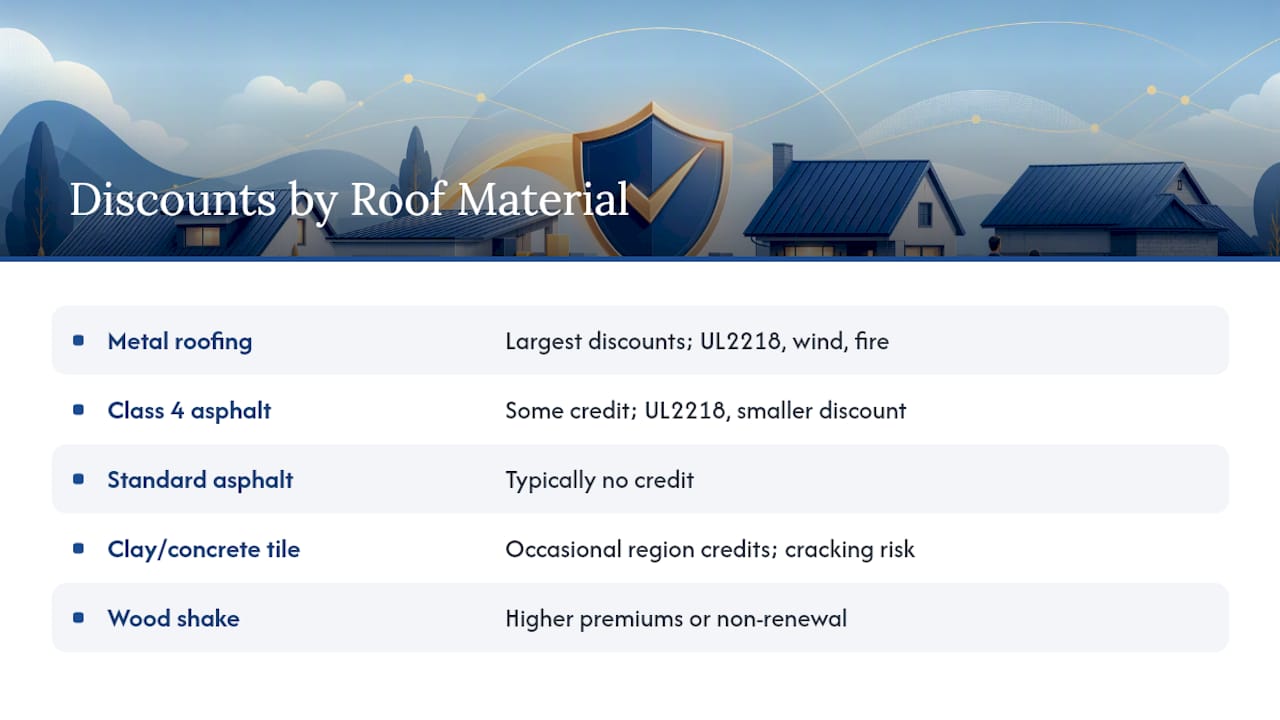
Asphalt shingles, the default on most American homes, rarely qualify for meaningful impact-resistance credits unless a homeowner specifically upgrades to a Class 4 impact-rated shingle product, and even then the discount tends to run smaller than what metal roofing earns. Standard three-tab shingles typically get no wind/hail mitigation credit at all.
Class 4 asphalt shingles close some of the gap, since they’re tested against the same UL 2218 standard, but they generally don’t match a well-installed standing seam system for wind uplift resistance or longevity, and insurers’ actuarial data reflects that difference in the size of the credit offered.
Clay and concrete tile roofs sometimes earn wind credits in specific regions but carry their own risk profile, including weight concerns and vulnerability to cracking on direct hail impact, which limits how generous insurers get with tile-specific discounts.
Wood shake roofs are the clearest loser in this comparison. Far from earning a discount, wood shake often triggers higher premiums or outright non-renewal in wildfire-prone areas due to elevated fire risk.
Metal roofing tends to sit at the top of the discount hierarchy specifically because it checks multiple boxes at once: high UL 2218 ratings, strong wind performance, fire resistance, and a service life that keeps replacement cost risk low for decades. That combination is hard for competing materials to match on all fronts simultaneously.
Balancing Insurance Savings With Long-Term Roof Value
The insurance discount is real, but treating it as the main reason to install a metal roof gets the priorities backward. A $300 or $600 annual credit is meaningful, but it’s a rounding error next to what you save by not replacing an asphalt roof every 15 to 20 years for the next four decades.
My honest recommendation: before you sign a roofing contract, get your insurer to run the actual with and without numbers on your specific policy. Don’t estimate off a percentage you read somewhere. Collect every document your contractor generates, and if your first quote after installation looks worse than expected, shop it. Carriers vary enormously on this, and loyalty rarely pays here. Work with a certified installer who hands you a complete paper trail without prompting. That documentation is what turns a good roof into a roof insurers will actually credit you for.
— David
Where to Verify Metal Roof Insurance Rules
Check your state insurance department for mandated credit programs, starting with the Texas Department of Insurance if you’re in a state with formal rules. Review your specific carrier’s discount page, such as State Farm’s homeowner discounts, and consult the Metal Roofing Alliance for material-level guidance.
Sources
- Insurance | Metal Roofing Alliance
- Products qualifying for impact-resistant roofing credits | Texas Department of Insurance (TDI)
- Homeowner Insurance Discounts to Help You Save | State Farm
- Metal Roof Insurance Discounts: How Much Can You Save? | RoofVista
- How Adding a Metal Roof Raised My Insurance Rate by $400 | Pro Tool Reviews
FAQ
How do insurance companies feel about metal roofs?
Insurers generally view metal roofs favorably because they reduce claims from wind, hail, and fire compared to asphalt shingles, which is why many carriers offer discounts once a roof carries proper impact-resistance documentation.
How much does a 2,000-square-foot metal roof cost?
Costs vary widely by profile, region, and material choice, and pricing isn’t something this article’s research covers in specific figures; get quotes directly from a licensed installer for an accurate estimate on your home.
Does a metal roof lower your insurance in Florida?
Florida homeowners in hurricane-prone areas often see some of the more formalized wind mitigation credits nationally, similar to Texas, though the exact discount depends on your specific carrier and their state-filed rate program.
Is a metal roof more affordable than shingles for insurance purposes?
Metal roofs typically qualify for larger wind/hail discounts than standard asphalt shingles, and Class 4 impact-rated shingles narrow that gap somewhat, but metal roofing generally sits higher in insurer discount tiers due to its combined wind, fire, and longevity performance.