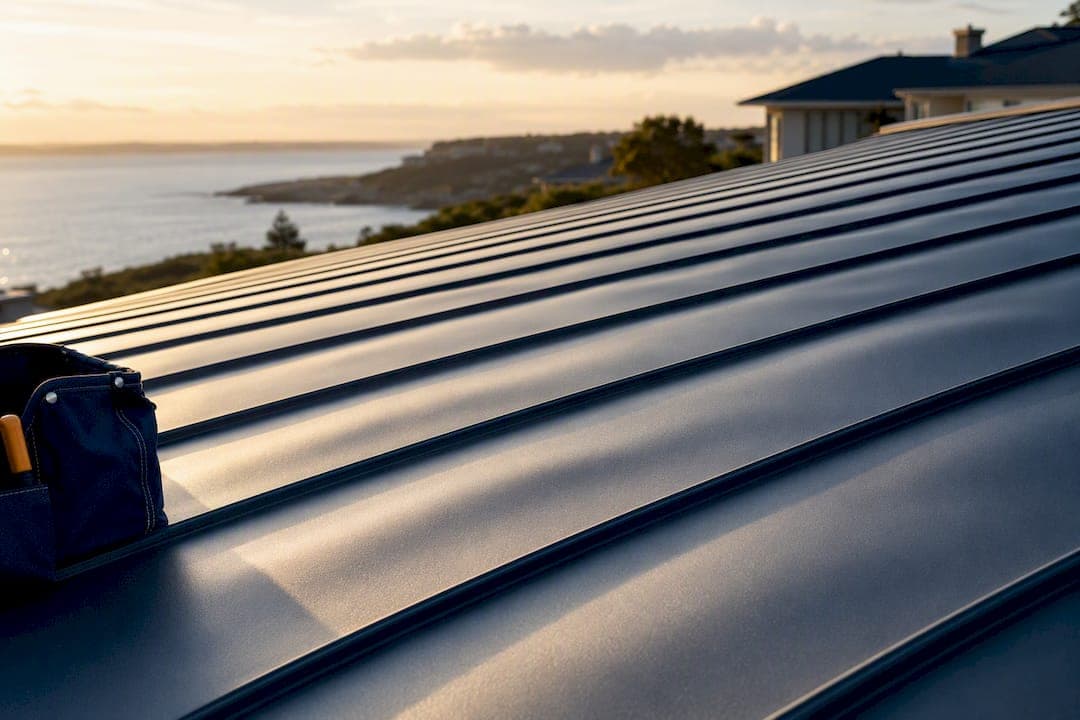
Oil canning is the visible waviness, or elastic buckling, that shows up on flat areas of metal roof and wall panels. It is almost always an aesthetic issue caused by manufacturing stresses, installation mistakes, or normal thermal movement, not a structural failure. Prevention comes down to correct specification and careful installation, and once panels are up, true fixes are limited: some waviness eases with time, but stress-induced distortion usually needs the root cause corrected rather than patched.
TL;DR:
- Oil canning is primarily caused by residual stresses from manufacturing, such as coil slitting and roll forming, which can be mitigated by specifying tension-leveled material in the purchase order.
- Wider flat panels without stiffening ribs and highly reflective, glossy finishes make oil canning more visible, especially under low-angle sunlight.
- Installing panels at extreme temperatures, over-driving fasteners, or mishandling panels can introduce stress or deformation that leads to waviness.
- Proper design strategies, including selecting appropriate panel gauge, profile with stiffening ribs, and using floating clips, help prevent oil canning at the specification stage.
- Repairing oil canning after installation is difficult and usually ineffective without addressing underlying issues like substrate flatness or restraint, making prevention critical.
Table of Contents
- What oil canning actually looks like and why it happens
- Manufacturing and material causes
- Installation and handling causes
- How thermal movement drives waviness over time
- Prevention checklist for specs and design
- Installation best practices that reduce risk on site
- Diagnosing oil canning and what repair can realistically fix
- Where the industry stands on oil canning today
- How SW Metal Roofing approaches oil canning on new roofs
- Where these technical details come from
- Sources
- FAQ
What oil canning actually looks like and why it happens
Oil canning is elastic buckling, sometimes called stress wrinkling, that occurs when a flat metal panel can’t hold a truly flat plane under internal stress. The metal itself hasn’t failed. It has simply found a slightly bowed shape that releases the stress inside it, similar to how a thin plastic lid pops and flexes when you press on it.
Whether you notice it depends heavily on geometry and light. A panel’s flat-width-to-thickness ratio matters: wider flat areas on thinner gauge material buckle more easily than narrow panels or thicker stock. Gloss level plays a role too, since a high-gloss finish reflects light in a way that exaggerates every ripple, while raking light at sunrise or sunset throws shadows across even minor waviness that would be invisible under flat, overhead sun.
- Darker colors and glossy finishes make oil canning far more visible than light, matte finishes.
- Steel, aluminum, and copper can all show oil canning, since it is a function of panel geometry and residual stress, not a specific metal.
- Low-angle sunlight is the most common condition under which homeowners first notice the effect.
Manufacturing and material causes
Much of the risk is baked in before a panel ever reaches a job site. Coil steel and aluminum carry residual stresses from the rolling process, and those stresses shift again when the coil is slit into narrower widths and roll-formed into a panel profile. According to Metal Construction Association technical material, oil canning is elastic buckling tied directly to these differential stresses from coil production, slitting, and forming, and tension leveling after those operations reduces the effect.
Tension leveling stretches the coil slightly beyond its yield point to relax internal stress before it becomes a panel. A Lysaght product advisory bulletin notes that residual stress from slitting and forming is a frequent contributor, and specifying tension-leveled material in the purchase order is a practical, low-cost control that does more to prevent oil canning than most after-the-fact site fixes.
Panel geometry and finish selection also matter at the design stage.
- Wider flat pans without stiffening ribs are far more prone to visible waviness than narrower panels or profiles with ribs pressed into the flats.
- Heavier gauge material resists buckling better than thin stock, though it adds cost and weight.
- Low-gloss or embossed finishes make waviness far less perceptible, a point echoed in MCA guidance on visual factors, which notes that panel orientation, color, and surface finish all influence how visible oil canning appears.
Requiring tension-leveled coil in your spec is one of the most cost-effective single steps a purchaser can take, since it addresses the stress at its source rather than trying to mask it later.
Installation and handling causes
Even flawless coil can end up wavy through mishandling on site. MCA’s technical guidance identifies installation errors as a primary driver of preventable oil canning, and most trace back to a handful of repeatable mistakes.
- Over-driving fasteners with an impact driver instead of a torque-sensitive screw gun crushes the panel locally and creates a visible dimple that ripples outward.
- Dual-pinning at clips or perimeter details locks the panel down at two points that were meant to allow slide, forcing the metal to buckle between them as it tries to move.
- Misaligned or out-of-plane substrate, including deck camber or structural movement, transfers a wave into the panel no matter how well the panel itself was made.
- Improper handling and storage, such as stacking panels flat without support or lifting them by the ends, can introduce a bow before installation even starts.
- Installing panels at extreme temperatures without accounting for expansion locks in stress that shows up as waviness once the metal cycles through its full range.
Sequential fastening, working from one end of the panel to the other rather than skipping around, helps distribute stress evenly instead of trapping a bow in the middle.
Pro Tip: Ask your installer whether they use a torque-limiting screw gun on exposed fastener panels; it is a small detail that separates a flat roof from a wavy one.

How thermal movement drives waviness over time
Metal panels expand and contract with every temperature swing, and standing seam systems are designed around that reality. NRCA guidance on thermal movement treats it as a core design factor: panels must be free to move through clip selection, slip sheets, and a deliberate fixed-point strategy, or the restrained movement shows up as oil canning.
Different metals expand at different rates, which is why clip and fastening choices vary by material.
| Design element | Function |
|---|---|
| Floating clip | Allows panel to slide during thermal cycling |
| Fixed-point anchor | Anchors one location so movement is predictable and directional |
| Slip sheet | Reduces friction between panel and substrate during movement |
| Two- or three-piece clip | Separates the panel attachment from the deck attachment to permit slide |
Daily heating and cooling cycles can create transient oil canning that looks worse at certain times of day and eases once the panel reaches a stable temperature.
Prevention checklist for specs and design
Most preventable oil canning gets designed out before fabrication ever starts, which makes the specification stage the highest-leverage point in the whole project.
- Require tension-leveled coil in the purchase order rather than assuming standard mill coil will do.
- Set a minimum gauge appropriate to the panel’s flat width, since wider pans need thicker stock to resist buckling.
- Choose profiles with stiffening ribs or striations on any panel with flats wider than a few inches.
- Set substrate flatness tolerances and name inspection points before panels go on, since a wavy deck guarantees a wavy roof.
- Specify slotted connections or floating clips at details where thermal movement is expected to concentrate.
- Write handling, storage, and shipping requirements into the contract so panels aren’t stacked or lifted in ways that introduce a bow before installation.
Coordinating these choices early matters more than most owners expect. NRCA guidance points out that design teams should settle on clip selection, profile geometry, and fixed-point strategy during design review, since late changes to these details commonly produce oil canning at handover.
Pro Tip: Put oil-canning acceptance criteria in writing before fabrication starts, not after the panels are on the roof.
Installation best practices that reduce risk on site
Good specifications only pay off if the crew on the roof follows through. The practices below are the ones that most consistently separate a flat, clean installation from a wavy one.
- Let panels acclimate to outdoor temperature before installation rather than fastening them straight off a hot truck.
- Install at a representative temperature, avoiding extremes of heat or cold that lock in unusual expansion or contraction.
- Use a torque-sensitive screw gun, never an impact driver, on any panel where the fastener or clip is visible.
- Fasten sequentially from one end toward the other instead of jumping between locations, which distributes stress evenly.
- Verify and shim substrate flatness before panels go down, since a wavy deck transfers directly into a wavy panel.
- Use backer rod where specified under panel edges on solid substrates to reduce thermally induced waviness.
- Check clip engagement carefully and avoid dual-pinning at perimeter details, allowing the panel room to move as designed.
These steps cost little in time or material compared with the alternative: MCA’s guidance notes that installer technique, including sequential fastening, correct torque, and checking for dual-pinning, is where many projects succeed or fail, and that simple tooling rules and training lower risk significantly.
Diagnosing oil canning and what repair can realistically fix
The first step is figuring out whether what you’re seeing is transient thermal movement or a permanent stress-induced wave, since the two call for different responses.
- Photograph the panel in raking light from a consistent angle and distance, ideally at the same time of day across multiple visits.
- Check the same area at different temperatures, since transient oil canning tends to soften or disappear as the panel reaches equilibrium.
- Note whether the wave sits at a fastener or clip location, which points to dual-pinning or over-driving rather than a manufacturing defect.
- Document findings with dated photos and notes for any warranty claim or dispute, since “it looks wavy” is harder to act on than a dated comparison.
MCA’s guidance is blunt about repair limits: fixing oil canning after installation is often difficult and frequently ineffective unless the substrate or the installation root cause is corrected first. Simply swapping a wavy panel for a new one without fixing an out-of-plane deck or a restrained clip tends to reintroduce the same problem. Root-cause remediation, meaning shimming the substrate, reframing, or reclipping, is usually required for a lasting fix. Cosmetic mitigation, like adjusting lighting near the roofline or repainting in a lower-gloss finish, can reduce how noticeable the waviness is but does not remove it.
Where the industry stands on oil canning today
Oil canning sits in an odd spot: it looks like a defect but usually isn’t one. MCA guidance on visual acceptance treats face distortion as an aesthetic condition, not automatic grounds for rejection, unless the contract spells out tolerances. Manufacturing controls and installation practices reduce fabrication and site variables, but no flat metal panel is ever perfectly rigid, and that reality gets overlooked until the sun hits a roof at the wrong angle.
We recommend agreeing on viewing distance and lighting conditions for acceptance before work begins, and writing that standard into the contract rather than settling the question after installation.
— Marcus
How SW Metal Roofing approaches oil canning on new roofs
We fabricate custom standing seam panels in San Diego, including our 18-inch snap-lock profile built for coastal wind and salt exposure, using tension-leveled material and installation controls that address oil canning at both the manufacturing and site stages.
We also handle solar integration alongside the roof itself, coordinating clip layout and fixed-point strategy with solar mounts to avoid conflicts during installation. Our projects are backed by a leak-free warranty. If you’re requesting a proposal, ask for tension-leveled coil, documented substrate tolerances, and a stated installation sequence. You can review our past standing seam work or get a metal roof replacement quote to start the conversation.
Where these technical details come from
The guidance in this article draws on published industry material rather than anecdote.
- Metal Construction Association technical bulletins on causes, prevention, and repair limits of oil canning.
- NRCA guidance on thermal movement design in metal roof systems.
- Manufacturer advisories, including Lysaght’s bulletin on tension leveling and installation controls.
Sources
- Oil Canning in Metal Roof and Metal Wall Systems (MCA technical material)
- Thermal movement in metal roof systems — NRCA
FAQ
How do you fix oil canning on a metal roof?
Fixing oil canning after installation is often difficult and frequently ineffective unless the underlying cause, usually substrate flatness or clip restraint, is corrected first, according to MCA’s technical guidance. Shimming the deck, adjusting clips, or reframing the substrate typically has to happen before a replacement panel will sit flat.
How do you avoid oil canning on a metal roof?
Specify tension-leveled coil, choose an appropriate gauge and profile for the panel width, and make sure installers avoid over-driving fasteners or pinning panels at two fixed points. Allowing panels to move as designed, through floating clips and proper fixed-point placement, is central to NRCA’s thermal movement guidance.
Is oil canning on a metal roof common?
Some degree of waviness is a normal characteristic of flat-panel metal roofing rather than a rare defect, since it results from ordinary manufacturing stress and thermal movement. Industry guidance on visual acceptance treats it as an aesthetic condition rather than grounds for rejection unless a contract sets specific tolerances.
How do you get rid of oil canning in sheet metal?
Transient oil canning caused by daily temperature swings can lessen on its own as the panel reaches a stable temperature and clips allow it to move. Permanent, stress-induced waviness generally needs the substrate or installation issue fixed rather than a cosmetic patch, since replacing the panel alone often reintroduces the same wave.